Decree No.386/2026/ND-CP dated October 12, comprises five chapters and 54 articles specifying mechanisms to attract experts, young talent and breakthrough initiatives; access to and exploitation of data; financing and venture capital; dedicated data innovation spaces; and the development of data products and services, and the data economy.
    |
 |
|
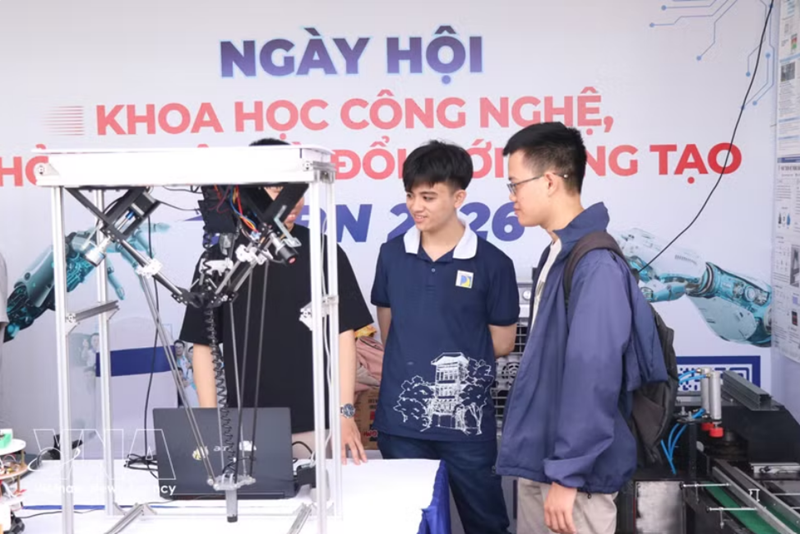
Students from the University of Science and Technology under the University of Da Nang showcase their technology products at the 2026 Technology, Entrepreneurship, and Innovation Festival. |
The decree applies to the center, Vietnamese and foreign agencies, organizations and individuals involved in innovation and data exploitation activities in Vietnam.
Particularly, along with providing detailed criteria for experts and young talents, Article 5 of the decree sets out mechanisms for attracting them to innovation and data exploitation activities. Accordingly, eligible experts and young talent will be entitled to one or more preferential policies, including those in recruitment, financial support, training, and scientific research.
According to the decree, agencies and organizations may enter into special agreements with experts and young talent on salaries, bonuses, intellectual property rights, rights to exploit research results, and the sharing of benefits generated by products, services, initiatives and added value from data innovation and exploitation. Such arrangements must ensure transparency and a balance of interests among the State, employing organizations and the experts or young talent concerned.
Income will be determined according to the performance of assigned tasks, positions held, products delivered, level of contribution and output results. Heads of agencies and organizations are authorized to approve income, bonuses and benefit-sharing rates after obtaining opinions from relevant professional units or evaluation councils. For tasks funded by the state budget, approval authority must comply with laws on state budget management, science and technology, innovation and other relevant legislation.
Funding may come from state budget allocations for assigned tasks, lawful revenues of the relevant units, or socialized funding, sponsorships and aid in accordance with the law. Expenditure must be used for its intended purposes, remain within approved estimates, be supported by documentation and be subject to internal controls.
Experts and young talent will receive the most favorable personal income tax incentives available under tax legislation, including personal income tax exemptions equivalent to those provided under the financial policy framework for international financial centers in Vietnam.
Those receiving incentives must commit to fulfilling assigned tasks, delivering specified products and results, meeting implementation schedules, and complying with the law, agreements, contracts or task-assignment decisions.
Incentives may be terminated, adjusted or withdrawn in accordance with the relevant agreement, contract, incentive decision and applicable law if recipients fail to meet their output commitments, breach their obligations, misuse the incentives, cease to satisfy eligibility conditions, or commit fraud or deliberate violations of the law.
However, incentives will not be withdrawn for objective risks that have been identified, reported and handled in accordance with the prescribed procedures, or for failed experiments falling within the accepted risk parameters for science and technology and innovation activities under Article 52 of the decree and other relevant legislation.
The decree will take effect on December 1, 2026.
Source: VNA