Smart urban governance
Amid rapid urbanization, Vietnam’s major cities are facing growing challenges, including traffic congestion, localized flooding, environmental pollution and mounting pressure on technical infrastructure and public services. These issues not only cause significant economic losses but also directly affect residents’ quality of life and the efficiency of urban administration.
    |
 |
|
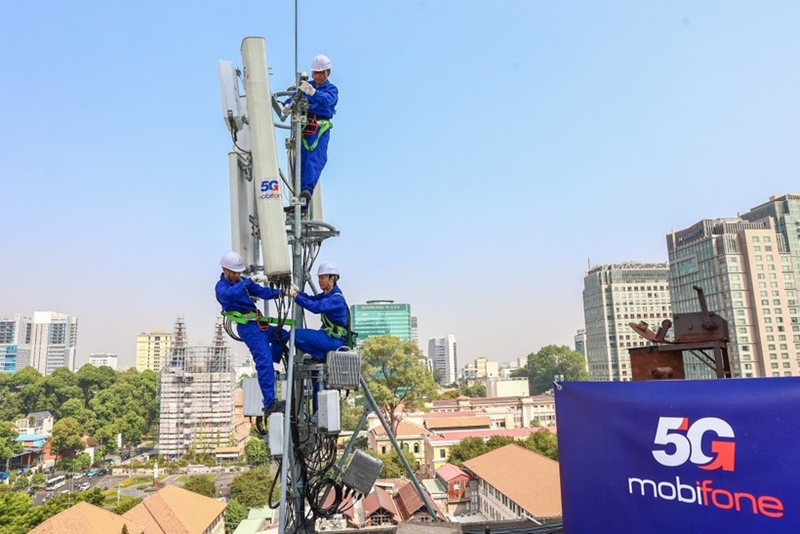
The rollout of 5G technology is gradually reshaping daily life in Vietnam, bringing tangible changes to urban governance, production organization and people’s livelihoods (Photo: nhandan.vn) |
The application of digital technologies, particularly 5G, is viewed as a critical solution for shifting from traditional management models to smart urban governance based on real-time data and automation. According to Nguyen Tuan Huy, head of Digital Transformation at MobiFone, modern urban management requires ultra-low latency connectivity and the ability to connect massive numbers of devices simultaneously - capabilities effectively enabled by 5G networks.
Practical implementation in Hanoi shows that smart traffic regulation, environmental monitoring and flood prevention systems are gradually taking shape. AI-powered cameras combined with 5G networks allow data to be collected, processed and analyzed directly on-site, enabling authorities to make faster and more accurate decisions. Over the long term, these models are expected to ease congestion, reduce social costs and enhance transparency and efficiency in urban governance, an increasingly urgent requirement for sustainable development.
Opening a “digital highway” for agricultural products
A notable aspect of Vietnam’s 5G rollout is its strong spillover effect beyond urban centers to rural, mountainous and remote areas, which have traditionally faced limitations in connectivity and market access. Expanded 5G coverage is helping narrow the digital divide between regions while creating new development space for the rural economy.
Nguyen Lam Thanh, General Director of TikTok Vietnam, said 5G enables farmers to directly participate in the digital economy. With wider connectivity, Vietnamese agricultural products gain greater opportunities to reach markets through online sales and digital marketing channels. Farmers can share their stories with tens of millions of users on digital platforms, improving incomes while narrowing the rural–urban gap.
In many localities, farmers have begun livestreaming agricultural products directly from fields and orchards using digital platforms supported by 5G infrastructure. This approach shortens supply chains, enhances transparency regarding product origin and quality, and strengthens consumer trust. More importantly, bringing farm produce onto digital platforms helps increase added value and improve livelihoods in remote areas through the integration of digital commerce and modern logistics.
Dinh Thanh Son, Deputy General Director of Viettel Post, noted that combining 5G infrastructure with logistics systems has opened a new approach to rural livelihoods, with 5G acting as a “digital highway” connecting farm produce from villages to urban dining tables.
Building strong digital infrastructure foundation
Vietnam’s telecommunications development over recent decades has brought technology and service costs closer to global standards, laying a solid connectivity foundation for people and the economy. As broadband internet becomes universal, the greatest opportunity now lies not in access itself but in transforming connectivity into value for production, business and social life.
Vietnam also benefits from a dynamic online service ecosystem and a large, active user base, creating a vibrant supply–demand cycle that drives innovation and value creation in the digital environment. In this context, 5G opens deeper development opportunities, with the Internet of Things (IoT) emerging as a core platform for building smart environments across factories, enterprises and cities.
In the next phase, 5G commercialization should adopt a more comprehensive approach, expanding towards industrial pillars including devices, solutions, platforms and application ecosystems, with the goal of mastering technology and gradually bringing Vietnamese products to international markets. Alongside this process, developing globally compatible standards for connectivity and interoperability will be essential to accelerate the growth of Vietnam’s national digital technology industry.
Source: VNA