 |
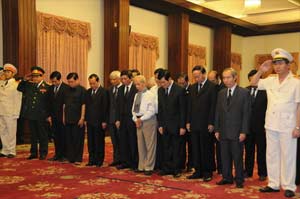
| Party and State leaders at the memorial service in HCM City . |
Sixty-eight years after the French colonial authorities executed Party General Secretary Ha Huy Tap (1906-1941) in HCM City, his remains have been found by family members.
On December 1, a special Vietnam Air flight repatriated Tap’s remains from HCM City’s Hoc Mon district, where they were discovered, to the colonial era Party chief’s hometown in Cam Hung commune in Cam Xuyen district of Ha Tinh province. Before the flight, a memorial ceremony was held at the Thong Nhat Convention Hall, HCM City. Thousands of people including Party and state leaders came to pay their regards.
Following a second memorial ceremony in the late Party Chief’s home village, Tap’s remains were reinterred on a hill overlooking the village.
Who was Ha Huy Tap?
Ha Huy Tap, a native of the north central province of Ha Tinh, first became active in revolutionary politics in 1926, aged 20. Two years later, Tap went to China to join the predecessor of the Vietnamese Communist Party, the Vietnam Revolutionary Youth Organisation, which had been established by Nguyen Ai Quoc (later Ho Chi Minh) in Guangzhou, China in 1925. Soon Tap was sent to study at the Oriental University in the Soviet Union. In 1936, he was assigned by the leadership of the Party to return to Vietnam to establish an underground Central Committee and serve as its General Secretary.
In 1938, Tap was arrested by the French police in Saigon and sentenced to house arrest. Two years later, after the fall of the Popular Front regime in France, Tap was seized again, and this time sentenced to five years imprisonment. He did not serve out the term. Instead, Tap was brought before a special military court in Saigon with other revolutionary leaders in March 1941 and sentenced to death. Tap was unfazed; he told his captors that “As long as I live, I will pursue my way.” A firing squad executed Tap in Hoc Mon on August 28, 1941. He was 35.
Before Tap’s execution, he sent his family and comrades a message: “If I die, my family, friends and comrades should not see me as a dead man nor feel sad. You should think of me as a living man, who is indefinitely absent from home. . . .”
And now Ha Huy Tap has returned home after 68 years of absence.
How Tap’s remains were found
According to VietNamNet and other newspapers, members of Ha Huy Tap’s family began searching for his remains eight years ago. After many years of war, hardly any landmarks remained. “Many people told us,” said Ha Van Sy, “that too much time has passed. We were reluctant to give up as long as there were individuals still alive who might have information about where Mr. Tap was buried. Sadly, we shelved our effort.”
In 2005, hope was reignited when Sy met a friend who had just found the remains of a relative. Inspired by the friend’s story, Sy and another family member, Ha Huy Loi, left Ha Tinh for HCM City to track down historical traces.
“We went to Hoc Mon District to collect information from local authorities, long time residents and some telepaths,” Loi related. “It was there that we learned of a man named Chin Gioi in Xuan Thoi Thuong Commune whose grandmother had told him about the execution of the Southern fighters.”
Chin Gioi took them to a site called Ben Tam Ngua where Mr. Tap was rumored to be buried.
Hearing this news, Ha family members from all over the country gathered to help Sy and Loi.
Further inquiries indicated that Tap was buried where a house now stood. With the permission from the homeowner, the group made plans to excavate.
The team decided to begin excavation of the site at three a.m. on November 22, 2009, the anniversary of the 1940 uprising in the southern region. Ha Huy Thanh, the youngest member of the search team, recalled: “The night before the excavation, we went to the area near Ben Tam Ngua to prepare everything. None of us could not sleep. One asked me ‘what would you think if you will be executed tomorrow?’ I only smiled and thought that when the revolutionary road is clear, anybody in that situation should feel relaxed. It is recorded that Mr. Tap saw the death as like a long journey.”
On November 22, after burning incense and praying, the Ha family began digging in a 100 square meter plot. Ben Tam Ngua was a marshy area in the past. Local residents had filled this area with sand, stone and soil to level it so the excavation was very difficult.
“We had to change our shirts three times, they were so full of sweat,” Thanh said.
Toward seven p.m, the diggers finally discovered a piece of a leg bone at a depth of 2.5 meters. Dismissing their fatigue, the group continued to dig, now using hand tools.
Four hours later, they found more bones and then a short, specially cut piece of almost fossilized bamboo, a find, said Sy, “that caused my heart to skip a beat. I knew this was proof that we’d found the grave of a fighter in the southern uprising who’d been executed by the enemy.
According to the testimony of the local people, in those days, after the French executed one of the fighters, they would cut off the head and stick it on a bamboo pike. The people of the area would wait until midnight and then retrieve the bodies and heads, reconnecting them with pieces of bamboo before burying them.
Now the digging became easier. As the Ha family continued to excavate, they found a skull, shoulder blades and shell fragments. By one-thirty on the morning of November 23, the group had finished digging up all the remains, joyful in the belief they had been reunited with their long lost family member. All who were present at the site were overcome by emotion.
Source: VietnamNet