Identifying major challenges tied to strategic techs
The rollout of strategic technology and product list follows directives from Party and State leaders, in line with the Prime Minister’s decision dated June 12, 2025, and aims to activate the amended Law on High Technology. The list will serve as a legal and scientific basis to design policies and incentives to support entities and enterprises engaged in strategic tech development.
    |
 |
|
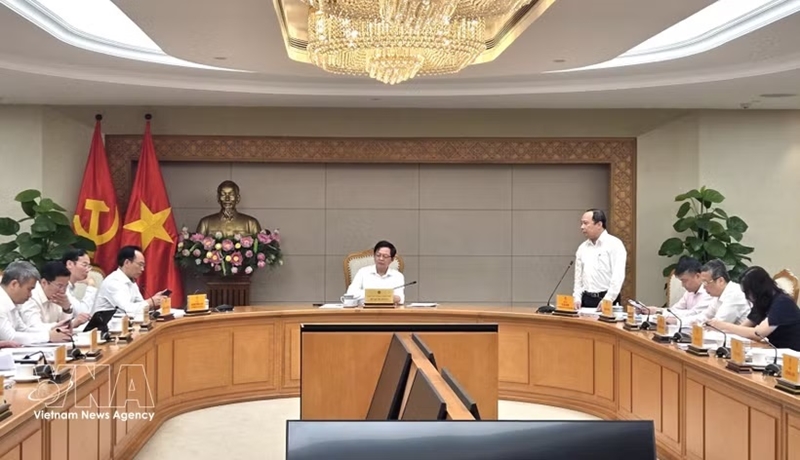
The meeting chaired by Deputy Prime Minister Ho Quoc Dung in Hanoi on April 20 |
Priority technologies will be selected based on three key criteria, including the need to sharpen economic competitiveness, capitalize on domestic industry strengths and potential, and build robust value chains and markets for tech products.
The proposed framework splits strategic technologies into two groups: those with ready markets and immediate impact, including agriculture, processing industries, apparel, construction, steel, and energy; and those poised to fuel future growth, such as foundational and security-related fields such as quantum technology, missile systems, small nuclear reactors, the low-altitude space economy, small satellites, and unmanned aerial vehicles (UAVs).
Minister of Science and Technology Vu Hai Quan said the ministry has worked closely with relevant agencies to compile the list, covering key sectors such as digital technology, biomedicine, advanced materials, energy, and automation.
Several ministries and agencies identified major real-world challenges tied to strategic technologies, contributing to digital transformation, improved governance, and greater production efficiency. Concrete results include sector-specific virtual assistants, digital mapping of raw material zones, and blockchain-based agricultural traceability systems.
Vietnam has made early inroads in mastering core technologies. Universities and research institutes have begun setting up specialized hubs in artificial intelligence (AI), semiconductors, and new energy. Localization rates have climbed, hitting about 50% in industrial robotics and nearly 80% in machine vision and AI systems.
Domestic companies are advancing toward technological self-reliance. Achievements include initial breakthroughs in quantum technologies, over 50% localization in AI-powered surveillance cameras, and about 85% mastery of core 5G technologies by Viettel. Other gains cover autonomous robots for logistics and manufacturing, roughly 70% localization in UAV technologies, and progress in natural language processing and digital infrastructure.
Accelerating review and rollout
Deputy PM Dung described strategic technologies and tech products as critical drivers for socio-economic growth in the new development phase.
According to him, ministries and agencies have actively reviewed and proposed revisions to the list, in line with directives from Party General Secretary and State President To Lam, who also heads the Central Steering Committee for science, technology, innovation, and digital transformation.
Dung called for careful evaluation of Vietnam’s comparative advantages, the potential to build value chains and markets, and the imperative to concentrate resources on truly strategic sectors while steering clear of scattered and inefficient spending.
Ministries and agencies were urged to promptly review, adjust, and finalize their proposed lists for submission to competent authorities. Other specific tasks were also assigned to relevant ministries.
The leader demanded the formation of an inter-ministerial task force by late April, together with the formal submission and issuance of the strategic tech list. Ministries must then propose dedicated funding allocations.
Source: VNA