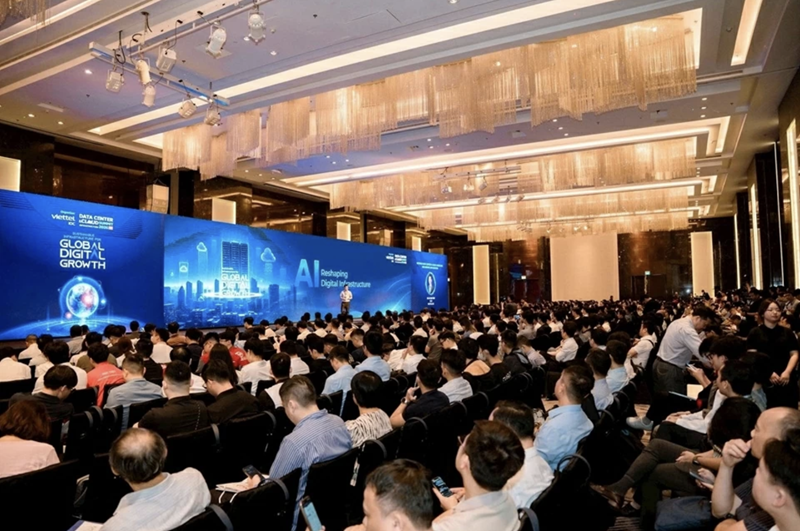
Held in Hanoi on April 20 by Viettel IDC, a subsidiary of the Viettel Military Industry and Telecoms Group specializing in data center and cloud services, the event focused on strategies for developing data centers and cloud infrastructure amid the accelerating adoption of AI.
    |
 |
|
An overview of the Data Center & Cloud Infrastructure Summit 2026 |
Under the theme “Sustainable Infrastructure for Global Digital Growth”, the summit highlighted how enterprises can align infrastructure capabilities with evolving technological demands.
AI reshaping digital infrastructure
Insiders noted that 2026 marks a pivotal stage for the data center and cloud industry as AI, big data and multi-cloud architectures impose entirely new requirements on digital infrastructure.
Next-generation AI models demand massive computing power, high-speed storage, ultra-high bandwidth networks and near real-time scalability. These requirements are placing unprecedented pressure on power supply, cooling systems, system architecture and operational governance.
According to the International Energy Agency (IEA), global data center electricity consumption reached around 415 terawatt-hours (TWh) in 2024 and could nearly double by 2030. This underscores that AI expansion is not only a technological issue but also a strategic challenge in energy and infrastructure planning.
Experts said in this context, the data center and cloud computing sector is entering a phase of redefinition. Infrastructure is no longer merely a backbone for data storage and processing, but is evolving into a foundational platform powering complex digital ecosystems, from AI and advanced analytics to real-time applications.
Le Ba Tan, CEO of Viettel IDC, said that in the 2026–2030 period, AI will no longer function as a standalone technology but will systematically shape digital infrastructure. While there are about 11,000 data centers worldwide, AI-focused facilities account for less than 1% of the total but consume up to 25% of overall electricity.
He noted that traditional data centers typically operate at 20–30kW per rack, whereas AI-driven workloads can push densities to 100kW or even over 200kW per rack. This shift requires major upgrades in power systems, cooling technologies, network connectivity and continuous operations.
As a result, modern data centers must be larger, smarter and more energy-efficient. Sustainability is no longer a branding message but a critical factor directly tied to investment efficiency and competitiveness in the AI era, Tan added.
From global trends to enterprise challenges
Beyond global trends, these shifts are driving a new growth cycle for regional data center markets.
Data presented at the summit showed that the global data center market is expected to reach 627.4 billion USD by 2030, with the Asia-Pacific region accounting for 174.8 billion USD. Vietnam, while smaller in scale, is among the fastest-growing markets, with an annual growth rate of around 14.2%.
|
|
 |
|
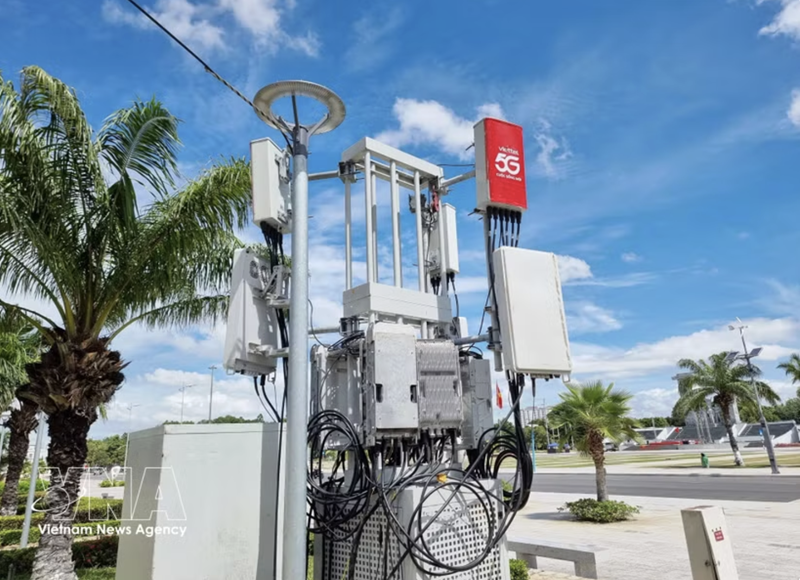
A Viettel 5G base station in Dong Hai ward, Khanh Hoa province |
The cloud market is also undergoing significant transformation. Previously seen mainly as a flexible resource-scaling solution, cloud computing now plays a broader role as AI adoption deepens. Businesses are increasingly concerned not only with scalability but also with data location, system control, security, regulatory compliance and long-term operational costs. Vietnam’s cloud market is projected to reach 1.5 billion USD by 2030.
Experts at the summit stressed that the key challenge lies not in the technology itself, but in execution capacity, from data foundations and operating models to decision-making speed.
Vietnam currently ranks 45th globally in the AI Readiness Index. However, it ranks sixth worldwide in public trust and acceptance of AI, according to the WIN World AI Index 2025. This suggests that while Vietnam is not yet a leading AI market across all criteria, it holds a strong advantage in social trust, technology adoption and policy readiness, and governance.
Discussion sessions at DCCI Summit 2026 focused on core pillars including AI-ready infrastructure, multi-cloud and hybrid cloud architectures, energy efficiency optimization, and new requirements for security, compliance and system resilience.
Delegates also shared practical AI use cases in businesses – from customer data analytics in finance and supply chain optimization in manufacturing to demand forecasting and personalization in e-commerce, as well as AI applications in IT operations and process automation. These real-world experiences provide businesses with clearer guidance on deploying AI effectively on cloud and data center infrastructure while ensuring scalability and long-term efficiency.
Source: VNA