Chairing a working session in Hanoi on April 20 with the two agencies, Deputy PM Thang emphasized that reform efforts must be substantive and aligned with the Government’s directive to streamline regulations and improve the business environment.
He called on the MoF and the central bank to take full responsibility before the Government and the Prime Minister, stressing that agencies must not cite sector-specific characteristics as a reason to delay or avoid reform.
    |
 |
|
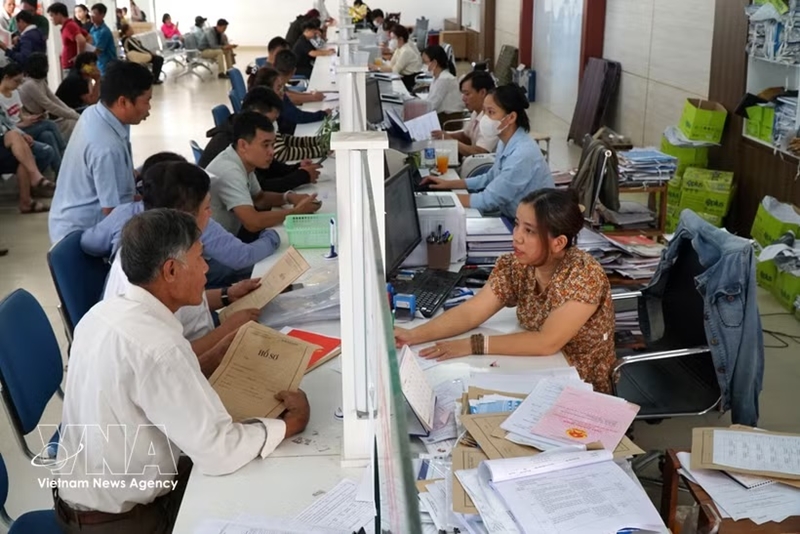
People come to do procedures at the “one-stop shop” of the People’s Committee of Hoa Vang district, Da Nang city. |
The official called on the MoF and the central bank to take full responsibility before the Government and the Prime Minister, stressing that agencies must not cite sector-specific characteristics as a reason to delay or avoid reform.
The two bodies were asked to absorb reasonable opinions from the Ministry of Justice, the Ministry of Public Security, the Ministry of Home Affairs, and the Ministry of Science and Technology to finalize plans for decentralizing administrative procedures. These include reducing at least 50% of administrative compliance costs and processing time, and scrapping 100% of unnecessary business conditions. The revised proposals must be submitted to the Ministry of Justice immediately after the meeting.
The two agencies were also requested to closely coordinate with the Ministry of Justice and the Ministry of Finance in drafting and finalizing resolutions of the Government on reducing, decentralizing, and simplifying administrative procedures.
Separately, the Ministry of Finance is tasked with leading the development of plans to reduce conditional business sectors, also to be finalized in April 2026 in accordance with Document No. 423 issued by the Prime Minister.
The Minister of Finance and the Governor of the SBV have been directed to take strong and proactive measures to accelerate the digitization of administrative records and results, issue electronic outputs in administrative procedures, and, in particular, promote the reuse of digitized data in line with the Government’ requirements.
The Deputy PM requested the Ministry of Justice to study and incorporate relevant recommendations from the SBV and the MoF, and to consolidate them for reporting and submission to the PM for consideration and decision.
He acknowledged the strong efforts made by ministries, particularly the MoF and the central bank, in recent years. However, he pointed out that decentralization remains limited and some reforms have yet to deliver tangible results, falling short of the ambitious targets set under Conclusion No.18-KL/TW by the Party Central Committee.
He stressed that while many administrative procedures and business conditions remain in place, reform must focus on removing impractical regulations while separately assessing genuinely necessary sector-specific requirements.
According to a report presented by Deputy Minister of Finance Nguyen Thi Bich Ngoc, as of April 15, 2026, the ministry oversees 738 valid administrative procedures across 25 sectors - one of the largest and most complex portfolios in the Government, directly affecting citizens and businesses.
The Ministry of Finance has proposed reducing the number of business sectors and occupations under its management to seven, reaching a rate of 36.8% (exceeding the target of six sectors, or 30%).
It plans to cut and simplify 821 administrative procedures, with an estimated total reduction in compliance costs of 41.46 trillion VND, accounting for 54.96%, and an estimated reduction in total processing time of 6,678 days, making up 54.35%.
Regarding the State Bank of Vietnam’s 2026 plan, Deputy Governor Pham Tien Dung stated that the number of administrative procedures expected to be cut and simplified is 93, with a projected reduction in processing time of 734 days. In 2025, the central bank reviewed and eliminated 260 out of 260 unnecessary business investment conditions, achieving a 100% rate.
Source: VNA