The diplomat underlined that the visit from April 21 to 24, which follows General Secretary of the Communist Party of Vietnam Central Committee To Lam’s state visit to the RoK in August 2025, carries significance in many aspects.
Science – technology emerging as “new pillar”
A key feature shaping the future of the Vietnam – RoK relations is the strong shift in their economic cooperation model. Moving beyond a phase centred on labour-intensive manufacturing, the two countries are now working together to build a future-oriented industrial ecosystem and share responsibility for ensuring global supply-chain stability.
    |
 |
|
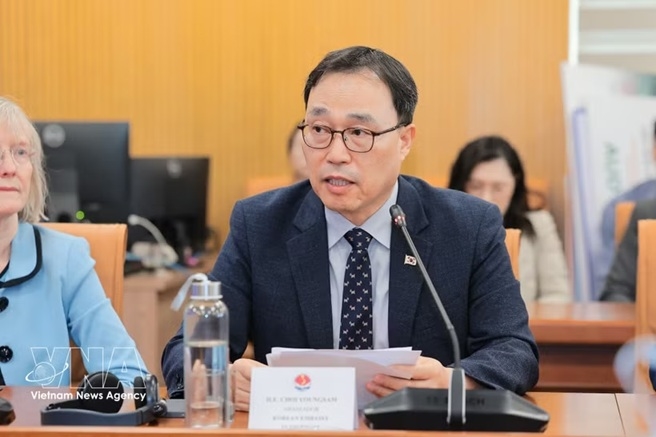
Ambassador of the Republic of Korea to Vietnam Choi Young Sam |
Both sides are striving to realize the trade target of 150 billion USD by 2030 through breakthroughs in key sectors, the ambassador noted.
Within this strategic orientation, science – technology, innovation and digital transformation have been elevated to a new pillar of cooperation. According to Choi, the RoK wishes to become Vietnam’s most reliable partner in digital transformation and green growth.
Large-scale infrastructure projects under discussion include the development of a high-speed railway network, smart city building, and renewable energy and LNG projects aimed at addressing climate change.
High-tech cooperation has already produced tangible results through major initiatives such as the Vietnam – Korea Institute of Science and Technology (VKIST) project in the Hoa Lac Hi-Tech Park, which is expected to soon enter its second phase; the National Innovation Centre, the Can Tho Technology Incubator, and the largest research and development center in Southeast Asia established by Samsung in Hanoi.
Priority areas of cooperation include semiconductors, artificial intelligence, biotechnology and advanced materials. Logistics collaboration is also opening new avenues, particularly through the goal of linking the comprehensive ecosystem of the Port of Busan with next-generation port projects in Hai Phong, Da Nang, Ho Chi Minh City, Gia Lai, An Giang and Ca Mau.
Prof. Choe Won Gi, Director of the Centre for ASEAN – Indian Studies at the Korea National Diplomatic Academy, said Vietnam and the RoK should build a foundation for next-generation technology cooperation that goes beyond consumer products.
Human resources training and technology transfer will be key for the two countries to move up the global value chain, he noted, adding that the combination of Korean technology and capital with Vietnam’s high-quality workforce and dynamic growth potential will create strong synergy internationally.
Promoting people-to-people exchanges
During his policy speech at Yonsei University in the RoK last August, Party General Secretary To Lam highlighted the Northeast Asian country’s “humanomics” philosophy, which places people at the center while combining innovation with inclusive and sustainable development. Vietnam similarly identifies people as the centre, the key stakeholder, a resource, the most important driving force, and the ultimate goal of development.
The community of more than 350,000 Vietnamese in the RoK, nearly 200,000 Koreans in Vietnam, and more than 100,000 multicultural families has helped connect the two nations. Meanwhile, tourism exchanges between the two countries reach around five million visits annually.
These exchanges have become even more dynamic in the digital era. Vietnam’s Ambassador to the RoK Vu Ho noted that the two countries hold vast potential for cooperation in digital content, with young people engaging actively through films, music, video games and webtoons.
In sports, the friendship has also been strengthened by contributions of Korean experts, including coaches Park Hang Seo and Kim Sang Sik, who recently helped Vietnam’s men’s U23 football team secure a third-place finish at the 2026 AFC U23 Asian Cup.
Beyond bilateral ties, President Lee’s visit also carries significance for enhancing cooperation on the international stage. Prof. Choe noted that Vietnam is a key partner in the RoK's policy towards Southeast Asia, particularly within the framework of the Korea – ASEAN Solidarity Initiative (KASI).
During high-level meetings, leaders of both countries have consistently affirmed their commitment to supporting each other at multilateral forums. This cooperation is reflected in the two sides' coordination for APEC 2025 in the RoK and APEC 2027 in Vietnam, as well as in promoting the Mekong – RoK Summit.
With the nature of a comprehensive strategic partnership, the state visit to Vietnam by President Lee is expected to herald a new phase of development with long-term strategic orientations for bilateral relations.
Ho described the visit as not only politically and diplomatically significant but also instrumental in aligning visions between the two sides in the new period, helping shape a long-term cooperation framework. “The spirit of the new phase can be summarized as higher trust, deeper cooperation and stronger connectivity,” he stressed.
Choi expressed his confidence that the trip will pave the way for a strategic breakthrough to lift bilateral ties to a higher level.
Notably, President Lee will become the first head of state to pay a state visit to Vietnam following the country’s completion of its top leadership in early April 2026, promising bright prospects for the Vietnam – RoK relations and providing a strong and solid impetus for their long-term development based on durable trust between the two sides' high-ranking leaders.
Source: VNA