The delegation is paying a working visit to Viet Nam from November 16 to 21 during which they attended the seventh Policy Dialogue between the two Parties.
Huan outlined the key achievements of the country’s 40-year Doi Moi (Renewal) process and its strategic shift towards the goal of becoming a developed, high-income country by 2045.
    |
 |
|
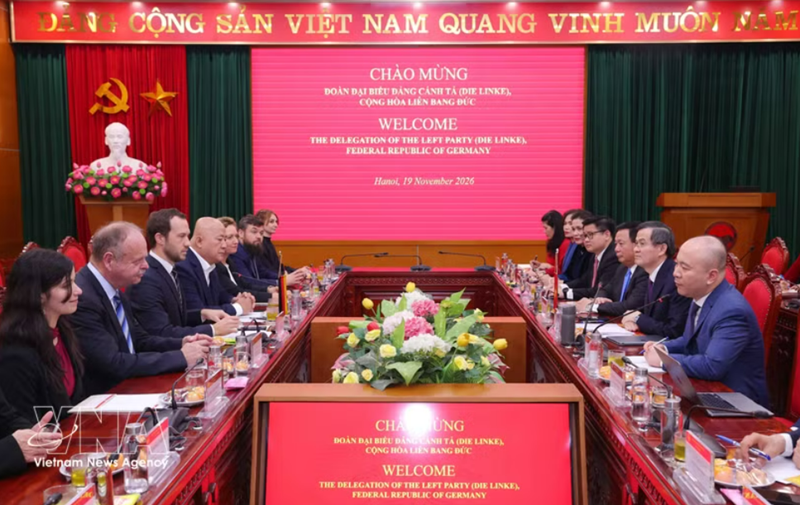
Representatives of the Ho Chi Minh National Academy of Politics meet with a delegation of Germany’s Left Party (Die Linke), led by its Federal Deputy Chair Dr. Theo Glauch, in Ha Noi on November 19. |
To realize this ambition, Viet Nam is transforming its growth model towards one driven by science-technology, innovation and digital transformation. It is also accelerating administrative reforms and streamlining its organizational structure by reducing the number of provincial-level administrative units from 63 to 34 and implementing a two-tier local administration model to improve national governance efficiency.
Alongside its pursuit of double-digit growth, Viet Nam remains steadfast in its socialist orientation, while seeking to harmonize economic development with cultural, social and environmental objectives and promote green transition.
Huan affirmed that the CPV attaches importance to Party-to-Party diplomacy, one of the three pillars of Viet Nam’s diplomacy, alongside State diplomacy and people-to-people exchanges. He said that the Ho Chi Minh National Academy of Politics and the Central Council for Theoretical Studies are focusing on three key areas of cooperation: theoretical and strategic exchanges; training and capacity building for officials; and academic research through joint seminars and discussions with the Rosa Luxemburg Foundation - one of Germany’s six major political foundations.
Regarding Party development among young people, Huan stressed the need to cultivate young intellectuals and high-tech workers, strengthen their ability to master the digital space and promote their leading role at the grassroots level in safeguarding the Party’s ideological foundation.
|
|
 |
|
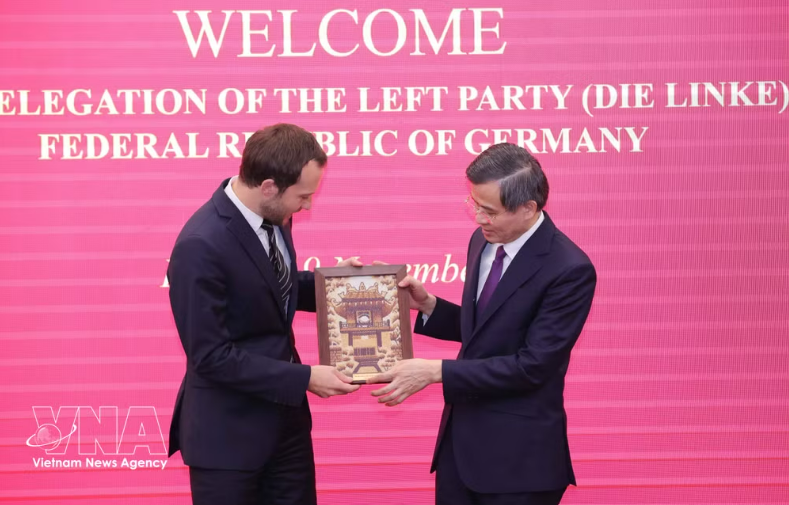
Politburo Member and President of the Ho Chi Minh National Academy of Politics Assoc. Prof., Dr. Doan Minh Huan (right) presents a gift to Federal Deputy Chair of Germany’s Left Party (Die Linke) Dr. Theo Glauch. |
At the meeting, Chairman of the Central Council for Theoretical Studies Prof., Dr. Nguyen Xuan Thang described the policy dialogue mechanism as an important channel of cooperation that directly supports the two Parties in making policies and strategies. Highlighting global challenges, including major-power strategic competition and the impact of artificial intelligence (AI) on employment, housing and migration, he praised Die Linke’s strong attention to workers’ interests.
He proposed that the eighth policy dialogue, scheduled to take place in Berlin, focus on the working class in the digital age, capital-labor relations under digital capitalism, epoch-making transformations and the role of youth organizations.
For his part, Glauch highlighted the significance of the seventh policy dialogue, held on the occasion of the 15th anniversary of the Viet Nam-Germany Strategic Partnership, and expressed his strong impression of Viet Nam’s economic growth and administrative reforms.
Glauch affirmed that the two Parties share common ideals and face similar 21st-century challenges, particularly in protecting workers’ rights, linking economic development with social equity and maintaining world peace.
Noting the growing number of young members and increasing support for Die Linke among voters aged 18-30, he pledged close coordination in preparing for the eighth policy dialogue, contributing to stronger and more effective traditional friendship and cooperation between the two Parties and peoples.
Source: VNA