Seeking slices of peacetime life
The idea for the “Stories in Peacetime” project was nurtured by the students in early February 2026, when they were learning about war veterans ahead of the 51st anniversary of the South Liberation and National Reunification Day (April 30, 1975 - 2026).
Van Gia Khanh, head of the project, said that at first, the group planned to explore war keepsakes or recreate memories of soldiers after they returned from the war. However, they realized that while history was often mentioned, little attention was paid to the present-day lives of those who had lived through war. In reality, the veterans are still living, working, and continuing to contribute to society.
    |
 |
|
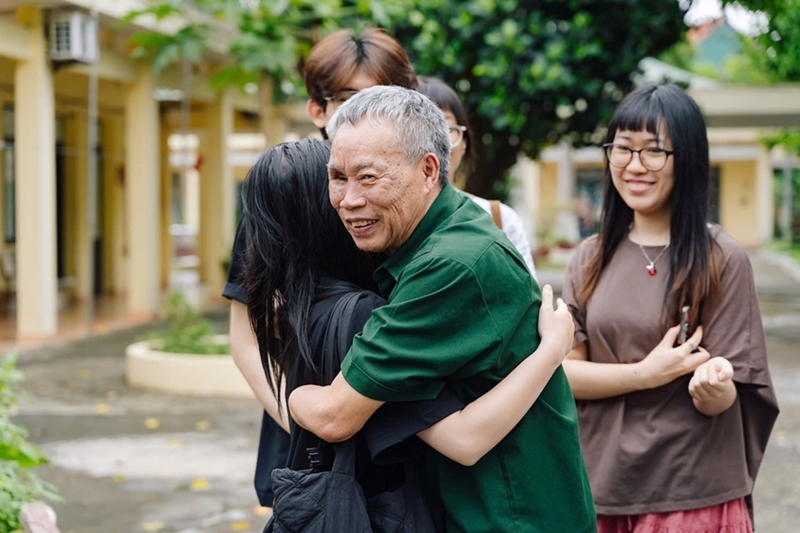
War veteran Khuay Thuan Thanh gives young people a warm hug after the conversation. |
From that thought, “Stories in Peacetime” was formed with the message: “Everyday stories after extraordinary years.” The project was developed in four chapters: “My peacetime,” “Scars of time,” “Companions,” and “Messages between two generations.” Each chapter took shape as the students approached the current lives of war veterans, portraying them not only through their wartime years but also through their resilience, sense of responsibility and devotion in the present.
Over more than a month of implementation, the student group traveled to several localities, including Hanoi, Bac Ninh, and Nghe An, to meet with war veterans, film them, and collect materials. The Hanoi municipal Vietnam Veterans’ Association accompanied the project as a content adviser, helping the group connect with relevant individuals and units.
However, the greatest challenge was approaching and understanding the lives of soldiers after the war. Many war veterans still carry both physical and mental wounds, so it was not easy for them to open up. Therefore, before each filming session, the group often spent a long time talking with them and building trust, so that the stories could be shared like heartfelt conversations rather than formal interviews.
The project leader said that some conversations lasted for hours before the camera was turned on. Yet the group said that the most important thing was not how many images or materials they could record, but whether they could create a sincere enough space for the stories to be told with trust.
|
|
 |
|
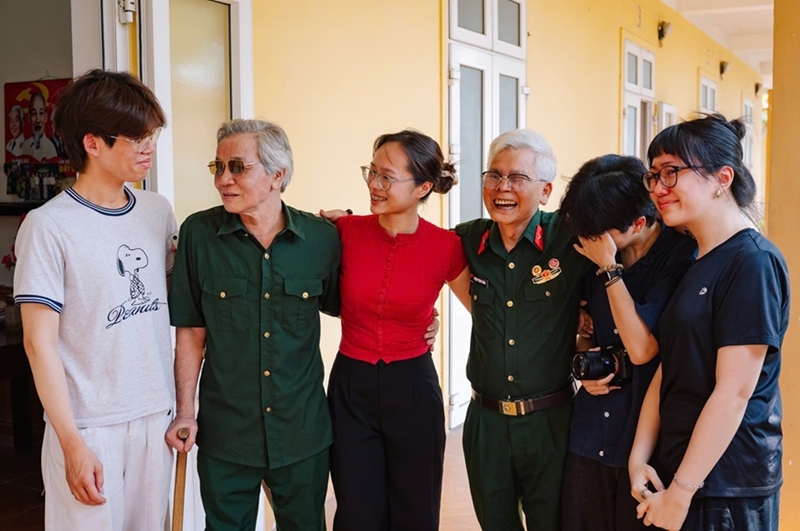
Students from the Academy of Journalism and Communication carry out the “Stories in Peacetime” project. |
More than a media project
One of the most emotional journeys was the visit to the Nghe An Nursing Center for Wounded and Sick Soldiers with Mental Illnesses. There, war was no longer something found only in books, but appeared in each wound, each gaze, and the daily rhythm of wounded and sick soldiers.
According to Gia Khanh, the place felt like a big family. Officials, doctors, nurses, and wounded and sick soldiers always cared for and looked after one another. Some soldiers, despite suffering from severe injuries, still tried to help their comrades in the smallest ways. That warmth helped the project members better understand the value of sharing.
Nguyen Thieu Lam, Director of the center, shared that what troubled many wounded and sick soldiers was not only physical pain, but also the feeling of being forgotten. Therefore, whenever young people visited them, they warmly welcomed the guests. It became unforgettable memories for the young people taking part in the project.
From their field trips, the “Stories in Peacetime” project gradually went beyond the scope of a media project. For its members, it became a journey that allowed them to view history from a closer distance, through the lives of people who had overcome war.
|
|
 |
|
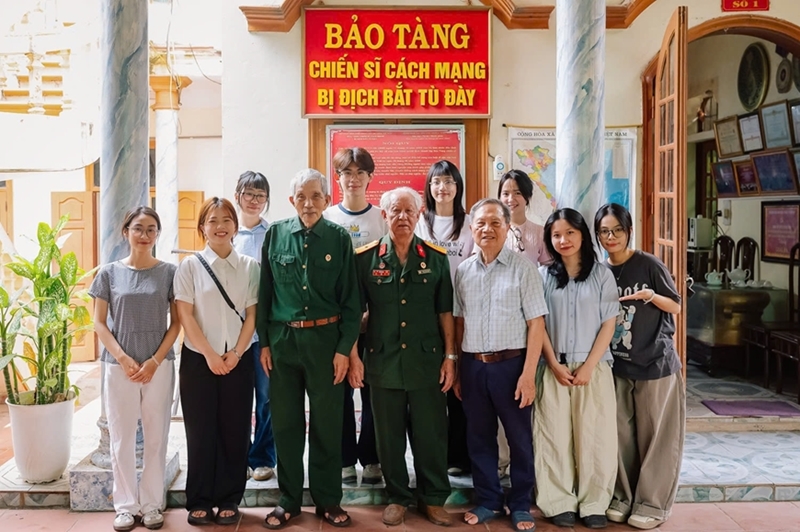
The students in a group photo with war veterans. |
Tran Bach Dieu Linh, a project member, said that after the journey, she better understood the meaning of responsibility. For her, it means living better, being more useful, and contributing to the community in her own way.
In addition to communication activities on digital platforms, the student group will organize an exhibition on May 9 and 10 at the Hanoi Museum. At the exhibition, the public will have the chance to see photos, documentary videos, and listen to the stories in the war. The group expects the exhibition to be more than a display space, it hopes it will become a place connecting the past and the present, where young people can feel history through the closest and most ordinary stories.
Translated by Minh Anh