This marks her first visit to the region and also her first trip to Vietnam since taking office. The visit takes place shortly after Vietnam has consolidated its high-level leadership apparatus, reflecting Japan’s treasuring bilateral relations and Vietnam’s role in the region and the world.
The visit reaffirms Vietnam’s consistent policy of attaching importance to developing relations with regional partners, including Japan. Vietnam regards Japan as one of its leading, long-term strategic partners, characterized by a high level of political trust, a top priority in its foreign policy, and a companion in a new era of development.
    |
 |
|
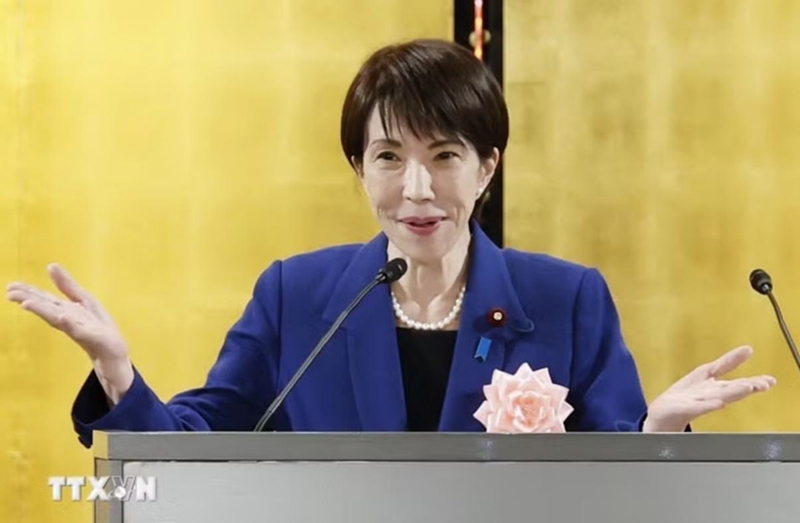
Japan Prime Minister Takaichi Sanae (Photo: VNA) |
Since the bilateral relationship was elevated to a comprehensive strategic partnership over two years ago, Vietnam - Japan ties have continued to expand across all fields. The two sides have maintained and upgraded numerous substantive and effective dialogue and cooperation mechanisms in diplomacy, defense, security, trade, and agriculture. Japan remains one of Vietnam’s top economic partners, with increasingly close economic linkages. Since November 2023, ODA cooperation has increased by more than USD 600 million. Japanese FDI in Vietnam has risen by 10%, reaching nearly USD 8 billion. Bilateral trade has grown by 20%, at nearly USD 9 billion, surpassing USD 50 billion for the first time. Cooperation in science and technology has seen notable progress, while defense and security ties have also achieved specific outcomes.
In the context that Vietnam - Japan relations are flourishing based on sincerity, trust, practicality, and effectiveness, the visit is expected to further consolidate and deepen political trust and promote cooperation across such key areas as politics - diplomacy, defense, security, economy, trade, investment, science and technology, education, human resource development, agriculture, local-level cooperation, and people-to-people exchanges. This will deepen the comprehensive strategic partnership on the basis of mutual benefit, serving the development goals and strategic autonomy of both nations.
Under the leadership of Prime Minister Takaichi Sanae, Japan is pursuing its “Sanaenomics” policy, aimed at building a “robust economy” through promotion of investment and financial transparency. Key pillars include ensuring energy security, strengthening defense capabilities, and enhancing crisis management. The policy also focuses on strategic sectors such as artificial intelligence, semiconductors, biotechnology, nuclear energy, and food security.
Japan supports Vietnam in building an independent and self-reliant economy, while appreciating the country’s efforts in streamlining its apparatus and achieving socio-economic development goals.
With shared vision and aligned strategic priorities in development policies, Prime Minister Takaichi Sanae’s visit offers an opportunity for both sides to exchange views and agree on concrete measures to enhance the effectiveness of cooperation pillars, identify priority areas for future collaboration, thus creating breakthroughs in bilateral relations.
In a rapidly changing global context negatively impacting energy security and causing supply chain disruptions, both sides view this visit not only as a chance to strengthen bilateral coordination under the comprehensive strategic partnership framework but also to cooperate in addressing regional and global issues.
Japan highly values Vietnam’s position and role in the region, considering it an important partner in advancing its Free and Open Indo-Pacific (FOIP) vision. Vietnam, in turn, consistently supports Japan in playing a greater role in the region and the world, and stands ready to work with Japan to contribute to regional peace, stability, cooperation, and development.
With such significance, the official visit to Vietnam by Prime Minister Takaichi Sanae is expected to elevate bilateral relations to a new height, benefiting the peoples of both countries while contributing positively to peace, stability, cooperation, and development in the region and the world.
By the Editorial Board of the People’s Army Newspaper
Translated by Mai Huong