The dispatch highlighted that the work has gained significant momentum following the launch of the nationwide 500-day campaign to accelerate the search for, recovery and identification of martyrs’ remains. Authorities have recovered the remains of 1,312 fallen soldiers, including 396 in Vietnam, 174 in Laos and 742 in Cambodia, while also locating three collective graves in Tuyen Quang province. Mine and unexploded ordnance clearance has been completed across more than 7,025 hectares, including over 3,175 hectares in the Vi Xuyen core area of Tuyen Quang, equivalent to nearly 78% of the planned workload.
    |
 |
|
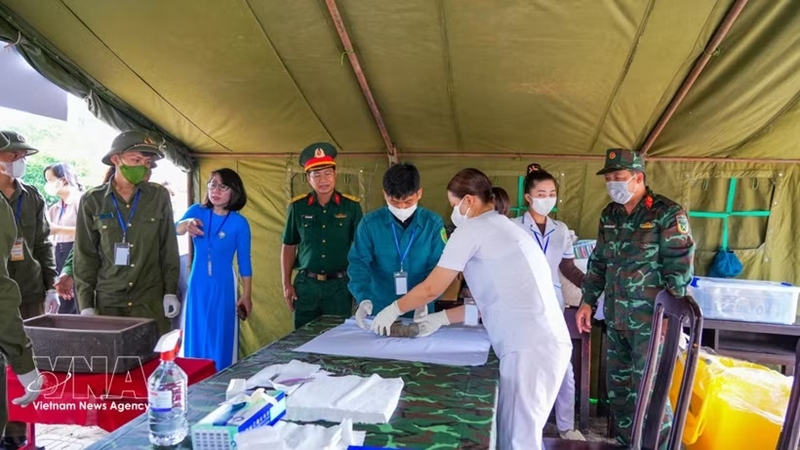
Medical personnel and specialists complete documentation and preserve DNA samples in accordance with established procedures. |
In parallel, DNA identification efforts have continued to expand. Samples have been collected from 35,925 unidentified graves at martyrs’ cemeteries nationwide, while biological samples from 93,464 relatives have been obtained. More than 53,000 of those samples have been integrated into the national database. Authorities are also preserving over 11,600 remains samples and accelerating DNA analysis to establish identities.
The Prime Minister commended ministries, sectors, localities, the armed forces and relevant agencies for their dedication, as well as the active support of people from all walks of life.
However, he noted that substantial challenges remain. Progress has been uneven across localities, coordination among agencies has not always been sufficiently close, and implementation in several areas still falls short of the objectives set under the 500-day campaign. In some cases, leaders of agencies and localities have yet to demonstrate strong accountability or mobilize available resources effectively.
To address these shortcomings, the Government leader instructed ministers, heads of ministerial-level agencies, members of the national and all-level steering committees for the work and local authorities to carry out campaign objectives in a serious, comprehensive, determined and coordinated manner.
Priority will be given to expanding communication efforts, accelerating searches within Vietnam, particularly in areas believed to contain large numbers of martyrs’ graves or collective graves. Authorities were instructed to strengthen historical research, verify archival records, gather information from witnesses and expand search operations in key localities, including Tuyen Quang, Lao Cai, Lang Son, Quang Tri, Hue, Da Nang, Ho Chi Minh City, Dong Nai, Quang Ngai, Dak Lak, Gia Lai and Tay Ninh.
The dispatch also calls for nationwide implementation of standardized procedures to collect, preserve and store samples from unidentified remains buried in martyrs’ cemeteries. DNA collection from relatives will be accelerated and integrated into the national gene bank to facilitate future identifications.
International cooperation is expected to play a greater role, with Vietnam seeking closer collaboration with Laos, Cambodia, the US, Australia, the Republic of Korea, China and other partners in sharing wartime records, declassified documents, artefacts, technological expertise and DNA identification experience.
The Government also ordered the completion of mine clearance in key search areas, particularly Vi Xuyen in Tuyen Quang, as well as Lao Cai and Lang Son, during 2026. Businesses and social organizations are encouraged to contribute specialized equipment and financial resources to support search and identification efforts.
Among the key assignments, the Ministry of National Defense was tasked with coordinating overall implementation of the campaign, completing remains sampling in northern localities by December 22, 2026, and in southern localities by April 30, 2027. Construction of a national storage facility for remains samples is scheduled to begin before July 27, 2026.
Meanwhile, the Ministry of Home Affairs was instructed to complete the national database on martyrs, martyrs’ graves and their relatives within 2026, while the Ministry of Public Security is expected to complete nationwide DNA sample collection from relatives and further develop the national gene bank.
The Prime Minister stressed that the National Steering Committee must ensure close inter-agency coordination, strengthen inspections, promptly resolve obstacles and prioritize all available resources to fulfil the objectives of the 500-day campaign. The secretaries of Party Committees and chairpersons of People’s Committees of provinces and cities were instructed to take direct responsibility for implementation, incorporate the mission into regular leadership agendas and ensure clear accountability, timelines and measurable outcomes.
Source: VNA