Following memories to find the fallen
The winding dirt road from Thach Mang intersection to Team K76’s search site stretches for about 30 kilometers, with sections eroded by rainwater and overgrown with vegetation.
    |
 |
|
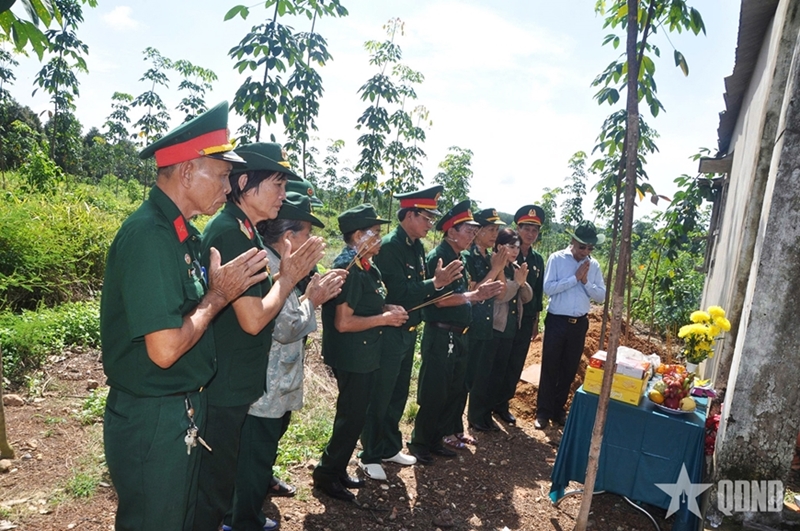
Veterans and former youth volunteers offer incense at Team K76’s search and recovery site under the Dong Nai municipal Military Command. |
During the journey, veterans and former youth volunteers from the Binh Phuoc ward’s Association for the Support of Martyrs’ Families and the Dong Xoai ward’s Truong Son-Ho Chi Minh Trail Traditional Association shared memories of their wartime experiences.
Among them was Nguyen Thi Dot, born in 1941, who served as a clandestine guerrilla during the resistance war against the U.S. She traveled to the site with her son, veteran Tran Van Hung, head of the Binh Phuoc ward’s Association for the Support of Martyrs’ Families.
More than half a century after her elder brother fought and laid down his life in this area, his remains have yet to be found. She hopes the search will uncover information that could help locate him.
As time has passed and the terrain has changed, identifying possible burial sites has become increasingly difficult. Search teams must rely on witnesses’ memories and compare their accounts with traces remaining on the ground. Some clues require repeated visits and information from several witnesses before a search area can be identified.
According to Colonel Tong Ngoc Truong, Political Officer of Team K76, the ongoing search was based on information provided by Hai Van, former Deputy Commander of a Youth Volunteer Unit and former Vice Chairman of the Long An provincial People’s Committee.
Veteran Tran Van Nhut, born in 1944, who owns the rubber plantation, recalled that in 2009, Hai Van and several former youth volunteers recovered 22 sets of martyrs’ remains from the area.
|
|
 |
|
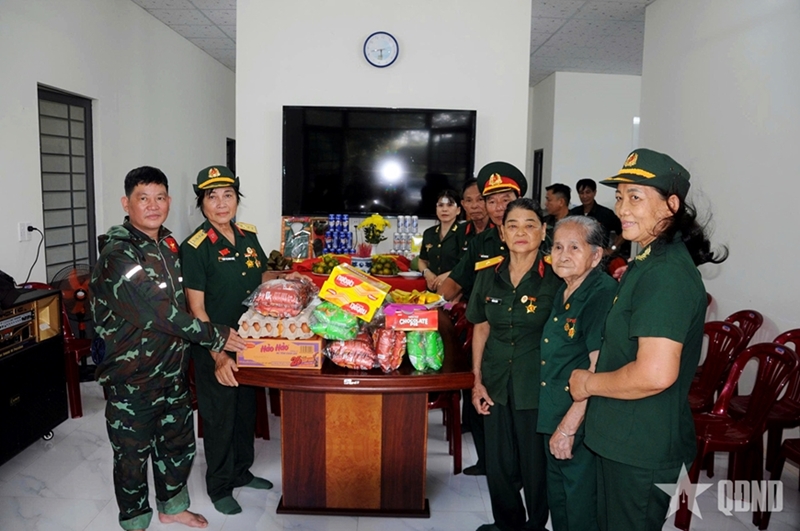
Veterans and former youth volunteers present gifts to officers and soldiers of Team K76 under the Dong Nai municipal Military Command. |
Treasuring every trace
Beside an abandoned house, Colonel Tong Ngoc Truong set up a makeshift altar using a wooden table covered with a blue cloth. Offerings of cakes, fruit, rice wine and cigarettes were carefully arranged in remembrance of the fallen.
Senior Captain Trinh Thi Minh Tuat, former Commanding Officer of the Truong Son Women’s Driving Company and head of the Liaison Board of the Dong Xoai ward’s Truong Son-Ho Chi Minh Trail Traditional Association, lit cigarettes as offerings to her fallen comrades. Members of the delegation stood in silence, many visibly moved to tears.
Not far away, soldiers continued digging with hoes, shovels and small trowels. Between rows of rubber trees, they carefully excavated suspected burial sites, examining changes in soil color and texture.
Whenever they encountered unusual soil layers or traces of military groundsheets, hammocks or human bones, the team expanded the search area and dug deeper, carefully examining every potential clue.
Medicine bottles, syringes and fragments of military groundsheets were collected and placed in plastic bags for preservation. Though few, these traces could provide valuable clues about wartime medical treatment activities in the area.
Every stroke of the hoe required patience. When a possible trace emerged, soldiers switched to small trowels, gently removing soil to examine the site in greater detail.
Colonel Tong Ngoc Truong said the unpredictable weather posed considerable challenges. In October, scorching midday sunshine could quickly give way to afternoon rain, forcing the team to make the most of every opportunity to continue its work.
From September 25 until the delegation’s visit, Team K76 recovered nine sets of martyrs’ remains and transferred them to the Suoi Nhung Forestry Station outpost. One set of remains was accompanied by an object believed to be a military mess tin or its lid, bearing several engraved markings.
According to the team’s preliminary assessment, the upper inscription may indicate February 22 or 23, 1968; the middle inscription may contain the name Hiep or Hien; and the lower inscription appears to show April 23, 1968.
However, the inscriptions are too faint to establish the martyr’s identity. The remains have also deteriorated significantly, leaving only small bone fragments and making the collection of samples for DNA testing difficult. Information about the location of a former wartime surgical station, including when troops were stationed there and where wounded soldiers were treated and buried, also requires further verification.
Under the scorching midday sun, many veterans and former youth volunteers volunteered to join Team K76’s officers and soldiers in the search. Some worked with hoes and shovels, while others carefully brushed away soil with small trowels or closely examined freshly exposed layers of earth. Beneath the rows of young rubber trees, the soldiers meticulously searched for any trace, hoping to find their fallen comrades and loved ones and bring them home.
Translated by Minh Anh