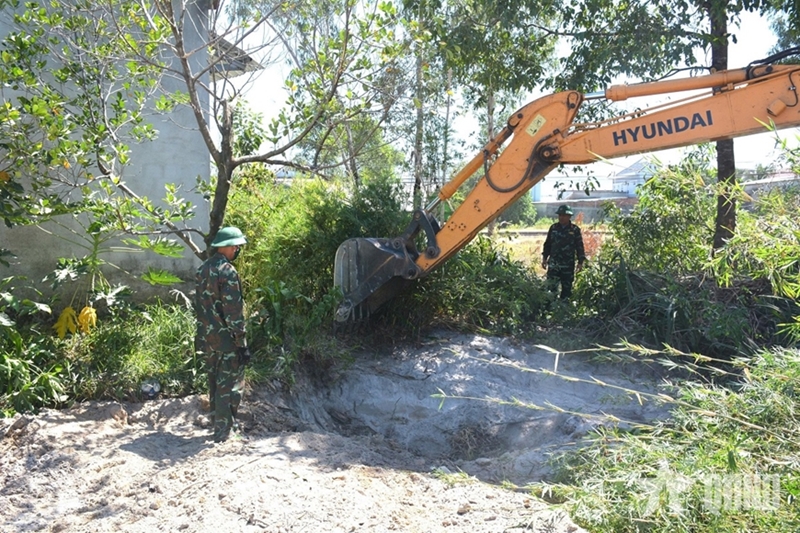
From 6:00 a.m., an excavator began operating on the 2,000-square-meter sandy area at the station. With no clear physical traces remaining, Team 192 has relied mainly on accounts from veterans and local residents to guide its search and collection efforts.
Veteran Le Huu Tong of Phu Bai ward, Hue city, a former commando who fought in Hue during the Tet Offensive 1968, provided key information. He recalled that many soldiers killed in the fierce fighting that year had been taken by the enemy to Huong Thuy Station for burial. Although a mass grave containing 83 sets of remains was discovered there in 1993, Tong believed that many of his comrades still remained buried in the area.
    |
 |
|
Martyrs’ Remains Search and Collection Team 192 under the Hue City Military Command searches for and collects martyrs’ remains in the sandy area at Huong Thuy Station in Huong Thuy ward, Hue city. |
His account was supported by recollections of local residents. Le Quang Thanh of Chau Son residential group in Huong Thuy ward remembered that the sandy area had been used to bury fallen soldiers between 1968 and 1975. Huynh Van Hung, also from Chau Son residential group, recounted information passed down by his father, Huynh Van Ba, former Party Secretary of Huong Thuy Station, who had said that the enemy buried many fallen soldiers there.
The consistent accounts provided by several witnesses over the years gave Team 192 an important basis for conducting field verification.
Senior Colonel Ngo Tri Hung, Head of Team 192, assigned forces to survey, search, verify information, and ensure logistic support. The excavation was conducted carefully. Because the 80-centimeter sand layer lies on hard clay, Non-commissioned Major Tran Hong Tinh, who has 10 years of experience in remains collection in Laos, operated the excavator to scrape thin layers of five to seven centimeters at a time, allowing observers to promptly detect any unusual signs.
In the early afternoon, the excavator was temporarily stopped after a layer of dark-colored sand was detected. Non-commissioned Major Nguyen Van Le then carefully removed the soil with a trowel and discovered a body bag.
After confirming that the discovery was a martyrs’ remains, Team 192 continued carefully excavating the surrounding area and found an intravenous tube. Based on the belongings and burial method, the relevant forces assessed that the soldier might have died from wounds or illness before being buried by the enemy.
According to the search mapping results, more than 3,700 fallen soldiers in Hue City have yet to be located. In July and early August alone, Team 192 received and verified 40 sources of information and conducted searches at 40 locations with the highest level of determination.
The journey ahead for Team 192 remains long. Each grave discovered and each biological sample collected brings new hope of identifying the fallen soldiers and returning them to their hometowns and families. The officers and soldiers will continue searching the area, following every remaining trace of the war.
Translated by Minh Anh