Leading the team, Colonel Vo Thanh Dan considers finding fallen comrades and bringing them home a sacred order from the heart.
Bridge through social media
Searching for, recovering, and repatriating the remains of Vietnamese volunteer soldiers and advisors who died during the resistance war has never been easy. In the 25th phase, covering the 2025-2026 dry season, information about burial sites has become increasingly scarce, terrain has changed, witnesses have grown fewer, and UXO, harsh weather, disease risks, and difficult working conditions continue to challenge the team.
    |
 |
|
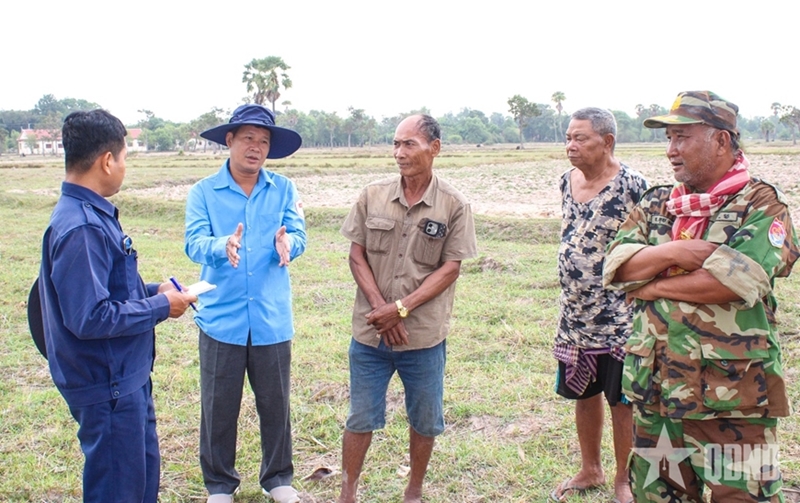
Col. Vo Thanh Dan (second from the left) verifies information provided by Cambodian residents in Kanhchriech district, Prey Veng province. |
Recognizing these difficulties, Col. Vo Thanh Dan directed the team to expand the use of social media and digital technology to gather information. The team's official fan page has become an important link between Team K91 and families searching for their missing relatives.
After long days of field surveys and excavations, Dan and his comrades often spend their evenings reading messages and answering calls from families. Some send old certificates honoring fallen soldiers, while others share brief and painful information about relatives who died in Cambodia or on the Southern battlefield.
Dan keeps reminding his personnel that every call or message represents a family's hope and must not be overlooked.
This approach has helped Team K91 receive and process hundreds of leads from Pursat and Prey Veng provinces in Cambodia and Dong Thap province in Viet Nam. Survey teams then verify the information directly in villages and hamlets, allowing the unit to map suspected sites and quickly deploy excavation teams when credible leads emerge.
Leaving no lead behind
With the principle that “as long as there is information, we will keep searching,” Col. Vo Thanh Dan leads his personnel regardless of weather, holidays, or difficult conditions. During the 25th phase and the beginning of 26th one, Team K91 excavated tens of thousands of cubic meters of soil and rock and recovered 68 sets of fallen soldiers’ remains, 47 in Cambodia and 21 in Dong Thap province.
|
|
 |
|
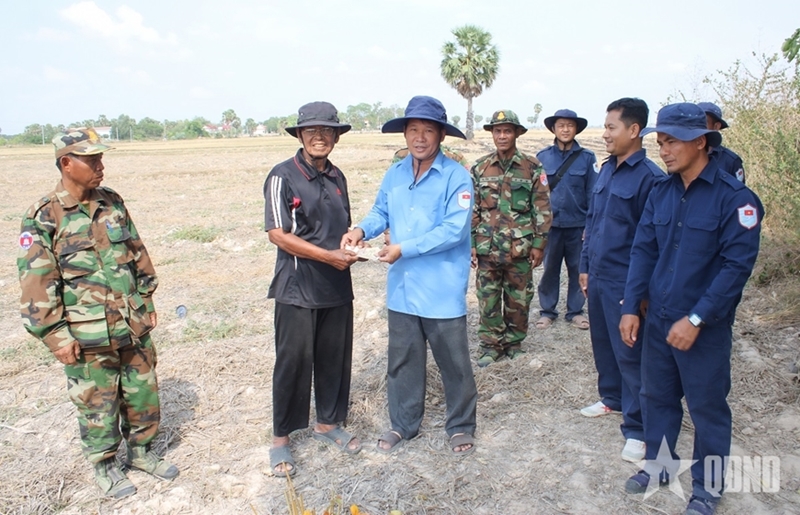
Col. Vo Thanh Dan (third from left) presents financial support to residents who provided information about fallen soldiers in Ba Phnum district. |
One urgent case involved information about five or six suspected graves of Vietnamese soldiers deep in Veal Veang district, Pursat province. The area was within a hydropower project site that was preparing to impound water. Dan immediately ordered his team to cross a fast-flowing stream and move through difficult forest terrain. They reached the site in time to recover the remaining traces before the area was submerged.
At Pua Pray mound in Prey Veng province, suspected remains were found beneath three more recently established local graves. Through patient persuasion, the team convinced the families to voluntarily relocate the graves so the search could proceed. At sites where remains are found, the team conducts solemn rituals and burns incense to express gratitude to the land, local deities, and Cambodian people who have protected the fallen soldiers for decades.
The team also faces the pain of finding remains whose identities remain unknown. In late April 2026, a resident of Preah Sdach district, Prey Veng province, reported human remains discovered while digging a house foundation. Team K91 expanded the search and found skull fragments, vertebrae, rubber sandals marked “Lac Da,” and an AK ammunition magazine.
Another discovery involved a worn pen engraved with the words “Quang Tuy.” Dan reviewed archived records and found that Team K91 had recovered remains in Prey Veng province on September 4, 2002, accompanied by a pen bearing the same inscription. The remains had been reburied at Tam Nong Martyrs’ Cemetery, but the identity of the pen’s owner had never been established.
The discovery prompted Dan and his comrades to continue connecting information and seeking relatives of unidentified fallen soldiers. In another case, Dan worked to trace information about “Thang,” a soldier from the Southwestern region who belonged to C7, D12, E11, F339, fought in Cambodia, remained there, started a family, and died in Pursat more than 30 years ago.
|
|
 |
|
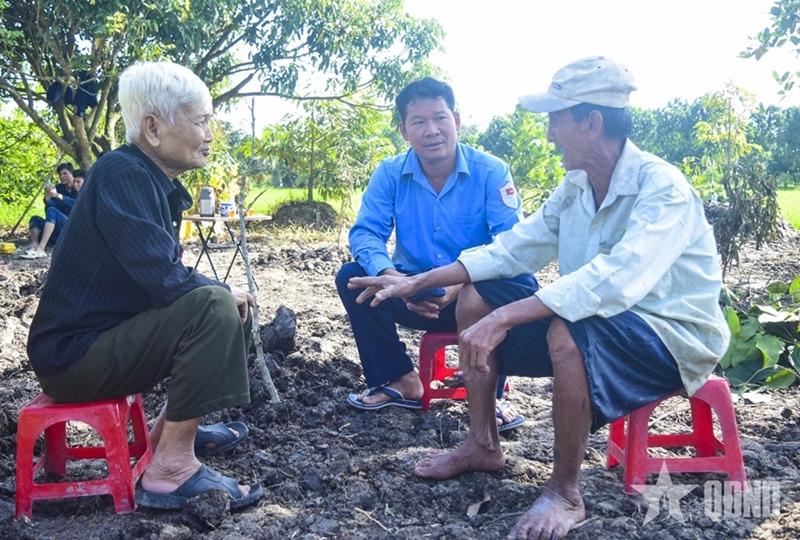
Col. Vo Thanh Dan (center) receives information about fallen soldiers in Phu Huu commune, Dong Thap province. |
Beyond searching for and recovering remains, the team also conducts mass mobilization and defense diplomacy through visits, gift-giving, medical examinations, medicine distribution, tree planting, well drilling, construction of shelters and sanitation facilities, the promotion of vegetable cultivation and livestock farming, technical assistance, and rural road repairs. These activities have helped build trust with Cambodian authorities and residents, encouraging them to share valuable information about the burial sites of Vietnamese fallen soldiers.
The 500-day campaign is still underway, and Team K91 continues its search. For Col. Dan, the greatest reward is not a certificate or commendation, but the recovery of more fallen soldiers and the opportunity to bring them home. To him, searching for fallen comrades is more than a political mission, it is a sacred calling and order that comes from the heart of a soldier.
Translated by Tran Hoai