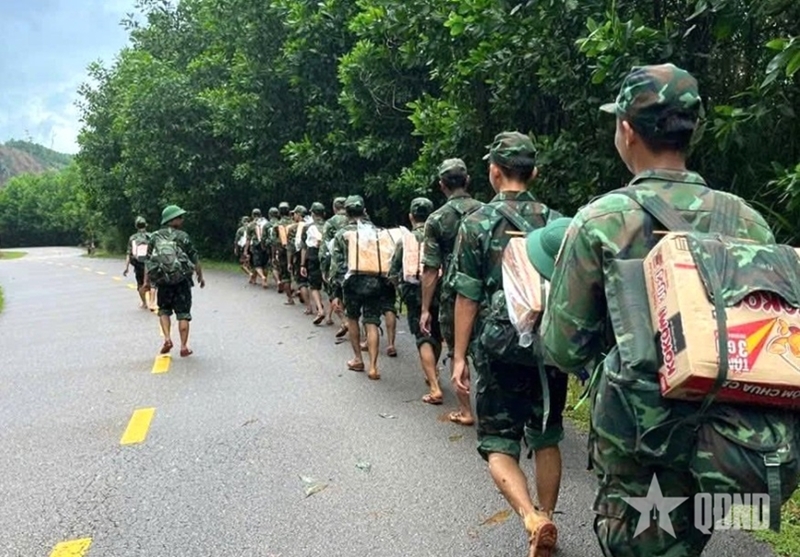
After three days of complete communication loss with residents in To Po hamlet of Ben Giang commune, on the morning of October 31, a reconnaissance team led by Lieutenant Colonel Nguyen Minh Thanh, Deputy Chief of Staff of the Defensive Area Command Region 2-Thanh My under the Da Nang Municipal Military Command, set out on foot.
    |
 |
|
Soldiers transport food supplies to residents in the mountainous commune of Tra Leng. |
Late that night, upon reaching To Po, the team met the village’s Party Secretary Po Long Dooch, who reported that all residents were safe but they had run out of food and medicines after days of isolation due to flooding and landslides. Many houses and crops had been swept away, and two villagers suffering from severe colds had no medicine. Without hesitation, the soldiers and militiamen emptied their backpacks, offering their rations of dried food, canned meat, instant noodles, and sticky rice to the villagers before returning to their unit to report the situation.
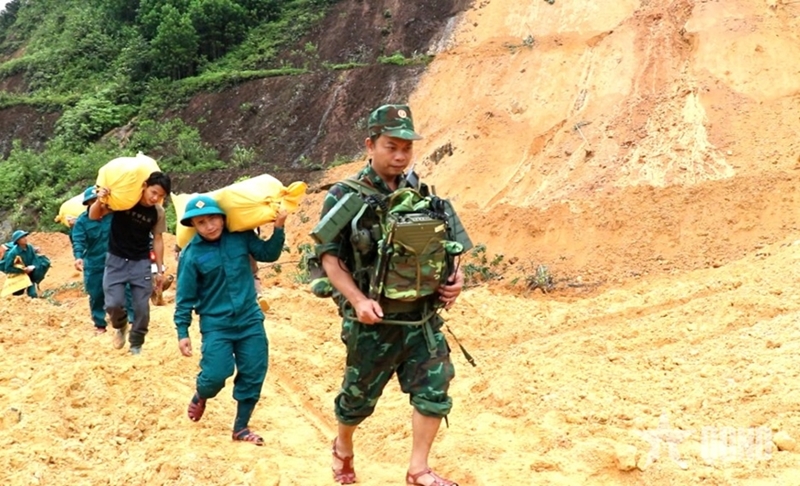
On the morning of November 1, the first relief convoy from the command set out with 50 boxes of dried rations, 300 kilograms of rice, 20 boxes of instant noodles, 15 kilograms of dried fish, along with cooking oil, fish sauce, and salt. Although the distance to To Po was only about 20 kilometers, the roads between villages and communes were severely eroded, with some sections submerged two to three meters deep, forcing the team to cut through dense forests in extremely difficult conditions. Carrying heavy loads along steep slopes and mud-covered trails, the soldiers had to support and pull one another through treacherous terrain. After more than half a day on foot, they reached a ferry, where the local militia used motorboats to ferry them across the Bung River.
To ensure safety, the soldiers wrapped their backpacks and gear in multiple plastic layers and divided themselves into small groups, making several crossings. They used bamboo poles and wooden sticks to push away floating branches and logs carried by the floodwaters, preventing them from striking and capsizing the boats.
|
|
 |
|
Despite having to cross mountain passes and climb steep slopes, each soldier carries 25–30 kilograms of food and essential goods to reach villagers. |
|
|
 |
|
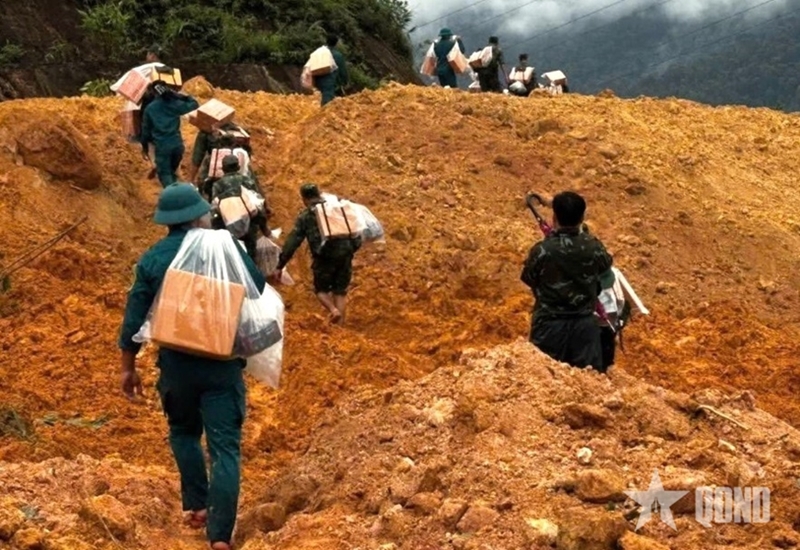
In areas affected by landslides, rescue forces must cut through forest paths to deliver aid to isolated communities. |
|
|
 |
|
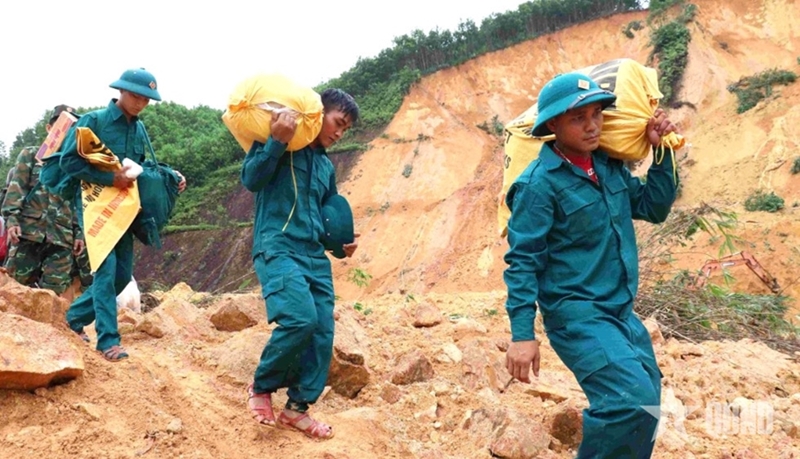
Militia members from Tra Tan commune transport rice and food supplies to residents of Hamlet 11 of Tra Tan commune. |
By around 10 p.m., the troops finally reached To Po, carrying supplies on their backs. Inside the stilt houses, villagers gathered around wood fires, cooking rice and chatting with the young soldiers. Beyond food and water, the troops also brought clothing, blankets, and medicine for coughs and colds.
For the ethnic minority communities living in the highland communes of Tra Tan, Tra Doc, Tra Leng, and Nam Tra My, floods and landslides that isolate entire villages near the year’s end are nothing new. Yet the recent historic flood still came as a shock. According to preliminary reports, since October 25, hundreds of houses have been swept away or buried by floods and landslides, 62 of them completely destroyed. Luckily, thanks to the early warnings and timely evacuation by soldiers and local militia, casualties were minimized.
From the second-floor balcony of the old Nam Tra My District’s Military Command's Headquarters, overlooking the village recently washed away by floodwaters, local resident Ho Van Nga said this year’s floods were terrifying. In just moments, eleven solid homes in Tra Giac and Hamlet 11 of Tra Tan commune, were swept into the Tranh River. Villagers were brought to the district headquarters by the Defensive Area Command Region 2-Thanh My for safety, where soldiers and militia worked tirelessly day and night to cook and care for everyone.
|
|
 |
|
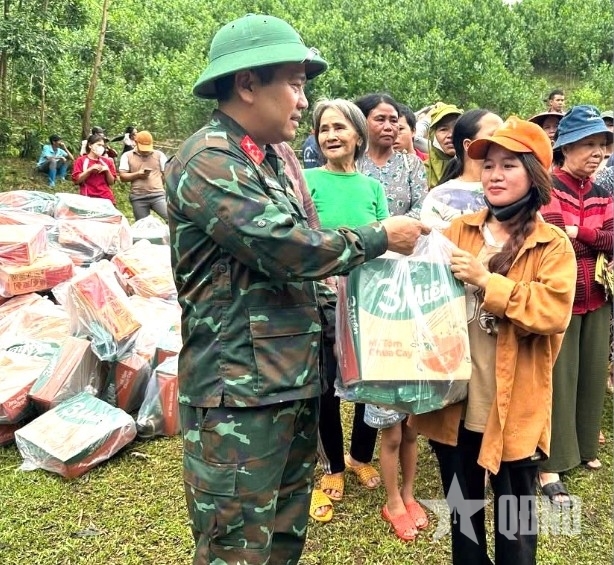
Soldiers from Military Region 5 present relief packages to people living in areas isolated by floods and landslides. |
On November 2, despite continued heavy rain, the command and the commune military commands divided their forces into smaller groups, heading in multiple directions to deliver food and other basic essentials to isolated areas. Some descended steep passes, others climbed rugged slopes or rowed across the Tranh, Leng, and Nuoc Xa rivers. Facing the constant threat of flash floods and landslides, they pressed on, determined to reach people as quickly as possible. Prolonged exposure to water and mud left many soldiers with rashes and swollen hands and feet, yet no one complained.
According to Colonel Dang Ngoc Toan, Head of the command, there were nearly 40 landslide points along National Road 40B and the inter-village roads leading to Tra Leng, Tra Tan, Tra Doc, and Nam Tra My. Engineers from Brigade 270 under Military Region 5 managed to clear five sites, but heavy rain continued to bring down soil and rocks, making access extremely difficult. For now, the forces would quickly survey and identify safe areas to build temporary shelters and prefabricated houses for families whose homes were swept away. Later, local authorities would plan permanent resettlement zones.
In the coming days, the troops and militiamen will continue opening routes, delivering supplies, and helping residents gradually recover from the disaster while staying ready to respond to any emergencies that may arise.
Translated by Tran Hoai