Most households of the Chut ethnic group, who have long settled at the foot of Giang Man Mountain, have now moved into solid, newly built houses. This year, people in Ka Ai border village are welcoming Tet more fully, no longer burdened by worries about floods, storms or harsh winter winds.
    |
 |
|
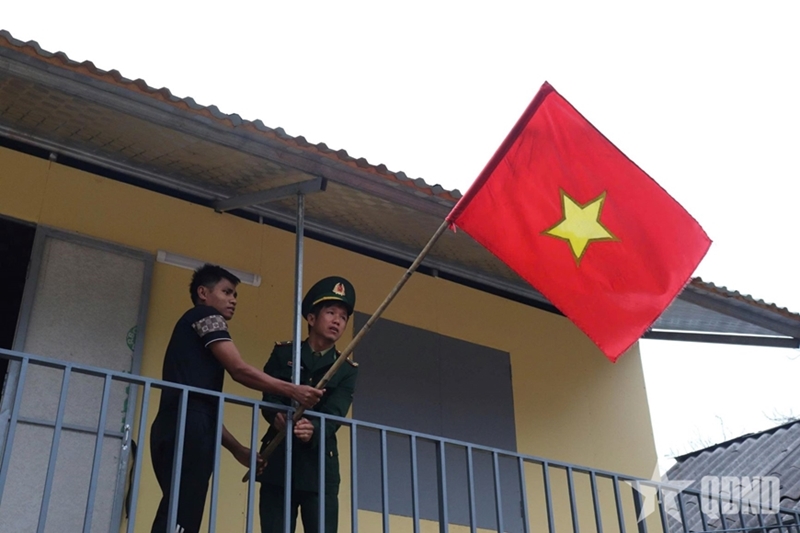
Border guard troop and local resident raise the national flag in preparation for the Lunar New Year. |
Ka Ai is home to 144 Chut ethnic households, located in rugged terrain with difficult travel conditions and a harsh climate. In the past, most families lived in temporary, dilapidated houses. Having a sturdy home that could withstand rain and wind was a long-cherished dream for local residents. Thanks to major policies of the Party and the State, the efforts of local authorities, and the close support of the border guard forces, that dream of the Chut ethnic people in Ka Ai village has now come true.
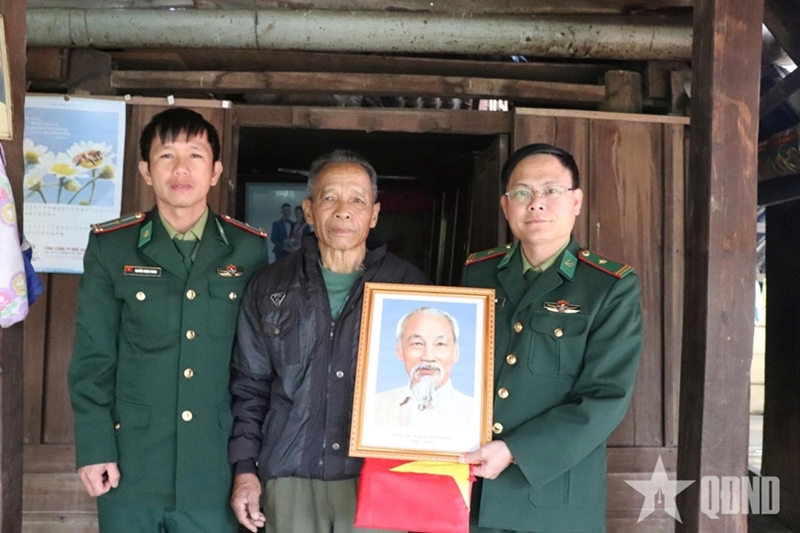
In a conversation, Ho Pheo, aged 75, a reputable figure in the village, said that “I have lived here my whole life and witnessed many changes, but never have people been as happy as this year. Most families now have new houses, people feel secure working and making a living, and children are no longer afraid of rain and storms. We are deeply grateful to the Party, the State, local authorities, and border guard troops.” His eyes reflected confidence and hope for a brighter future for the border village.
That joy is not limited to the elderly, but is spreading through young families as well. Ho Luong and his wife Ho Thi Dat are among those who moved into a new house just before the New Year. Holding her young child while tidying up, Dat shared: “Our old house was very run-down. Whenever it rained, we had to catch water, and on stormy nights no one could sleep well. Now we have a new house, we feel secure working and taking care of our children. This Tet will definitely be much warmer.”
For the Chut ethnic people there, a solid house is not only a shelter from rain and sun, but also a foundation for stabilizing life and looking toward a long-term future. This brighter picture stems from the Party and State’s deeply humane policy to eliminate temporary and dilapidated housing, with the synchronized involvement of all levels and sectors in Quang Tri province, in which the border guard forces play a core role.
Over the past year, the Quang Tri Provincial Border Guard Command has closely coordinated with local authorities, mobilized forces to stay close to the stationed area and directly participated in building houses for 126 households in Ka Ai village. Each house was designed to suit the living conditions, customs and practices of local residents, ensuring quality and long-term durability. Despite hardships, border guard officers and soldiers lived, worked alongside villagers, helping them move into their new houses in time for Tet.
|
|
 |
|
Elder Ho Pheo (center) feels happy witnessing the village’s new appearance. |
Directly overseeing the housing construction progress, Major Nguyen Thanh Trung, head of the border guard working group in Ka Ai village under the Border Post of Cha Lo International Border Gate, said, “Entrusted with this task by our superiors and driven by our affection for the people, I always urge contractors and construction teams to ensure proper techniques and quality. When people feel secure living and remain attached to their village, border security becomes stronger.”
In the days leading up to Tet, the image of border guard troops and villagers raising the national flag along inter-village roads and on the roofs of new houses has brought vibrant life to this border area. The national flag fluttering in the early sunlight stands out vividly in the new “picture” of Ka Ai village
Alongside housing support, the Quang Tri provincial border guard force has also carried out a number of models to help local people develop the economy and achieve sustainable poverty reduction. Notably, they reclaimed land, encouraged villagers to cultivate five hectares of wet rice. To date, the Chut ethnic people have gradually mastered new farming methods and become more pro-active in ensuring food security.
A new spring has arrived in Ka Ai village. In their new houses, local residents gather around the fire, talking about livelihoods and ensuring their children’s school attendance. The new “picture” of Ka Ai village is a testament to change, prosperity, peace, and trust.
Translated by Chung Anh