At the campaign’s summary conference on the morning of January 16, Prime Minister Pham Minh Chinh described its significance in vivid terms: although Quang Trung Campaign involved no gunfire, it advanced swiftly and decisively, achieving what he called a “resounding victory.” Beyond the number of completed houses, the success demonstrates national solidarity and effective coordination across the political system, with the armed forces central to serving the people.
    |
 |
|
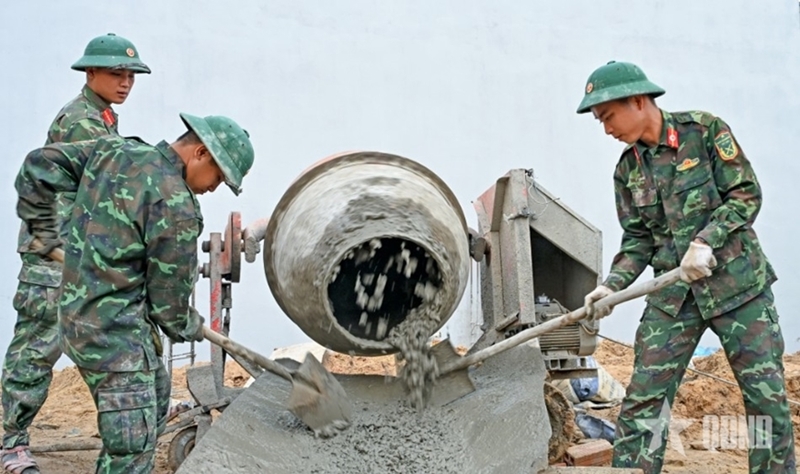
Soldiers of Army Corps 34 carry out “Quang Trung Campaign,” helping residents rebuild houses destroyed by floods. |
Ahead of the lunar New Year (Tet), the campaign's impact resonates in Central Vietnamese villages once devastated by storms. At a newly finished house, a mother watches her child play in a dry, stable space. For this family, the new house is more than shelter; it restores their fundamental sense of security.
Quang Trung Campaign redefines disaster recovery, transforming housing for flood-prone areas from charitable relief into a strategic social security task. In a nation vulnerable to climate change, rebuilding is no longer temporary aid but an integral part of national resilience. Executed with military discipline, the campaign met strict deadlines to ensure families could welcome the Tet in new houses by January 15, a symbolic milestone of renewal and stability.
Efficiency was driven by what Prime Minister Pham Minh Chinh described as "swift and decisive action" rooted in empathy. Speed was essential to minimize insecurity for the vulnerable before the next monsoon season. The Vietnam People’s Army played a pivotal role, transitioning from emergency rescue to hands-on reconstruction. Soldiers worked alongside residents to complete structures, reinforcing the "people’s heart posture," a profound bond between the military and the public.
This mission proves that social stability grows when citizens trust the institutions serving them. Each house, built with technical guidance from the Ministry of Construction and 486.2 billion Vietnamese dong mobilized via the Vietnam Fatherland Front, serves as a foundation for long-term development. By standardized planning and collective solidarity, the campaign has moved beyond improvised responses to create a sustainable model for national disaster preparedness.
|
|
 |
|
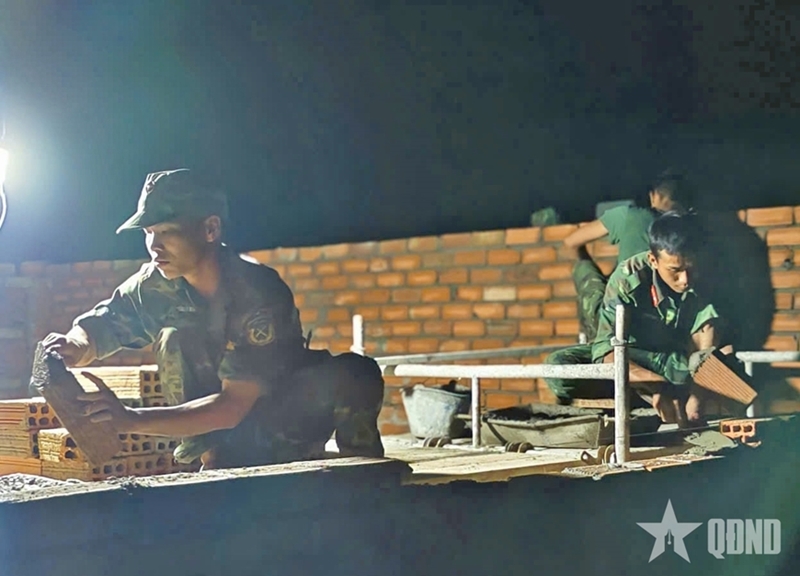
Officers and soldiers of Military Region 5 work day and night to actively build houses for the people. |
Viewed more broadly, Quang Trung Campaign stands as evidence of national governance capacity in times of crisis. Sustainable development requires more than economic growth; it demands the ability to withstand and recover from shocks. Such capacity is tested most clearly in moments of hardship. By meeting that test, the campaign became a symbol of a Vietnam that acts decisively, values compassion, and relies on discipline and unity to overcome challenges.
When the final houses were completed, families received more than physical shelter. They gained a renewed sense of protection, support, and companionship. That feeling forms the basis of social trust, an invisible but enduring source of strength. In the light of the approaching Tet, each new house stands as a reminder that while disasters can damage landscapes, they cannot erode solidarity or compassion. Quang Trung Campaign, a “victory without gunfire,” achieved its greatest success not on any battlefield, but in the hearts of the people.
Translated by Tran Hoai