Border areas of Quang Ninh province are home to the Dao, Tay, Hoa, and San Chi ethnic groups. Due to divided terrain, difficult transport conditions, and uneven educational levels, local lives remain fraught with difficulties. In response, Defense-Economic Unit 327 has stuck close to the grassroots level, coordinating with local party organizations and authorities to implement projects for poverty reduction and cultural life development.
    |
 |
|
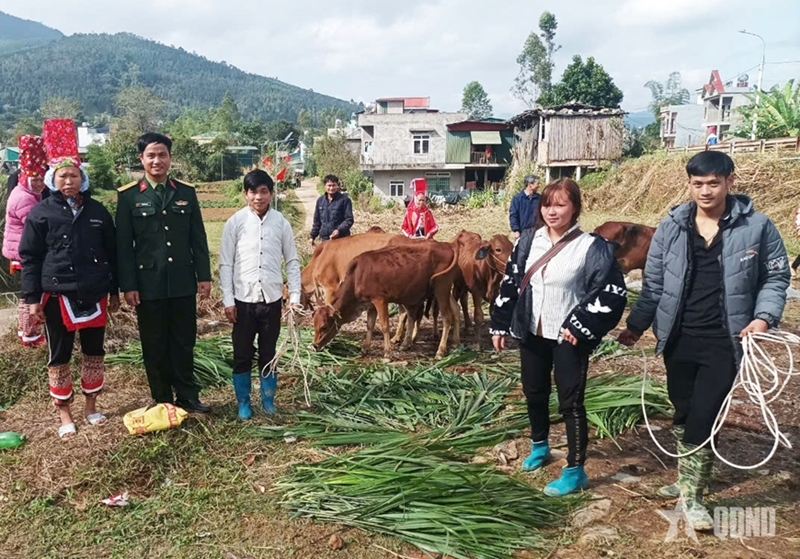
Officers of Forestry Enterprise 156 of Defense-Economic Unit 327 present breeding cows to locals in Hoanh Mo commune, Quang Ninh province. |
A typical example is the family of Chieu Tai Mui from Dao ethnic group in Ngan Meo village, Luc Hon commune. He had long dreamed of owning a cow for livelihood but could not afford one. Recently, Mui was overjoyed to receive a breeding cow worth VND 15 million from Forestry Enterprise 156 of Defense-Economic Unit 327. Mui shared that when the soldiers informed him about the gift, he renovated the land and built a spacious new barn. The abundant food source here would help the cow grow fast without requiring too much labor.
Sharing Mui’s joy, 62 other near-poor ethnic households in Luc Hon commune also received breeding cows. Colonel Pham Xuan Kha, Political Officer of Forestry Enterprise 156, stated that after providing the cows, the unit organized a training course on reproductive breeding techniques for the recipients. Recently, as the weather turned cold, the unit regularly sent officers and young volunteer intellectuals to guide local people on cold protection and disease prevention for the cattle.
Recently, Defense-Economic Unit 327 has effectively implemented various models such as breeding cows, pigs, and goats, alongside the “Paving the way to school” program. Senior Colonel Kim Ngoc Hinh, Political Chief of Defense-Economic Unit 327, said that they have worked closely with local authorities and mass organizations to implement economic support projects, helping mobilize additional resources to assist local people. Beyond state-funded projects, forestry enterprises have leveraged internal resources to build practical models. Lieutenant Colonel Nguyen Van Dao, Mass Mobilization Assistant of Defense-Economic Unit 327, stressed that the enterprises have proactively surveyed local customs, climate, and soil conditions to select suitable breeds and crops. Thanks to this, poverty reduction models have yielded sustainable results over a long period.
With the motto “Talk for people to understand, do for people to trust, guide for people to follow,” the Party Committee and chain-of-command of Defense-Economic Unit 327 have directed production teams and forestry enterprises to stand side-by-side with residents in areas where they are stationed. Officers have become “agricultural engineers” in highland villages, guiding locals in applying scientific and technical advances. Over the past 10 years, dozens of models for growing hybrid rice, hybrid corn, oyster mushrooms, red-fleshed dragon fruit, anise, and cinnamon have been carried out successfully. These efforts have helped border families escape poverty, transformed the appearance of the Northeastern border region, and strengthened the military-civilian ties.
Translated by Minh Anh