They include a tactical reconnaissance and target-designation unmanned aerial vehicle (UAV), smart ammunition currently undergoing testing, 40mm naval gun ammunition, and 125mm hypervelocity armor-piercing ammunition.
Four products developed to meet practical operational requirements
This year's exhibition marks the second time the Institute of Technology has participated in the Viet Nam Defense Expo. At the 2024 edition, its semi-automatic mortar module demonstrated the potential of applying automation to equipment that traditionally requires numerous manual operations. Previously, the mortar crew had to carry and assemble three separate components. Once integrated into a single unit with a control system, however, the equipment can automatically calculate firing data as soon as the operator enters the coordinates.
    |
 |
|
Senior Colonel Le Dai Phong, Deputy Director of the Institute of Technology |
At this year's exhibition, the institute will showcase a broader range of products, from reconnaissance platforms to ammunition designed for different missions. According to Senior Colonel Le Dai Phong, Deputy Director of the Institute of Technology, preparations for the exhibition have involved assigning relevant departments to review product quality, prepare explanatory documents and illustrative images, and arrange personnel to help visitors better understand the functions of each displayed item.
One of the new products on display will be a tactical reconnaissance and target-designation UAV. Designed by the institute's own technical staff, the UAV has successfully completed flight tests, building on experience accumulated through missile research.
UAVs come in various types depending on their intended applications. Therefore, mastering the design of one UAV model is a necessary step toward developing other types to meet the military's requirements.
While the reconnaissance UAV represents a new breakthrough in unmanned technologies, the smart ammunition project stems from the urgent requirement to counter small aerial targets. Some UAVs are no larger than birds, whose compact dimensions and high maneuverability make them exceedingly difficult to hit.
To address this challenge, the research team proposed the concept of ammunition that detonates upon approaching the target, creating a controlled fragmentation zone to increase the kill probability. Consequently, the ammunition’s effectiveness no longer heavily depends on direct impact. The product is currently undergoing testing.
In fact, this research direction was conceptualized years ago, but was hindered by technological limitations at the time. It was not until 2023, when technological prerequisites were met, that the institute embarked on smart munition research. Showcasing this prototype at the expo provides an opportunity to introduce the cutting-edge applications the unit is pursuing.
The other two products are the ĐP-40-L70-PSTC-VĐ 40mm naval gun ammunition and the ĐP-125-XVT 125mm hypervelocity armor-piercing ammunition. Notably, the institute has mastered the design and manufacture of the 40mm naval gun ammunition, with its own personnel handling the whole process, from calculations and design to manufacturing. The ammunition is primarily intended for low-altitude air defense, while also being capable of suppressing direct-fire weapons on enemy warships and engaging maneuvering surface targets.
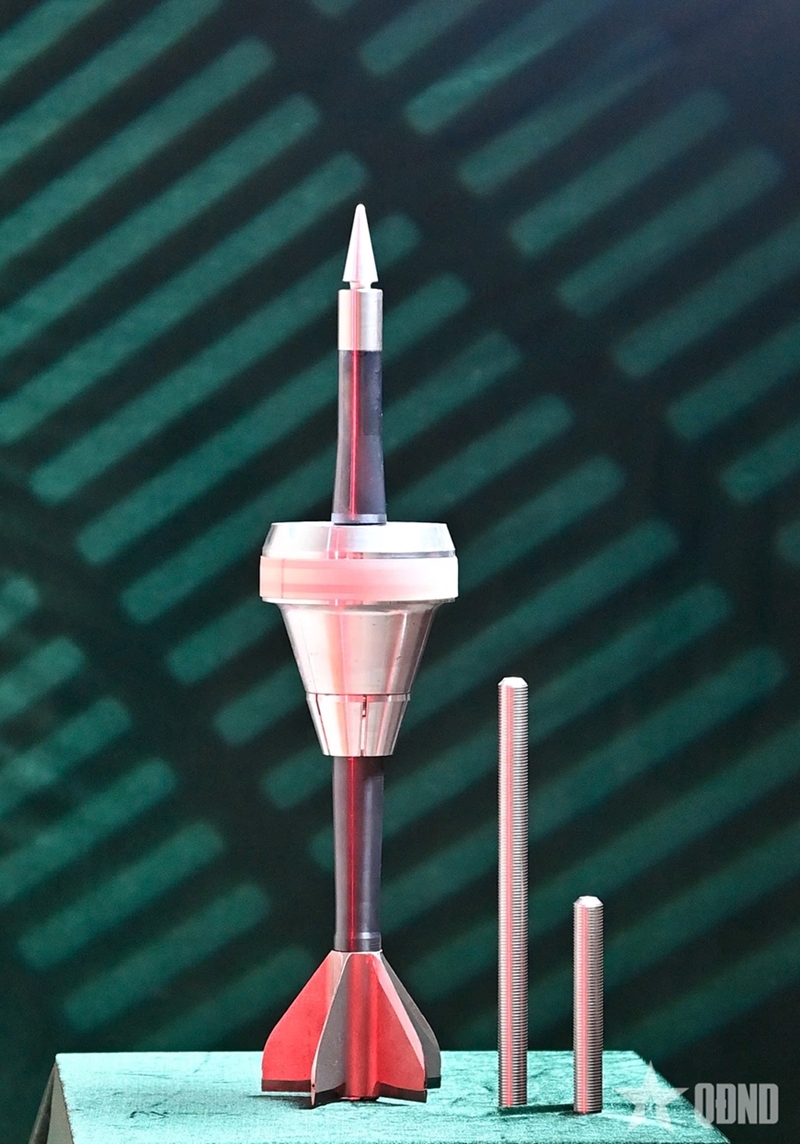
Meanwhile, the 125mm hypervelocity armor-piercing ammunition features a discarding-sabot penetrator and is designed for direct-fire engagement of tanks, self-propelled artillery and heavily armored targets. Both types of ammunition have passed acceptance tests at the General Department level.
These products demonstrate that, from reducing manual operations in mortar systems to designing UAVs, manufacturing artillery ammunition and developing smart munitions, the institute's research is consistently driven by specific operational requirements of troops in the field.
Bridging gap between exhibition displays and cooperation opportunities
At the 2024 exhibition, alongside showcasing its semi-automatic mortar module and radar systems, the Institute of Technology established connections with many foreign partners. These meetings provided additional contacts for sourcing components at reasonable prices.
Building on this experience, the institute expects its participation this year to further expand opportunities for exchanges with partners, both in terms of immediate supply capabilities and prospects for long-term cooperation.
During technical discussions on UAVs, the institute hopes to share its product development experience while learning about advances in areas of interest, including strong yet lightweight airframe materials, electronic systems and electronic warfare systems for UAVs. These exchanges will also enable the institute to assess the capabilities of individual partners and consider incorporating suitable companies into its supply chain.
For large-scale research projects, pooling adequate human resources and funding always poses a challenge. Research teams must deliver preliminary outcomes to demonstrate feasibility before proposing larger-scale investments. Therefore, every testing session and every discussion with partners yields practical experience essential for perfecting products.
|
|
 |
|
The ĐP-125-XVT 125mm hypervelocity armor-piercing ammunition |
Having increased its exhibition lineup from two products at the Viet Nam Defense Expo 2024 to four this year, the Institute of Technology aims to showcase at least 10 high-tech products at the 2028 exhibition.
Alongside expanding the number of products, the institute also seeks to increase their technological sophistication and level of integration. "The foremost requirement is to meet the needs of the military," Senior Colonel Le Dai Phong emphasized.
This principle also serves as the basis for the institute's selection of research directions, product development and efforts to identify partners to accompany it on the path toward gradually mastering advanced technologies.
Translated by Quynh Oanh