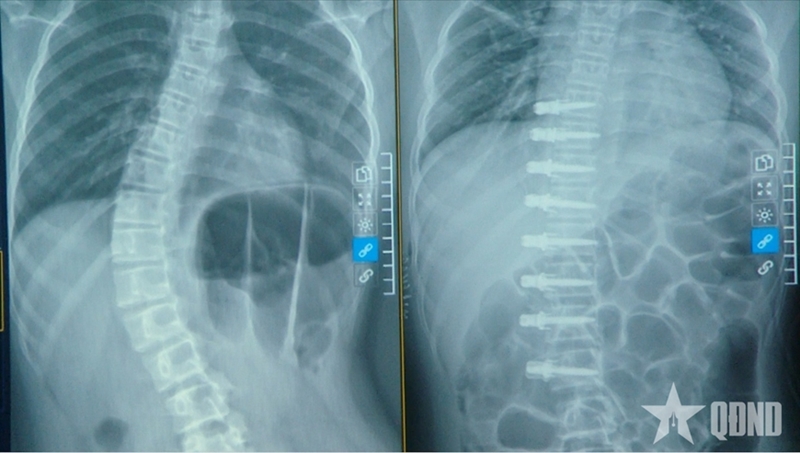
The patient is a girl born in 2014 from Bac Ninh city who had previously been in good health. In recent months, her family noticed that her shoulders had become asymmetrical, her torso had become deformed, her gait had been unbalanced, and her spinal curvature had become increasingly pronounced. Following clinical examinations and X-rays, doctors diagnosed her with thoracolumbar scoliosis, with a Cobb angle of 48 degrees from T7 to L2. The significant deformity carried a risk of further progression, and surgical treatment was indicated for consideration.
    |
 |
|
X-ray images of the patient’s spine before and after surgery |
The family brought the patient to Military Central Hospital 108 in search of an effective treatment that could improve her physical appearance while minimizing the impact on mobility and long-term development.
After a direct examination and comprehensive assessment, Senior Colonel, Dr. Phan Trong Hau, Head of the Spinal Surgery Department, found that the patient was at Sanders stage 5 of skeletal maturity and still had some growth potential. Considering the characteristics of the curve and her skeletal maturity, the doctors selected VBT, a non-fusion spinal correction technique. After receiving thorough advice on its benefits, risks and requirements for long-term follow-up, the family agreed to the procedure.
Curve correction of nearly 80% after surgery
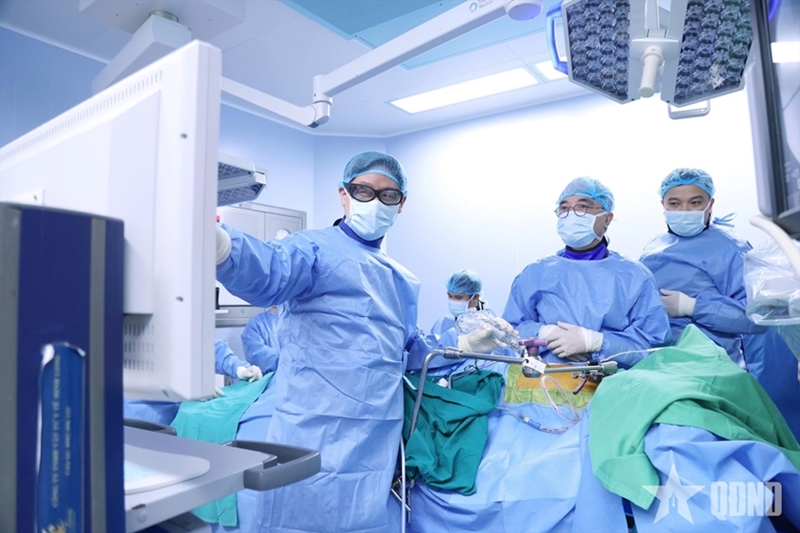
Following careful preparation and surgical planning, the team led by Senior Colonel, Dr. Phan Trong Hau performed the VBT procedure. The technique requires high precision in placing screws into the vertebral bodies, controlling the tension of the tether and determining the appropriate level of correction. Surgeons must also take the patient’s remaining growth potential into account to minimize the risk of overcorrection.
|
|
 |
|
Doctors at the Military Central Hospital 108 perform the surgery. |
The surgery was successful, with highly positive initial results. The Cobb angle from T7 to L2 decreased from 48 degrees before surgery to about 10 degrees afterward, representing nearly 80-percent curve correction. The spinal axis improved significantly, and the patient’s torso became more symmetrical. Importantly, the correction was achieved without spinal fusion, helping preserve mobility in the treated spinal segments.
As the patient is at Sanders stage 5 of skeletal maturity, she still has some growth potential. Doctors expect this remaining growth to contribute to further correction of the spinal deformity. However, she will need regular monitoring of the Cobb angle, skeletal maturity and condition of the tether, as well as the risks of overcorrection or loss of correction.
Senior Colonel, Dr. Phan Trong Hau said that in conventional scoliosis surgery, doctors generally use screw-and-rod systems to correct spinal deformities and spinal fusion to maintain long-term correction. Once spinal segments are fused, however, relative movement between the vertebrae is lost.
In contrast, VBT uses screws placed in the vertebral bodies on the convex side of the spinal curve and connected by a durable artificial tether. By adjusting the tension of the tether, surgeons can correct the curve during the operation.
The technique also takes advantage of the principle of spinal growth modulation. Relative compression on the convex side can slow growth on that side, while the concave side continues to grow, thereby contributing to further correction of the deformity as the child matures. According to Senior Colonel Phan Trong Hau, the key advantages of VBT are that it eliminates the need for spinal fusion, preserves mobility in the treated segments and allows children to continue their natural growth.
|
|
 |
|
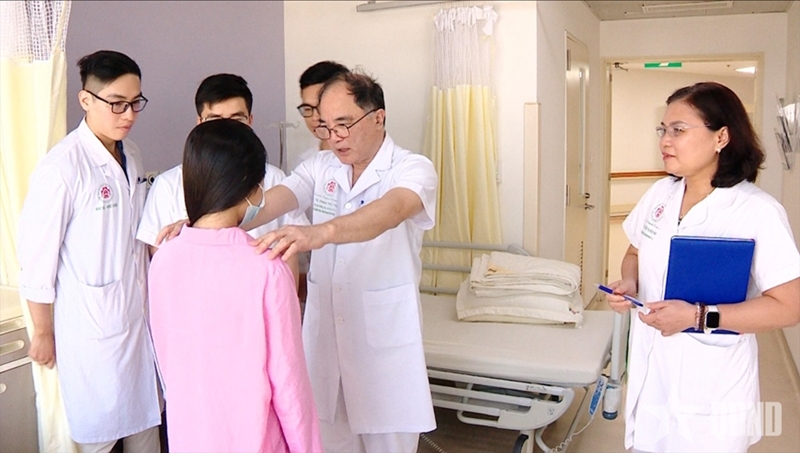
A doctor checks the patient’s condition after surgery. |
A new step in spinal surgery in Viet Nam
Scoliosis is a complex condition that is often idiopathic. It can involve structural abnormalities, vertebral deformities and congenital malformations. Because the spine contains and protects the nervous system, one of the major concerns during spinal surgery is nerve injury, which can lead to paralysis. The favorable initial outcome brought great joy to the patient’s family.
For the doctors, the success of the surgery means more than a significant improvement in the spinal curve shown on X-rays. It also offers an opportunity to preserve spinal mobility and allow the pediatric patient to continue developing with a more flexible spine.
The successful performance of the first VBT surgery in Viet Nam marks a step forward in the application of advanced techniques for treating spinal deformities at Military Central Hospital 108. It also provides an additional treatment option for young patients with appropriate indications.
Correcting spinal deformities without sacrificing spinal flexibility is the key value of VBT, offering a modern treatment approach for children with idiopathic scoliosis, particularly those who still have significant growth potential.
Translated by Minh Anh