“Serving the people!” is the guiding principle laid down by President Ho Chi Minh, who named the newspaper. Since its first issue was published on October 20, 1950, in the Dinh Hoa Safe Zone (ATK Dinh Hoa) in Thai Nguyen province, the PAN has remained steadfast in upholding this principle. The newspaper’s birth under such special circumstances demonstrated the profound importance President Ho Chi Minh attached to ideological and cultural education for the people, particularly the Viet Nam People’s Army (VPA), a loyal soldier of his thought, imbued with the spiritual strength and faith of the Communist Party of Viet Nam (CPV).
    |
 |
|
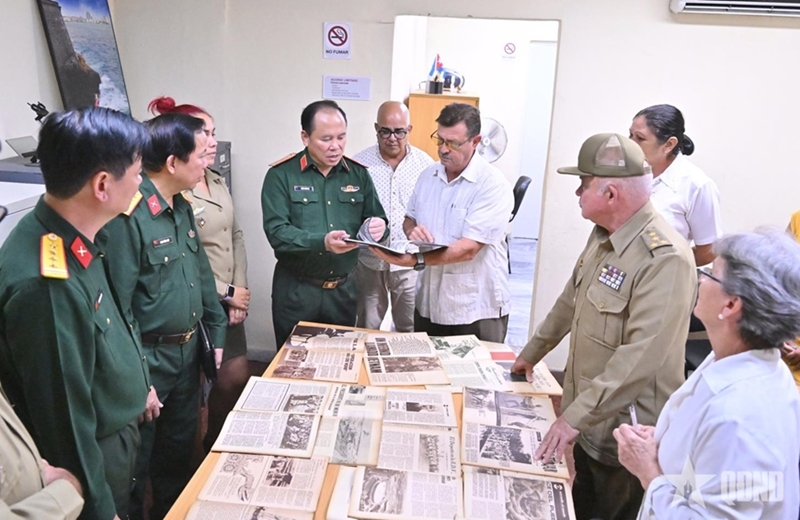
A delegation from the PAN explores publications by Verde Olivo Publishing House, including numerous works on Viet Nam, September 2025. |
To grow into what it is today, one of the outstanding symbols of Viet Nam’s revolutionary press, the PAN has built up a glorious record in the struggle for national liberation and the cause of national construction and defense. Its journalists have always been present on the front lines, becoming faithful chroniclers of revolutionary history and the epic struggle of the Vietnamese nation. Their news reports, features and interviews stand as vivid testimonies, enriching the sacred memory of the nation and the VPA. The PAN’s heroic journalists who laid down their lives have become shining examples of loyalty, resilience and sacrifice for the newspaper, the military and the people.
José Martí, Cuba’s national hero, who devoted his extensive journalistic career to the struggle for independence, once wrote, “A journalist also possesses many of the qualities of a soldier.” This statement encapsulates the virtues of revolutionary journalists: courage, boldness and unwavering dedication to their profession. These qualities become even more noble when journalists serve the cause of a nation fighting an armed struggle and standing ready to face every danger, including threats to their own lives.
Viet Nam and Cuba share a valuable legacy in the establishment of press institutions serving revolutionary armed struggles. One distinctive tradition that comes to mind is that of El Cubano Libre, a newspaper that went through three periods of publication. Initially, it served as the voice of the Liberation Army during the wars of independence against the Spanish colonial rule. It later became the mouthpiece of the Rebel Army during the final stage of the national liberation struggle.
|
|
 |
|
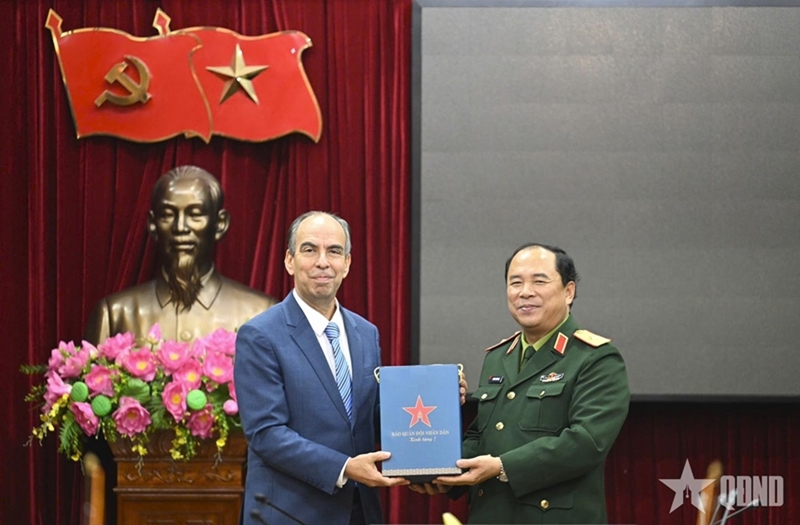
Major General Doan Xuan Bo presents a gift to Ambassador Rogelio Polanco Fuentes during his visit and working session at the PAN, December 2025. |
Major General Antonio Maceo of the Liberation Army during the wars of independence once likened the newspaper to “a corps comprising twelve columns of print, fighting day after day and fighting valiantly for the cause of Cuba.” Later, when the newspaper was revived to disseminate the ideas and activities of the Rebel Army in Sierra Maestra, Commander Ernesto Che Guevara described it as “a voice calling for victory or sacrifice.”
Building on the legacy of El Cubano Libre, as well as the Cuban people’s revolutionary struggle and the traditions of revolutionary journalism, Verde Olivo, the magazine of the Cuban Revolutionary Armed Forces, was established just months after the victory of the Cuban Revolution. It subsequently developed into a publishing house specializing in historical, patriotic and military publications.
As part of the profound bonds between our two peoples, we take great pride in the Cuban journalists who reported from the Vietnamese battlefield during the years when the Vietnamese people courageously fought against the U.S. imperialists. Journalists such as Marta Rojas and Raúl Valdés Vivó, together with filmmakers Santiago Álvarez, Julio García Espinosa and José Massip, produced an extensive body of works exposing the crimes committed by foreign invaders and celebrating the epic struggle waged by the Vietnamese people and their heroic VPA.
Our generation bears a great responsibility for preserving and passing on the historical memory of the proud solidarity between our two peoples forged in struggle. This ensures that future generations of Cuba and Viet Nam will continue to draw inspiration from the countless noble acts of courage and unconditional solidarity that have shaped relations between our two countries, while serving as enduring pillars of Cuba–Viet Nam brotherhood.
Over the years, the PAN has maintained cooperative relations with Cuban press organizations, particularly those associated with the Revolutionary Armed Forces. These exchanges have focused on improving the effectiveness of defense journalism and preserving historical memory. In September 2025, a PAN delegation led by its Editor-in-Chief Major General Doan Xuan Bo visited Havana for a working trip. The delegation held discussions with leaders of the Union of Journalists of Cuba (UPEC) on journalism in the defense sector and the modernization of revolutionary press organizations. During the visit, the delegation also met with leaders of Verde Olivo Publishing House to exchange views on political communication strategies, ideological education within the armed forces and opportunities for joint publication of historical works.
More recently, PAN leaders received a delegation from the Latin American news agency Prensa Latina, led by its President Jorge Legañoa Alonso. At the meeting, both sides agreed to further step up information exchanges, coordinate coverage of defense-related events and strengthen international multimedia integration. Bilateral cooperation has also expanded to Cuban digital platforms such as Ideas Multimedios and Cubadebate, enabling both sides to share experience in digital journalism, podcast production, infographic design and the application of advanced technologies to information and communications work.
In a world undergoing dizzyingly rapid technological change, with direct and far-reaching impacts on the socio-economic development of each country, we are also facing increasingly intense waves of disinformation and media manipulation designed to undermine our societies and political systems. Against this backdrop, press organizations in both countries need to strengthen cooperation in a more practical, effective, coordinated and comprehensive manner, thereby contributing to the successful fulfillment of the task assigned by General Secretary and State President To Lam to Vietnamese press organizations, including the PAN: “building a loyal, professional, humane and modern revolutionary press in Viet Nam.”
Over the past years, the PAN has consistently followed and reported on visits to Viet Nam by delegations of the Cuban Revolutionary Armed Forces, as well as visits to Cuba by leaders and senior officers of Viet Nam’s Ministry of National Defense. We also greatly appreciate the newspaper’s regular coverage of the historical ties between our two countries and activities reflecting their special friendship, traditional solidarity and comprehensive cooperation.
We express our profound gratitude to the Party, State, Army and people of Viet Nam for their steadfast and unwavering solidarity with Cuba at international forums, as well as for their valuable cooperation in areas such as agricultural production, food security and energy, alongside widespread campaigns of public support. This solidarity is an invaluable source of encouragement for Cuba and once again affirms the just nature of the cause we are pursuing. We highly appreciate the PAN’s continued attention to the Cuban people’s struggle against the U.S. economic blockade and embargo. The increasingly harsh restrictions have added to the hardships facing the Cuban people in their daily lives. We hope the newspaper will continue to give due attention to this issue.
We are confident that the PAN will continue to perform its information and dissemination tasks effectively and make important contributions to achieving the goals set for the centenary of the founding of the CPV (1930–2030) and the centenary of the founding of the Socialist Republic of Viet Nam (1945–2045). It will contribute to Viet Nam’s development into a prosperous, civilized and happy socialist country with an increasingly important role in the region and the world.
By Rogelio Polanco Fuentes
Ambassador Extraordinary and Plenipotentiary of the Republic of Cuba to the Socialist Republic of Viet Nam
Translated by Quynh Oanh