The decision was made under exceptionally critical circumstances after the first transplanted heart suffered complete functional failure with no signs of recovery. The patient developed multiple organ failure and faced a fatal prognosis.
The 50-year-old man was admitted with end-stage heart failure caused by dilated cardiomyopathy. Despite optimized medical treatment, his left ventricular ejection fraction had fallen to just 22%. Before surgery, his condition continued to deteriorate, with repeated episodes of acute heart failure, persistent shortness of breath, and chest pain, posing a direct threat to his life if a heart transplant was not performed in time.
    |
 |
|
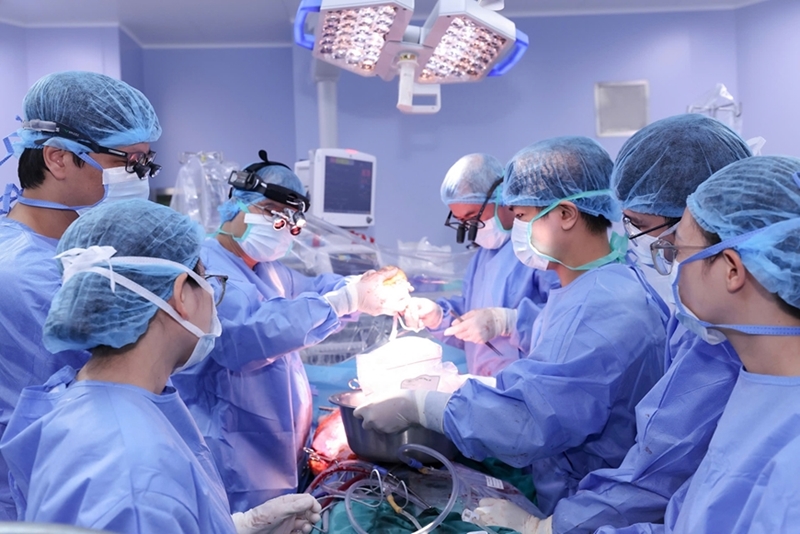
Doctors perform the second heart transplant on the male patient shortly after the first. |
On July 25, the patient received a heart transplant from a brain-dead donor. In the first hours after surgery, his condition was relatively favorable. After the aortic cross-clamp was released, the donor heart began beating again with good myocardial contractility. His hemodynamics were stable, requiring only low doses of inotropic and vasopressor medications, with no need for ECMO support. Bleeding was well controlled.
However, less than 24 hours later, the transplanted heart began showing signs of severe and complex dysfunction. Its contractile function was almost completely lost, forcing doctors to provide full circulatory support with ECMO, combined with left ventricular venting. The patient was diagnosed with primary graft dysfunction and faced an extremely poor prognosis.
Over the following 48 hours, despite intensive treatment, the transplanted heart showed no signs of recovery. His condition progressed to multiple organ failure, with a fatal prognosis.
At that point, two days after the first transplant, Military Central Hospital 108 received a brain-dead multi-organ donor. Following an assessment, the donor heart was classified as an expanded-criteria organ and was considered unsuitable for all other heart transplant candidates on the waiting list.
Sr. Col., Dr. Ngo Vi Hai, Head of the Department of Thoracic Surgery and leader of the heart transplant team, said the decision was extremely difficult. The donor heart was not ideal: its left ventricle was significantly thickened due to the donor's history of hypertension and renal failure, while echocardiographic indicators were also concerning. Meanwhile, the recipient was critically ill with multiple organ failure and faced great difficulty undergoing another major operation.
With the first transplanted heart showing no recovery after 72 hours and the patient was certain to die without further intervention, Military Central Hospital 108 convened an emergency consultation involving leading specialists.
Maj. Gen., Associate Professor, Dr. Pham Thai Giang, Deputy Director of the hospital, said that performing a second heart transplant on the same patient was perhaps the first procedure of its kind in Viet Nam. The second transplant was significantly more challenging because the patient had already undergone a complex operation, developed multiple organ failure, and required emergency surgery.
Following consultation and assessment, the hospital decided to use the newly-donated heart for a second transplant.
On July 28, the second heart transplant was performed while the patient was suffering from severe multiple organ failure. The procedure required close coordination among the anesthesia, intensive care, and perfusion teams. According to Dr. Ngo Vi Hai, the recipient's tissues were no longer intact after the first transplant, making the surgical procedure considerably more difficult.
Sr. Col., Dr. Ngo Dinh Trung, Director of the Intensive Care Center at Military Central Hospital 108, said the patient's condition has since improved significantly. He is now conscious, responsive, and participating in rehabilitation activities, including standing, sitting in a chair, and cycling exercises. His organ functions are gradually recovering, although he still requires close monitoring and continued treatment.
Performing two heart transplants on the same patient within just a few days is an exceptionally rare situation. The success of the second procedure resulted from several factors, including the timely availability of a brain-dead donor, rapid coordination across the hospital, multidisciplinary consultation, and the determination to find a chance of survival for the patient.
Col., Dr. Ngo Tuan Anh, Head of the Department of Cardiovascular Surgery, said the recovery of the second transplanted heart brought enormous relief to the medical team.
The road to recovery remains long. But for a patient who stood on the brink of life and death and underwent two heart transplants within just a few days, each step taken today by him signals that the difficult decision made on July 28 has opened a new chance at life.
Translated by Tran Hoai