In a nation struggling to recover from ethnic conflicts, peace is more than the absence of gunfire. It is an enduring journey built on sacrifice, resilience, and a multi-generational aspiration for reconciliation.
During my U.N. peacekeeping mission at MINUSCA, I witnessed "green shoots" of hope in the Central African Republic. Bangui's landscape is changing: presidential elections were successful, the judicial system is progressing, and major roads now feature traffic lights. As the mission returns strategic areas to the government, ceasefire agreements have facilitated dialogue with armed groups, allowing tens of thousands of refugees to finally return home after years of displacement.
    |
 |
|
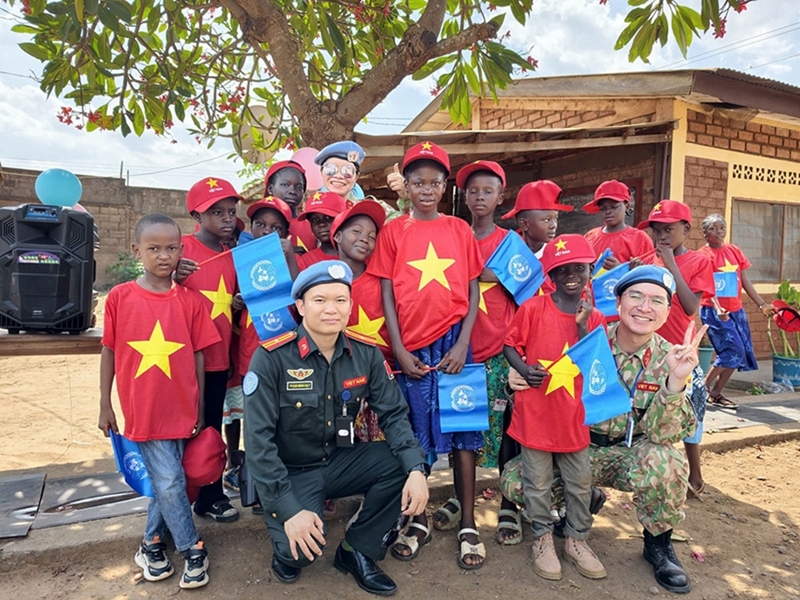
Vietnamese peacekeeping officers with children in the Central African Republic |
Behind recent progress lies the challenge of building a government based on national unity. Across 600,000 square kilometers, security remains fragile for six million people, leaving civilians in heartbreaking hardship.
Instability in the Central African Republic stems from ethnic conflicts, coups, and economic collapse. Since its 1960 independence, the nation has faced near-continuous turmoil. Devastating civil wars starting in 2012 displaced millions and crippled production, leaving the country among the world’s three poorest on the U.N. Human Development Index (HDI). Paradoxically, its vast gold and diamond reserves have rarely benefited ordinary citizens.
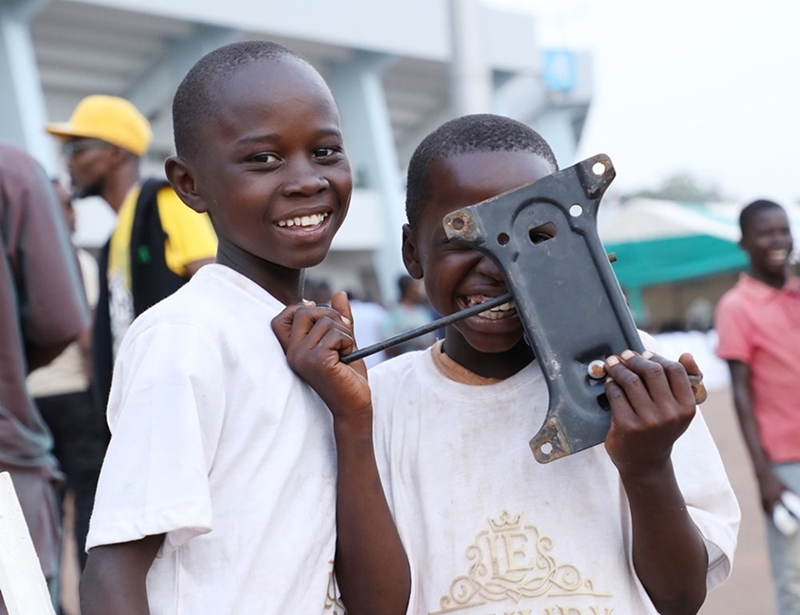
Children suffer most from this instability. According to a 2024-2026 report by UNESCO and UNICEF, the education system is in crisis. Only 40 percent of girls and 58.4 percent of boys complete primary school; at the upper secondary level, these figures plummet to 9.2 percent and 14.6 percent, respectively. Many children work from dawn to help families survive. Nine-year-old Malekatcha mimics taking photographs with a piece of metal, while ten-year-old Mamadou Youssouf carries a weighing scale featuring faded football stars. Fourteen-year-old Djouma Ali Bani balances a full basin of popcorn at dusk, his only wish a successful sale.
The government continues seeking stability, yet true peace exceeds official statistics. It exists when farmers work without fear and checkpoints vanish. Peacekeeping missions and government forces must create "safe spaces" for trust, secure trade, and stable prices. Peace means children carrying schoolbags instead of weapons, supported by disarmament and reintegration programs that offer former young fighters sustainable livelihoods. Above all, it requires reconciliation to break the cycle of illiteracy and poverty.
In Bangui, simple concerns like electricity or water highlight the disparity. During blackouts, I often long for the comforts of Vietnam, which were secured through generations of sacrifice. Vietnam’s development serves as a testament to the rewards of peace and stability. Today’s younger generation enjoys advanced education and a social welfare system ensuring "no one should be left behind," a vivid expression of the national unity deeply woven into the Vietnamese identity.
|
|
 |
|
The struggle for survival is far from easy for children living in a conflict-ridden nation. |
Witnessing a nation torn by conflict, I have learned that ideological and territorial divisions consume national strength in civil war. Peace is more than the absence of gunfire; it is a daily choice for every citizen. Its immeasurable value can only be sustained when individuals cultivate solidarity, national pride, and self-reliance.
From distant Bangui, as I look toward my homeland during these radiant, sun-drenched April days, I carry with me the smile of little Malekatcha. I hope that one day, the small hole in his scrap metal will become the lens of a modern camera, capturing a peaceful and flourishing Central African Republic free from gunfire.
True peace begins with our ability to protect and nurture the dreams of children.
By Dang Thu Ha (From the MINUSCA, Central African Republic)
Translated by Quynh Oanh