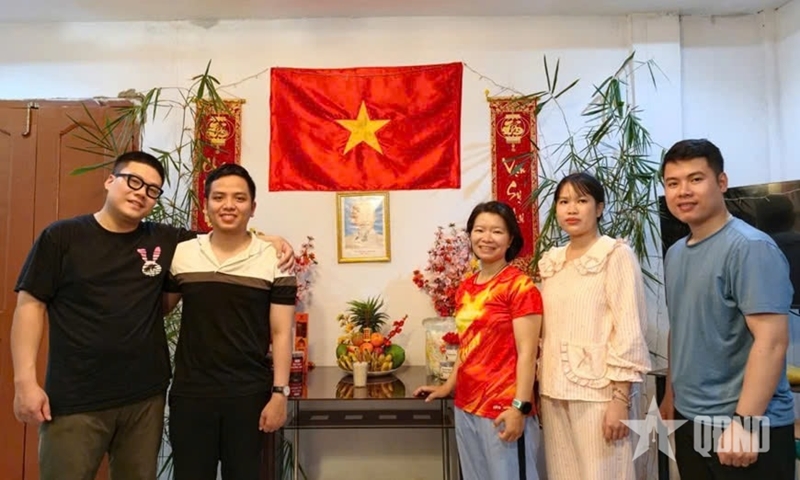
As Tet approached, the shared residence of the Vietnamese task force grew lively with preparation. An altar dedicated to President Ho Chi Minh was respectfully arranged. The red flag was hung with pride. A five-fruit tray was set out, paper peach and apricot blossoms were placed around the room, and red couplets added a festive touch. The space felt warm and familiar despite the distance from Vietnam.
    |
 |
|
Vietnamese blue berets prepare to celebrate Tet in the Central African Republic. |
When a photo of the preparations was sent back home, a friend replied, “It’s warm and complete, but if you had a few green bamboo branches, it would be truly Vietnamese.” The comment struck a chord. In Vietnam, bamboo embodies resilience, unity, and the national character. Suddenly, it felt as though one final piece was missing from the celebration.
February in Bangui marks the peak of the dry season. Dust rises from the red earth, and the relentless heat drains both land and people. Yet hope emerged when a local colleague mentioned a green bamboo grove hidden near the Bangui hills. Without hesitation, the team set out in search of it.
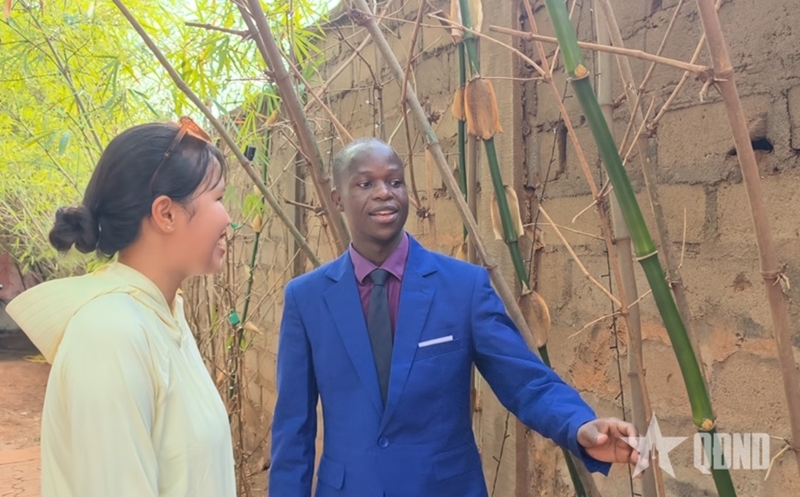
The grove belonged to Ochieng John Francis. In stark contrast to the surrounding vegetation, his bamboo stood tall and vividly green. Francis explained that he had brought the bamboo from another region more than five years earlier, intending to create a natural barrier against dust and to provide shade along the narrow alley leading to his home. Over time, the bamboo not only protects his house from the harsh sun and wind, but has also become a striking feature in the arid landscape.
When he learned that the Vietnamese peacekeepers hoped to use bamboo branches for their Tet celebration, Francis responded generously, “Take as much as you need.” He personally selected the freshest and most beautiful branches. Listening to the story of Saint Giong and the meaning of the New Year bamboo pole, he reflected, “It is an honor that my bamboo can help ease your homesickness. I realize it is not just a plant, it represents the spirit and soul of the Vietnamese people. I want this gift to be part of your Tet.”
Captain Nguyen Thi Ngoc Tram, a Training Staff Officer, explained the cultural significance of bamboo and its symbolic role during Tet. She shared emotionally, “In Central Africa, finding bamboo is like finding gold. With these branches, our spring corner feels complete. It makes us feel that home is right beside us, even when we are far away.”
What began as a simple search for bamboo became a story of cultural connection and mutual understanding between people from two distant nations.
Back at the residence, Senior Captain Nguyen Anh Tuan, an Intelligence Analyst with MINUSCA, carefully arranged the branches. Soon, a sturdy bamboo gate stood at the entrance, the national flag fluttered nearby, and the festive red decorations framed the space. The modest yet meaningful setting warmed the hearts of the Vietnamese peacekeepers and drew the admiration of international colleagues.
|
|
 |
|
Over time, the bamboo has not only sheltered Ochieng John Francis’s house from the harsh elements, but also become a distinctive highlight in this arid land. |
Roman Daniel, an officer from Romania, expressed his appreciation after visiting, “Celebrating Tet with my Vietnamese colleagues is a meaningful experience. It helps me understand more about the spirit of unity and reunion behind this special holiday. I am very happy to join you. Happy New Year.”
As the team gathered around cups of hot tea, admiring the completed spring corner, distance no longer seemed to matter. Amidst the sun and wind of Central Africa, the green of bamboo and the red of Tet stood as a quiet affirmation, wherever Vietnamese blue berets serve, their national spirit and friendship shine brightly.
A new spring has arrived, carrying with it a message of peace and compassion from those serving far from home.
By Thu Ha – Ngoc Tram
Translated by Tran Hoai