Following the opening message of Senior Captain Vu Hong Son, Deputy Commanding Officer of Brigade 171 of Naval Region 2, the 39th joint patrol between the navies of Vietnam and China officially commenced at 7:15 a.m. on November 19, with the starting point located 30 nautical miles east of Vietnam’s Co To Island. The Chinese side assigned Task Group Ships 649 and 630 under the command of Colonel Zhang Ming, Deputy Commanding Officer, and Colonel Wang Bin, Director of the Political Affairs Department of China’s Missile Frigate Squadron No. 18. English was used as the operational language throughout the joint patrol.
    |
 |
|
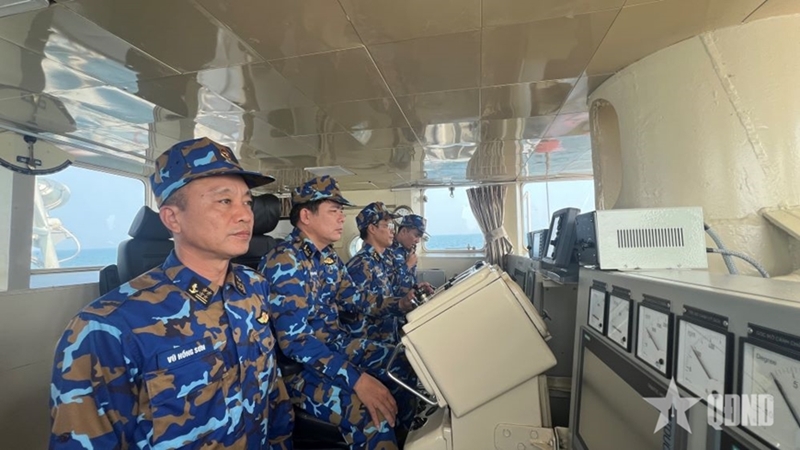
Senior Captain Vu Hong Son (first from left), Deputy Commanding Officer of Brigade 171 of Naval Region 2, Head of Task Group Ships 17 and 09 during the patrol |
Despite strong Northeast monsoon winds, and waves reaching up to 4 meters, both task groups maintained speed and formation along the pre-determined seven-point maritime route heading toward the mouth of the Gulf of Tonkin. The Vietnamese task group moved in a row of ships; the Chinese task group moved in a similar formation on the other side of the demarcation line, with both groups forming a rectangular patrol formation along the Gulf of Tonkin demarcation line.
After 24 hours at sea, on the morning of November 20, the two task groups conducted joint training modules near the Gulf of Tonkin entrance, including maritime search and rescue, simplified communication, formation maneuvering, and damage control drill.
|
|
 |
|
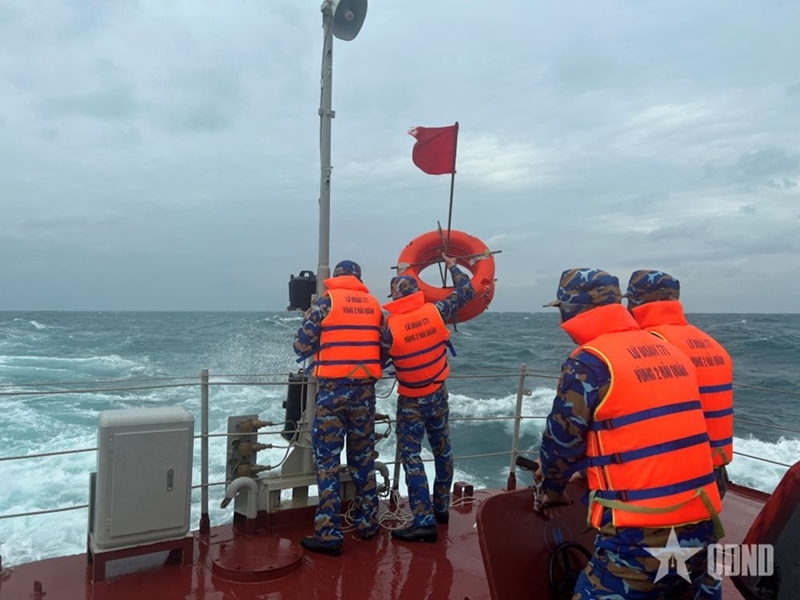
Crewmembers of Ship 17 release the floating target during the search and rescue drill. |
In the search and rescue drill, each side released a floating target, comprised of three joined buoys, for the other side to detect and recover. In rough seas with heavy winds, detecting the buoys was difficult, and approaching them even harder, yet ships from both navies successfully completed the mission.
Formation maneuvering was considered one of the most challenging modules. As planned, ships alternated between formations: single-column, single-line abreast, double-column, and relative bearing formation. During the process of moving in formation, the ships in the formation are in the waters of which country, the ship of that country takes command. Vessels had to move with, across, or against the waves while keeping tight formation and ensuring absolute safety. Sudden squalls, high waves, and conditions where ship bows seemed to “scoop” water made continuous communication, speed adjustments, and precise course changes critical. Thanks to the experience and strong coordination of both task groups, the maneuvering drills were carried out successfully.
“Although joint patrols in the Gulf of Tonkin have been conducted since 2006, this is the first time ships of Naval Region 2 has been entrusted with the mission. It is a great honor for the officers and sailors of Brigade 171 of Naval Region 2,” said Senior Captain Vu Hong Son. He emphasized that the patrol materializes the shared strategic understanding reached by senior leaders and defense ministries of both countries; promotes naval exchanges; strengthens friendship, cooperation, trust, and mutual understanding; and enhances coordinated responses to non-traditional security challenges.
He added that despite operating far from base for the first time, facing demanding mission requirements, the officers and sailors of Brigade 171 demonstrated strong professional competence, political will, unity, and determination to overcome all hardships and fulfill their tasks.
Preparations for the patrol were carried out swiftly and thoroughly. Upon receiving the task from the Vietnam People’s Navy Command and Naval Region 2 Command, Brigade 171 issued mission directives, established the task group, sought guidance from functional bodies, learnt from experience of Naval Regions 1, 3, and 4, and ensured comprehensive logistical, technical, and operational readiness. The unit also received close direction and assistance from the the Vietnam People’s Navy Command, the Naval Region 2 Command, and relevant forces.
“Our joint patrol has concluded successfully. Once again, we wish the entire command group and crew good health, happiness, and a safe voyage home,” Senior Captain Vu Hong Son transmitted over the communication system at 2:00 p.m. on November 20, as the two task groups completed the patrol 52 nautical miles northeast of Con Co Island.
|
|
 |
|
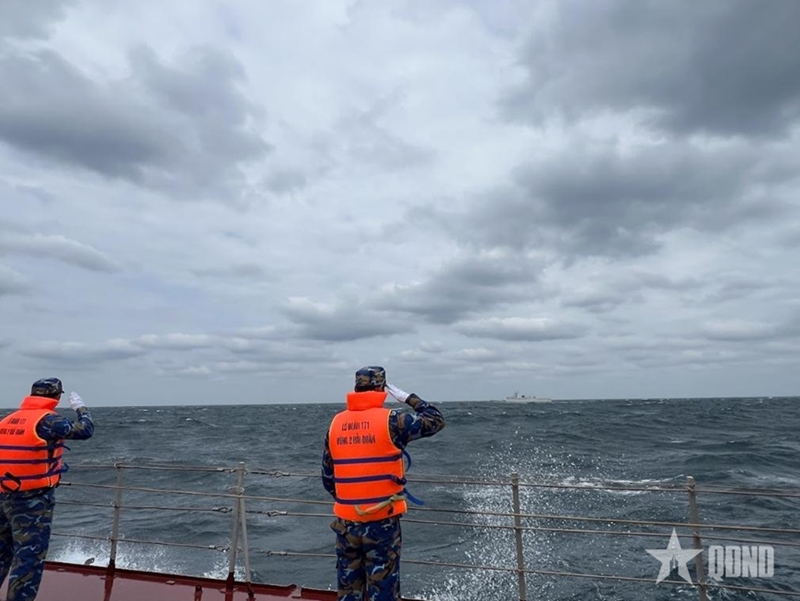
Sailors of the Vietnamese naval ship salute Chinese ships at the end of the joint patrol. |
The mission offered valuable opportunities for Brigade 171’s officers and sailors to accumulate long-distance seafaring experience under rough-weather conditions; improve command coordination; and enhance professionalism in joint operations with foreign navies. More importantly, successful joint patrols between the Vietnamese and Chinese navies contribute to strengthening friendship, cooperation, trust, and mutual understanding; and improving coordination in responding to non-traditional security challenges, for a peaceful and developed maritime region.
Translated by Trung Thanh