PANO – The ASEAN Community officially comes into being today, December 31st 2015. The face of regional geo-politics has changed dramatically since leaders of the 10 ASEAN member states signed the Kuala Lumpur Declaration on November 22nd, 2015 on the establishment of the ASEAN Community, a historic document marking an enormous change of the bloc. Looking back at the process of realizing the community, people easily see that regional defense and military relations have made a considerable contribution to and played an important part in building the political and security community, one of the three pillars, which have constituted the ASEAN Community. Although the current regional context is creating large potentials and opportunities for further development, defense and military relations and cooperation within ASEAN still face a number of obstacles and challenges.
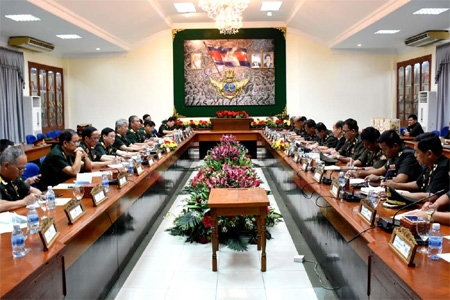 |
| At the first defence policy dialogue between Vietnam and Cambodia in Phnom Penh. |
Highlights in regional defense and military cooperation
Alongside defense dialogues within the framework of the ASEAN Regional Forum, ASEAN member states have established defense and military cooperative mechanisms – ASEAN defense and military conferences – since the beginning of the 21st century, which have served as various platforms for wider and deeper regional defense and military cooperation at different levels. The new mechanisms, indeed, laid a firm foundation for defense and military cooperation not only within the bloc, but also between the bloc and its regional partners. The important mechanisms that have recently taken shape and contributed significantly to the development of defense and military cooperation within ASEAN and between the bloc and its partners include the ASEAN Defense Ministers’ Meeting (ADMM), the ASEAN Defense Ministers’ Meeting plus (ADMM+), and the ASEAN Chiefs of Defense Forces Informal Meeting (ACDFIM). In fact, they have created good opportunities for the bloc to foster and deepen regional defense and military cooperation in specific areas for regional peace, stability, development and prosperity.
Founded in December 2004 after the initiative proposed on May 9th, 2015 by the ASEAN Security Cooperation Working Group adopted at the 10th ASEAN Summit, ADMM is viewed as the highest official defense and military cooperation channel of ASEAN. Over the past 10 years, ADMM has deepened and concretized regional defense and military cooperation.
Meanwhile, ADMM+ has brought additional benefits to regional peace, stability and development. ADMM+ was established when the region saw dynamic development; cooperation and conflict were interwoven; the Asia-Pacific region drew more international attention; and national interests of countries in the world became more involved in the region. In this context, the birth of ADMM+ indeed was a success of ASEAN as it developed the regional security mechanism from exchange, discussion, preventive diplomacy and confidence building into more concrete and practical cooperation, and gave an additional impulse to the available defense cooperation mechanisms of ASEAN. What is more, ADMM+ opened potentials for defense and military cooperation and exchange between the bloc and outsiders for the sake of peace, stability and development in the region. ADMM+ that includes eight world’s biggest military powers serves as a support for ADMM as ADMM can exploit support from ADMM+ to realize its ideas as well as consolidate regional peace, stability and development.
Alongside the development of regional defense cooperation, regional military cooperation has gained positive results. The 12 ACDFIM events show that the military of each country always plays an important role in maintaining security and stability. Facts show that the military has always been used to deal with all emergencies. ACDFIM is seen as a platform for regional military cooperation. Based on the outcomes of ACDFIM, regional military cooperation activities are deployed with the participation of various military services and arms of the ASEAN countries’ armies.
ACDFIM has also laid foundations for a number of other annual regional military conferences and military exchanges. These include meetings of ASEAN Chiefs of Military Intelligence, Chiefs of Army, Chiefs of Navy, Chiefs of Air Force, Chiefs of Military Operations and Chiefs of Military Medicine as well as regular exchanges of regional young officers of military services and arms and the ASEAN Armies Rifle Meet. The expansion of regional cooperation and exchange over the past years has contributed to promoting confidence building, mutual trust and understanding, friendship and unity among the armies of the ASEAN countries.
In short, it can be said that defense and military cooperation within ASEAN and between the bloc and its partners has been carried out in a comprehensive and practical manner, meeting the development demand of the bloc and fitting the conditions and abilities of each member state. The outcomes of the cooperation has contributed significantly to the success in building the Political and Security Community of ASEAN in particular and the ASEAN Community in general.
Challenges for future regional defense and military cooperation
After nearly half a century building and growing, ASEAN has entered a new development phase, in which it has more opportunities and faces more challenges. The foundation of the ASEAN Community 2015 has demonstrated its importance position in the region and world. It also allows the bloc to head for bigger goals and higher-level cohesion as well as to boost its relations with partners around the world. The success in building the ASEAN Community 2015 also requires the bloc’s general cooperation and defense and military cooperation to generate more practical outcomes as well as better serve and bring more benefits to regional people.
What is more, the regional and international context continues to see new, complex developments, which require the bloc to be more active in cooperating with its partners in seeking solutions for and dealing with emerging issues on time.
The bloc also sees other challenges. First, the regional geo-political and strategic structure keeps continuously changing and being influenced by the competition between regional powers. Second, disputes over territories, seas and islands remain complex. Third, maritime and aeronautical security, safety and freedom issues directly affect regional people’s economic activities. Finally, non-traditional security issues, particularly international terrorism, piracy, energy security, cyber security and natural disasters, also become more acute and complicated in the region.
Furthermore, its general development trend requires ASEAN to maintain the available cooperation mechanisms on one hand, and beef up regional defense and military cooperation in a more practical and effective manner on the other hand while strategic dialogues should be underlined as the foundation for all cooperation frameworks.
ASEAN should not limit its cooperation to discussion, experience exchange and improvement of mutual understanding between and among its member countries, but also effectively realize initiatives on cooperation and deepen cooperation in specific cooperation areas.
Joining efforts to foster cooperation
In order to boost ASEAN defense and military cooperation, every member country should uphold their sincerity and responsibility for ensuring regional peace, stability and security; consider the community’s security their own national security; consolidate ASEAN’s common viewpoint on restraining from the first use of force, resolving disputes via peaceful means and in line with the UN Charter while honoring international law, particularly the UN 1982 Convention on the Law of the Sea (UNCLOS 1982), fully and seriously implementing the Declaration on the Conduct of parties in the South China Sea (East Sea), and backing diplomats to early finish negotiations on the code of conduct of parties in the East Sea (COC).
The bloc also draws up clear-cut strategic directions for future development of ADMM and ADMM+ as well as promotes the central role of ADMM as the influencing factor for all existing defense and military cooperation mechanisms within ASEAN and between ASEAN and partners in general, and strengthen these mechanisms and raise the effectiveness and practical result of cooperation activities in the region.
Finally, ASEAN should give priority for strengthening bilateral defense cooperation so as to expand cooperation within and outside ASEAN. But all kinds of cooperation should not affect national security of other countries, while trying to avoid misunderstanding in relations with regional major powers, promote confidence building, prevent and well manage risks that possibly lead to clash and conflict, via frequent and good consultancy, information exchange, direct communications lines and joint activities between regional armies.
To conclude, as a community, ASEAN should smartly choose directions for cooperation within and outside the region.
Written by Major General Vu Tien Trong, Director of the Defense Institute for International Relations
Translated by Thu Nguyen