Reporter: The 81st session of the United Nations General Assembly opened on September 8, 2026, in New York with the theme "Restoring Trust, Managing Transformation: A United Nations That Delivers for All." Could the U.N. Resident Coordinator share your assessment of the significance of this theme against the backdrop of compounding crises, conflicts, poverty, and climate change impacts that are eroding confidence in global collective action?
    |
 |
|
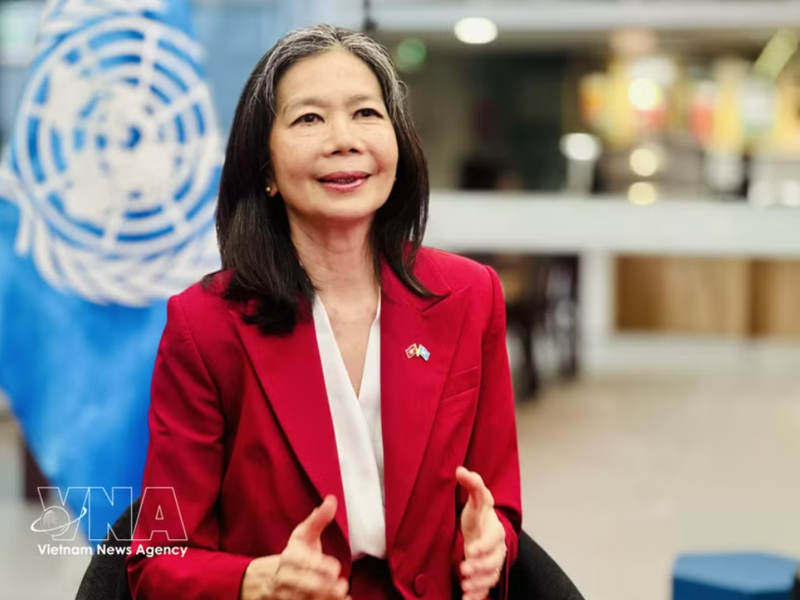
U.N. Resident Coordinator in Viet Nam Pauline Tamesis |
U.N. Resident Coordinator: "Restoring Trust, Managing Transformation: A United Nations That Delivers for All", the theme of the 81st session of the General Assembly is both timely and future-facing. In his opening remarks, the U.N. Secretary-General himself emphasized that, “rebuilding trust in the multilateral system is the defining challenge of our time.”
We are living through a period of profound uncertainty. Conflicts and geopolitical divisions, persistent poverty and inequality, worsening climate impacts, record displacement of people, declining resources for development and humanitarian action, and rapid technological change. These are global challenges that require multilateral solutions. Take artificial intelligence, for example. We all know AI brings enormous opportunities, but it also creates significant risks. At the same time, progress towards the Sustainable Development Goals remains far too slow.
Against this backdrop, restoring trust cannot simply mean reaffirming our commitment to multilateralism. Trust must be earned through results. It means demonstrating that international cooperation can help prevent conflict. Committing to multilateralism requires member states to uphold international law and human rights. To accelerate sustainable development and respond to climate change. Global solidarity and collective action will need to ensure that major shifts, such as green transition and digital transformation, work for all people and leave no one behind.
This is why the second part of the theme “Managing Transformation: A United Nations That Delivers for All” is equally important. The world is changing rapidly, and our multilateral institutions must change with it. We need a United Nations that is more effective, coherent, and responsive. We need a United Nations better equipped to turn global commitments into tangible improvements in people’s lives.
There is reason for hope. The United Nations remains the place where the world comes together to confront its most difficult, shared challenges. The U.N. Secretary General reminds us that through dialogue, diplomacy and cooperation, we can rebuild trust, and translate that trust into a more peaceful, sustainable and equitable future for all.
Reporter: What is the significance of the General Secretary and State President of Viet Nam leading the high-level delegation to the High-level General Debate of the 81st U.N. General Assembly for the Viet Nam–U.N. partnership, as well as Viet Nam's commitment to multilateralism?
U.N. Resident Coordinator: The high-level delegation from Vietnam headed by no other than the Party General Secretary and State President sends a very clear and strong message about the importance that the country attaches to the United Nations and to multilateralism, at a time when international cooperation is needed more than ever.
During the celebration of the 81st National Day of Viet Nam, the General Secretary and State President himself expressed this commitment very clearly when in his speech he affirmed Viet Nam’s support for “an equal and fair multilateral system with the United Nations at its center.” He also expressed readiness for Viet Nam to serve as a bridge for cooperation and dialogue, and to make increasingly substantive contributions to addressing shared global challenges.
It was a proud moment for me sitting in the audience listening to the General Secretary’s speech at the 81st National Day celebrations.
It also tells an important story about Viet Nam’s development journey and its relationship with the United Nations. Over the decades, Viet Nam has transformed from a country emerging from war and isolation into an upper-middle-income country, a deeply integrated economy, and an increasingly active contributor to regional and global affairs. As the General Secretary and State President acknowledged, international solidarity and cooperation have been an important part of that journey.
Today, we see Viet Nam increasingly moving from being a beneficiary of international cooperation to becoming an active contributor to global solutions—through U.N. peacekeeping, its engagement in multilateral institutions, its commitments on sustainable development, climate action and AI governance, as well as its willingness to contribute to dialogue and consensus-building.
So this visit is important not only for the Viet Nam–U.N. partnership. It is also an opportunity for Viet Nam to bring its perspectives, experience and aspirations to the global conversation at a critical moment for multilateralism.
In that sense, the partnership is increasingly a two-way partnership: the United Nations supporting Viet Nam’s development aspirations, and Viet Nam contributing its experience, leadership and solutions to our shared global agenda.
As Viet Nam enters its new era of development, the United Nations looks forward to a partnership that also evolves with it, one that supports Viet Nam’s ambition to become a developed, high-income country by 2045, while enabling Viet Nam to make even greater contributions to peace, sustainable development and international cooperation.
Reporter: Over the years, Viet Nam has transformed significantly from an aid recipient into an active, proactive partner contributing to international peace and security (e.g., participating in U.N. peacekeeping missions, holding positions on the Human Rights Council, the Security Council, etc.). How do you assess this transformation and Viet Nam's role as a "bridge-builder" in fostering international consensus?
U.N. Resident Coordinator: I would frame this less as an assessment, rather more as a recognition of how Viet Nam’s engagement with the United Nations has evolved.
Viet Nam today brings to multilateral cooperation its own experience of transformation, from post-war reconstruction and poverty reduction to economic integration, sustainable development and, lessons about its remarkable journey as an upper-middle-income country. Increasingly, that experience is being shared beyond Viet Nam’s borders through its contributions to U.N. peacekeeping, its engagement in the Human Rights Council and the Security Council, and its active participation across the U.N. development system.
This gives particular value to Viet Nam’s role as a bridge-builder. At a time of growing geopolitical fragmentation, countries that can promote dialogue, build confidence and help identify common ground are increasingly important. Viet Nam’s own experience demonstrates the value of peace, international cooperation and development as mutually reinforcing objectives.
Looking forward, I believe there is an important opportunity for Viet Nam to contribute even more, not only by participating in multilateral institutions, but also by helping shape the solutions, norms and standards that will define our common future. This includes areas where Viet Nam itself is undergoing major transformation: responsible digital transformation and AI governance; a just and inclusive energy transition; climate action and resilience; and development approaches that combine economic dynamism with social inclusion and environmental sustainability.
This is also the vision behind the new U.N.–Viet Nam Sustainable Development Cooperation Framework for 2027–2031: a more strategic, two-way partnership. The United Nations will continue bringing global knowledge, expertise and partnerships to support Viet Nam’s development ambitions. At the same time, Viet Nam’s experience, innovations and solutions can increasingly contribute to regional and global progress.
For me, that is an important expression of Viet Nam’s evolving role in multilateralism: not only benefiting from international cooperation, but increasingly helping shape it, and ensuring that the transformations ahead are inclusive, sustainable and work for everyone.
Reporter: In light of the U.N.'s call to scale up resilient infrastructure investment and regional connectivity and get the Sustainable Development Goals (SDGs) back on track, how will the U.N. in Viet Nam continue to partner with the Government of Vietnam to safeguard development gains and address prevailing challenges?
U.N. Resident Coordinator: This is an important question. As Viet Nam rises to a new era with its eyes on high-income status by 2045 and net-zero emissions by 2050, protecting its hard-won development gains is everything.
That is really what our new U.N. Sustainable Development Cooperation Framework for 2027–2031 is all about, it serves as our strategic compact with the government to get the Sustainable Development Goals back on track.
When you look at the reality on the ground, where extreme weather and climate shocks cost the country 1 to 1.5 percent of GDP every year, we know we have to act decisively. To tackle this, our partnership ranges across many interlinked areas:
From resilient infrastructure to climate action: we are partnering with the government to build climate resilience directly into infrastructure and agri-food systems.
Adaptive capacity and energy transition: We are helping to improve early warning systems and anticipatory action for disaster risks. This includes modernizing weather observation networks. Actions can also include harnessing AI and digital tools for real-time risk forecasting, while driving clean energy expansion through frameworks like JETP.
Investing in people and expanding Social Protection: Through closely interlinked efforts in inclusive human development and economic transformation, we are expanding rights-based, gender-transformative social protection systems. This ensures vulnerable groups like ethnic minorities, informal workers, and older persons are shielded from shocks.
In terms of digital Inclusion & financing: We are supporting a digitally-enabled economy with strong digital public infrastructure safeguards and green skills. This means building resilient societies. We are also exploring how to expand domestic resource mobilization and establish blended finance ecosystem to ensure sustainability of resources.
At the end of the day, our goal is to help Viet Nam demonstrate that economic growth, social inclusion, and climate ambition can all advance together. By building resilience right now, Viet Nam can protect its past achievements and build a greener, more prosperous future for everyone.
Source: VNA