    |
 |
|
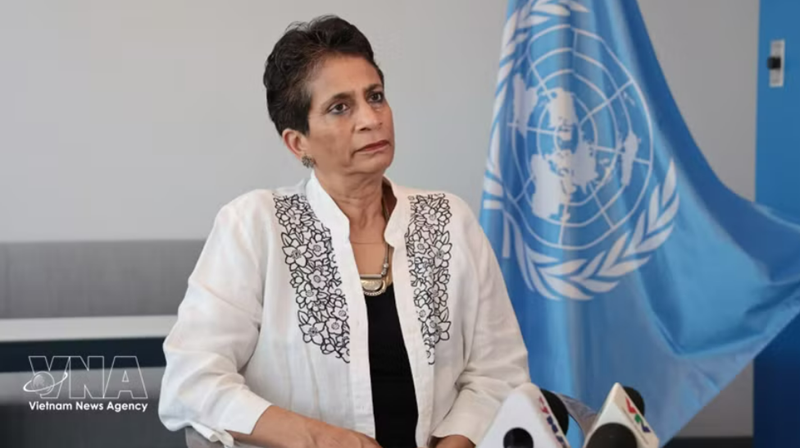
Kanni Wignaraja, U.N. Assistant Secretary-General and Regional Director for Asia and the Pacific at the U.N. Development Program (UNDP), in an interview granted to the Vietnam News Agency |
During an interview granted to the Viet Nam News Agency (VNA), Wignaraja, who has over 30 years of experience within the U.N. system and previously worked in Viet Nam during the early 2000s, considers the country’s development story, spanning domestic transformations to its opening-up and deep integration into the world, an impressive narrative in its own right.
Assessing the significance of General Secretary of the Communist Party of Viet Nam Central Committee and President To Lam’s attendance at the U.N. General Assembly High-Level Week, she noted that Viet Nam’s presence consistently reflects a development and foreign policy vision that places peace, stability, security, and the well-being of the people at the center.
Historical experience has given Viet Nam a profound understanding that a nation requires not only a sense of security within its own borders but also an environment of peace, stability, and cooperation at both regional and global levels, she said, adding that this spirit also permeates the messages consistently conveyed by Vietnamese leaders, ministries, agencies, and representatives at the U.N. in international forums.
Viet Nam has left a significant mark on key U.N. mechanisms—ranging from its two terms as a non-permanent member of the U.N. Security Council to its contributions within the U.N. General Assembly and the Human Rights Council—and has increasingly demonstrated a sense of international responsibility by deploying forces to U.N. peacekeeping operations and supporting countries and communities affected by natural disasters, crises, and hardships, according to the official.
In her view, these actions represent more than just technical or diplomatic contributions; they reflect an open-minded perspective that what benefits other nations and the international community also benefits Viet Nam.
The UNDP Regional Director expressed her appreciation for Viet Nam’s transition from a recipient of development assistance to an increasingly proactive partner capable of making greater contributions to shared global goals.
Wignaraja held that Viet Nam can offer two major lessons to the U.N. and the international community. The first lesson is the necessity of placing people—especially the most vulnerable—at the heart of all development policies.
She said regardless of the hardships a country or community faces, centering investments and policy planning on the well-being and security of the people will always drive society forward. From this perspective, a nation can transition from war to peace, from underdevelopment to prosperity, or from climate conflict and injustice to climate equity.
Viet Nam’s experience demonstrates that people-centered development is not merely a slogan; it must be translated into concrete policies aimed at reducing poverty, expanding access to basic services, strengthening social safety systems, improving the quality of education and healthcare, and ensuring opportunities for all population groups to participate in development.
The second lesson, she went on, is that a nation need not choose a single objective or a linear path of development. In an increasingly complex global landscape, countries must be capable of pursuing multiple goals simultaneously and maintaining a balance among priorities.
Wignaraja noted that Viet Nam has demonstrated this approach by strengthening state institutions and public governance capacity, fostering the growth of the private sector and the business community, and promoting economic growth while prioritizing the preservation of nature, natural resources, and biodiversity.
This offers a valuable lesson at a time when the world is grappling with a series of intertwined crises, according to the official.
Mentioning Viet Nam’s roadmap for achieving the Sustainable Development Goals (SDGs) by 2030, Wignaraja placed special emphasis on the important role of youth. The Asia-Pacific region is home to approximately 700 million people aged 16 to 24, a generation that is better educated and more connected than its predecessors.
However, she noted that opportunities for young people are narrowing, even as their aspirations, expectations, and ambitions continue to grow. The gap between the qualifications, connectivity, and expectations of youth and the actual employment and development opportunities available can cause frustration, erode trust, and impact social stability.
The UNDP Regional Director added that Viet Nam is entering a period of population aging. Consequently, development must be viewed through the lens of the human life cycle—encompassing children, youth, the working-age population, and the elderly.
A key priority is ensuring that individuals at every stage of life have access to opportunities and the ability to realize their aspirations. Therefore, increasing investment in healthcare and reforming education to meet the requirements of new types of jobs—rather than clinging to an outdated educational model from two decades ago—represents another crucial priority.
The UNDP and the U.N. will continue to support Viet Nam in strengthening its development foundations, while the country contributes its experience, resources, voice, and increasingly significant responsibility to the international community. It is a mutually beneficial relationship, she stated.
Source: VNA