According to Deputy Minister of Foreign Affairs Dang Hoang Giang, taking place from September 20–25, the trip comes amid rapid, profound and epochal changes in the world situation. It demonstrates Viet Nam’s consistent foreign policy of independence, self-reliance, self-strengthening, multilateralization and diversification, as well as its pro-active and active international integration in a comprehensive and extensive manner, making effective use of favorable conditions and resources to open new space and room for national development.
General Secretary and President To Lam’s attendance and important speech at UNGA 81 will reaffirm the country’s strong support for and commitment to the central role of the U.N. in multilateral cooperation and the promotion of respect for international law.
    |
 |
|
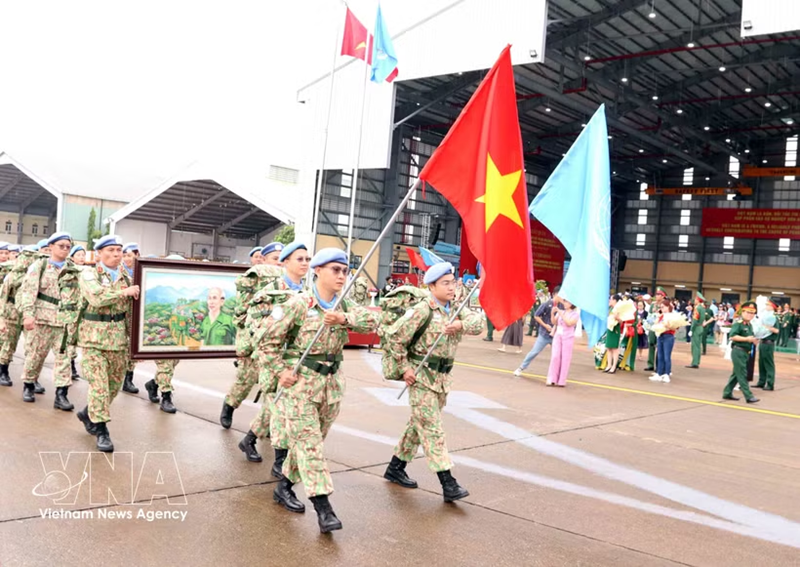
On the morning of September 22, 2025, at Tan Son Nhat International Airport in Ho Chi Minh City, the Ministry of National Defense held a send-off ceremony for Level-2 Field Hospital Rotation 7 and Engineer Unit Rotation 4 as they departed to undertake United Nations peacekeeping missions at the U.N. Mission in South Sudan (UNMISS) and the Abyei Area under the U.N. Interim Security Force for Abyei (UNISFA). |
On the occasion, the Vietnamese leader will share with leaders of other countries lessons from Viet Nam’s 40 years of Doi moi (Renewal), while putting forward practical initiatives to address common global challenges, such as climate change, sustainable development and advance governance of the future’s core technologies. This will further affirm the country’s reputation, position and new potential on the international stage, the deputy minister said.
Meanwhile, the working trip and bilateral activities in the U.S. would contribute to implementing the common perceptions reached by the two countries’ senior leaders, while continuing to promote their Comprehensive Strategic Partnership in a stable, substantive, effective and sustainable manner.
With Canada, building on sound bilateral relations and major achievements in various areas of cooperation, the state visit is expected to provide strong political momentum for the ties to develop in a more substantive, balanced and effective manner, commensurate with the potential, strengths and needs of both countries.
The diplomat stressed that Viet Nam has now emerged as a particularly trusted partner, making pro-active, responsible and breakthrough contribution to the U.N.’ core pillars.
A notable example was the successful hosting of the signing ceremony for the United Nations Convention against Cybercrime, known as the Hanoi Convention, laying an important legal foundation for global cooperation on cybersecurity.
“Our multilateral diplomacy has also continuously achieved important milestones, including assuming the presidency of the 11th Review Conference of the Treaty on the Non-Proliferation of Nuclear Weapons (NPT); being re-elected to the UN Human Rights Council for the 2026–2028 term; and, for the first time, chairing the 35th Meeting of States Parties to the United Nations Convention on the Law of the Sea,” he said.
Viet Nam also helped promote the U.N. adoption of a resolution establishing International Day of Play on June 11, and initiated the 2027–2036 period as the “International Decade of Culture for Sustainable Development.”
In addition, it has consistently received high recognition from the U.N. for achieving or surpassing targets for 13 of the 20 goals under its National Strategy on Gender Equality.
Meanwhile, Viet Nam has truly become an ambassador for international peace and humanitarian causes. The image of Vietnamese blue-beret peacekeepers bravely and devotedly carrying out their duties in U.N. peacekeeping missions has become a vivid and noble symbol.
Assessing the cooperation situation and expectations for breakthroughs in Viet Nam-U.S. and Viet Nam-Canada relations during the trip, Deputy Minister of Foreign Affairs Dang Hoang Giang said that the achievements made by Viet Nam and the U.S. over more than three decades have been comprehensive and substantive.
The two countries have built an increasingly solid foundation for cooperation based on respect for the U.N. Charter, international law, each other’s independence, sovereignty, territorial integrity and political systems. At the same time, the scale and scope of bilateral cooperation have continued to expand across numerous strategic areas.
Political trust has continued to be strengthened, with cooperation in addressing the consequences of war standing out as a bright spot. Economic, trade and investment ties have become drivers of the relationship, with an increasingly high degree of connectivity and complementarity.
The two sides are actively expanding cooperation into new strategic areas that will shape the future, including science and technology, innovation, the semiconductor industry, artificial intelligence (AI), energy transition and the development of high-quality human resources.
Regarding Viet Nam-Canada relations, after more than half a century of diplomatic ties and nearly a decade under the Comprehensive Partnership framework, the two countries have built an increasingly solid foundation for their relationship.
Both sides are working to make areas such as science and technology, innovation, AI, semiconductors, clean energy and human resource development new drivers of bilateral ties.
Viet Nam and Canada also share many common views on international law, free trade, and maintaining peace and stability in the region.
On that basis, the deputy minister concluded that there are expectations that the trip would make an important contribution to strengthening and deepening Viet Nam’s relations with the U.N., the U.S. and other partners; promoting more substantive and closely connected Viet Nam-Canada relations; and affirming Viet Nam as a pro-active, constructive and responsible country in global affairs, making positive contribution to peace, stability, cooperation and development in the region and the world.
Source: VNA