    |
 |
|
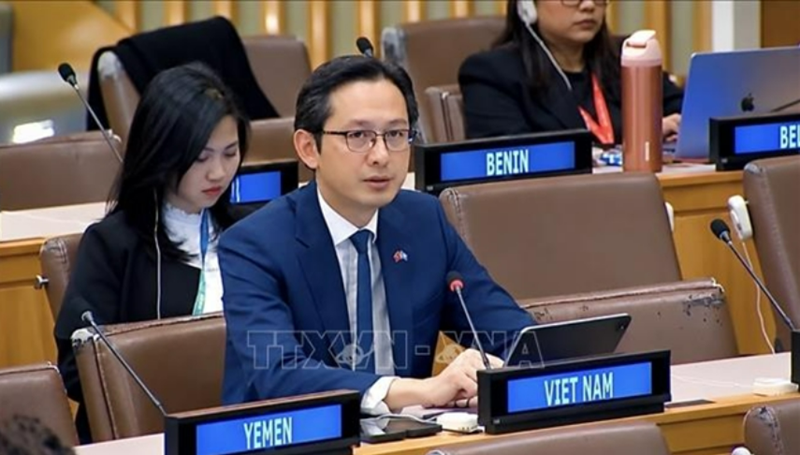
Ambassador Do Hung Viet, Permanent Representative of Viet Nam to the United Nations, addresses a general debate of the U.N. General Assembly in New York on October 6 (local time). |
The call was made by Ambassador Do Hung Viet, Permanent Representative of Viet Nam to the United Nations, at a general debate of the U.N. General Assembly’s Second Committee (Economic and Financial Committee) in New York on October 5-6. The session focused on financing for sustainable development in a changing global economic context to accelerate the implementation of the Sustainable Development Goals (SDGs).
He expressed concern over the slow and uneven progress in implementing the SDGs, noting that developing countries continue to face economic uncertainties, widening development gaps, climate change and increasingly frequent natural disasters, along with growing fragmentation of the global economy.
Sharing Viet Nam’s experience, he noted that 2026 marks an important milestone as the country becomes an upper-middle-income economy, reflecting the achievements of four decades of Doi moi (Renewal), international integration and sustained efforts to improve people's livelihoods. However, higher income does not mean the end of the development journey, he stressed.
Viet Nam, therefore, calls for stronger global partnerships tailored to the needs and conditions of countries at different levels of development, including fair access to new and emerging technologies. Such cooperation will help developing countries acquire knowledge, skills and technologies needed for innovation and competitiveness.
Viet also underscored the need to maintain an open and fair international economic environment, with trade continuing to serve as a driver of sustainable development, and at the same time keep global supply chains open, stable and resilient, and avoid protectionism and unnecessary trade barriers.
The Vietnamese diplomat further called for faster reform of the international financial architecture to make it more inclusive and equitable and better meet the needs of developing countries, highlighting the necessity for them to strengthen their voice and representation in global economic governance.
U.N. Under-Secretary-General for Economic and Social Affairs Li Junhua warned that multiple, interlinked crises are slowing progress towards the SDGs. The global economy is projected to grow by only 2.6% in 2026, while the annual financing gap for achieving the SDGs has reached more than 4 trillion USD.
Source: VNA