Recent activities in external relations and international cooperation across politics, economy, defense, security and culture demonstrate concrete steps to realize this approach, increasingly linking international integration with national construction, development and defense.
From participation to pro-active contribution
Viet Nam’s pro-active role in multilateral diplomacy has been evident in preparations to host Asia-Pacific Economic Cooperation (APEC) Year 2027. Preparations are focused on organizational consolidation, agenda development, logistics, training and communications.
At the fourth meeting of the National Committee for APEC 2027, Standing Deputy Prime Minister Pham Gia Tuc said hosting APEC 2027 will be an important multilateral diplomatic activity and an opportunity for Viet Nam to affirm its stature and position. Successful organization of APEC Year 2027, particularly the APEC Economic Leaders’ Week, will enable Viet Nam to make its mark on APEC while creating opportunities to mobilize international resources for socio-economic development.
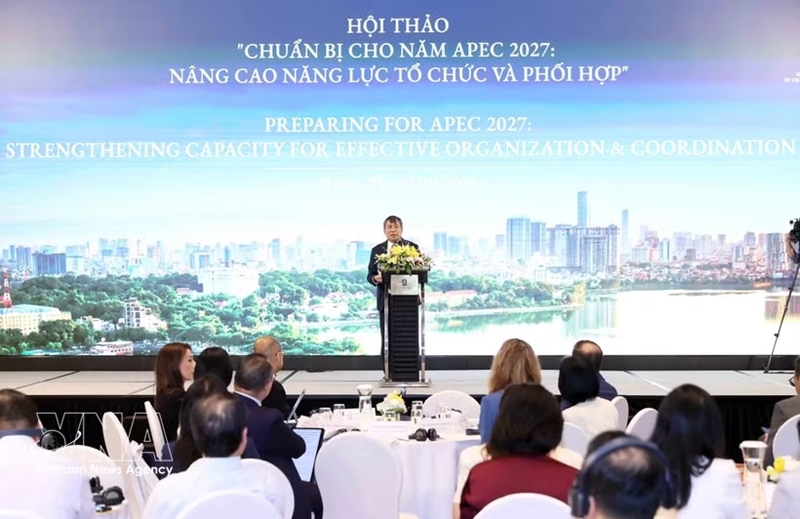
A workshop on preparations for APEC Year 2027, jointly organized by the APEC 2027 National Secretariat, the Ministry of Foreign Affairs and the US Department of State, also helped Viet Nam learn from international experience and strengthen its organizational and coordination capacity.
    |
 |
|
The Ministry of Foreign Affairs hosts a workshop titled “Preparing for APEC Year 2027: Strengthening capacity for effective organization and coordination” on October 1. |
At recent senior officials’ meetings of the Cambodia-Laos-Myanmar-Viet Nam (CLMV) and Mekong-Japan cooperation frameworks, Viet Nam pro-actively proposed renewing approaches, shaping a common vision and identifying priorities suited to new development requirements, focusing on economic connectivity, tourism, human resources and sustainable water management.
Viet Nam also proposed cooperation priorities including smart supply chains, renewable energy, artificial intelligence and emerging technologies, combating transnational crime and stronger resource mobilization. Senior officials backed the proposals for submission to the 12th CLMV Summit and 13th Mekong-Japan Summit.
These activities reflect a shift from participating in cooperation mechanisms to proposing initiatives and helping shape their agendas and priorities, in line with Resolution 59-NQ/TW’s call for Viet Nam to become an active and responsible partner in international mechanisms.
Comprehensive integration across sectors
The resolution calls for comprehensive and extensive international integration, with different areas closely linked and mutually reinforcing. Recent activities show that integration is expanding beyond economic and diplomatic fields to defense, security and responses to transnational challenges.
The Ministry of Public Security recently hosted an ASEAN law enforcement high-level conference on cooperation in combating criminal fugitives, seeking to enhance regional coordination and implement the ASEAN Plan of Action in Combating Transnational Crime for 2026-2035.
In defense, the Ministry of National Defense assigned four Viet Nam People’s Army officers to U.N. peacekeeping missions. Two will serve as experts at U.N. Headquarters in the U.S. and two with the U.N. Interim Security Force for Abyei (UNISFA), reflecting Viet Nam’s growing professional capacity and involvement in international peacekeeping.
The Viet Nam Maritime Forum 2026, themed “Building Viet Nam into a strong maritime nation through international cooperation and integration”, promoted dialogue among authorities, researchers, businesses and the public, with international cooperation expected to help protect Viet Nam’s sovereignty and sovereign rights while mobilizing knowledge and resources for maritime development.
Meanwhile, Viet Nam’s cooperation with UNESCO in organizing the Asia-Pacific Dialogue on Heritage and Authenticity, which adopted the Hanoi Document on the occasion of the 50th anniversary of Viet Nam-UNESCO relations, highlighted the country’s growing role in multilateral and cultural diplomacy. The document reflected regional perspectives and priorities in heritage conservation and demonstrated Viet Nam’s capacity to contribute policy orientations, expertise and international standards.
From multilateral cooperation and defense and security to culture, international integration is becoming increasingly comprehensive. Viet Nam is not only expanding relations and mobilizing external resources, but also strengthening its capacity to contribute to shared international efforts. Turning international resources, knowledge and experience into internal strength will help ensure that integration directly serves national construction, development and defense while enhancing Viet Nam’s overall national strength in the new development era.
Source: VNA