During the month-long session, which began on September 7, the council adopted 38 resolutions and decisions, held six thematic panel discussions and 37 interactive dialogues with its special procedures and other U.N. human rights mechanisms, and considered reports and updates on thematic issues and human rights situations in 20 countries and territories. It also completed the adoption of the outcomes of the fourth-cycle Universal Periodic Review (UPR) of 15 countries.
    |
 |
|
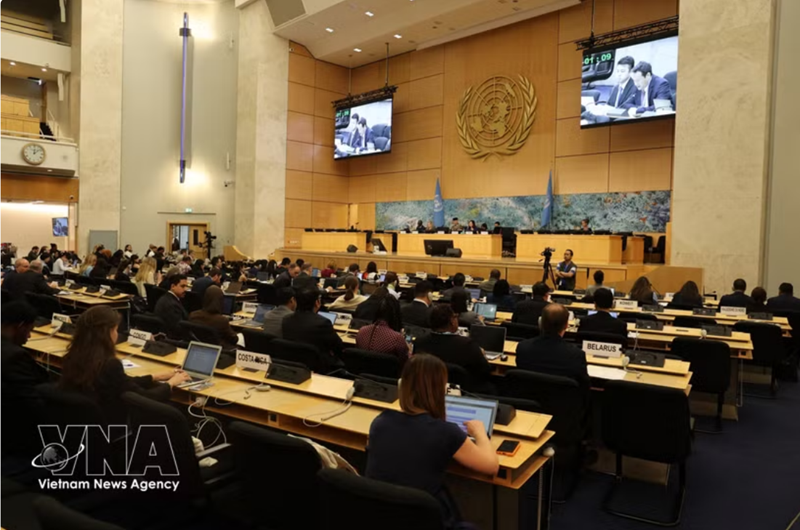
A view of the general debate at the 63rd session of the U.N. Human Rights Council |
Throughout the session, the Vietnamese delegation engaged in consultations and negotiations on nearly 40 draft resolutions and discussions, co-sponsored eight resolutions and seven joint statements, and co-hosted and participated in a number of initiatives and side events.
Notably, Viet Nam took the lead in drafting and presenting a joint statement on immunization and access to vaccines, co-sponsored by 42 countries. The statement highlighted the essential role of immunization in primary healthcare, universal health coverage and the achievement of the Sustainable Development Goals (SDGs). It called for narrowing immunization gaps and ensuring timely, affordable and equitable access to vaccines, while strengthening international cooperation, sustainable financing, and the sharing of technology and knowledge to promote the right to the highest attainable standard of health.
Another highlight was Viet Nam’s hosting of a dialogue with a focus on promoting older person’s right to healthcare, co-sponsored by the Philippines and Slovenia.
The dialogue brought together the U.N. Independent Expert on the enjoyment of all human rights by older persons Zvezdan Pirtošek, representatives of the World Health Organization (WHO), the Gavi Vaccine Alliance, the International Labor Organization (ILO), the Philippines and Viet Nam’s Ministry of Health, along with nearly 100 delegates.
Viet Nam also co-hosted two side events on strengthening cooperation in combating human trafficking amid online scams, organized by Thailand, and reviewing the efforts and achievements of the ASEAN Intergovernmental Commission on Human Rights (AICHR), organized by the Philippines.
The Vietnamese delegation also delivers speeches at sessions on economic, social and cultural rights, the right to development, the rights of older persons, the right to clean water and sanitation, human rights education, the rights of indigenous peoples, and climate finance, among other issues of international concern.
Viet Nam’s engagement at the council came as the country implements the Resolution of the 14th National Congress of the Communist Party of Viet Nam and enters a new development phase focused on rapid and sustainable growth, including an ambition for double-digit economic growth and continued improvements in people’s living standards.
Viet Nam’s active participation in the council’s 63rd session reaffirmed the consistent policy of the Party and State on respecting, ensuring and protecting human rights and citizens’ rights, while placing people at the center, as both the subject and objective of development.
As Viet Nam enters a new development period, it continues to promote dialogue, cooperation and a balanced approach, share experiences and contribute practical initiatives, particularly in advancing the rights of vulnerable groups.
Through these efforts, Viet Nam seeks to play a proactive and constructive role as a member of the U.N. Human Rights Council for the 2026-2028 term and make substantive contributions to the Council’s work based on respect for the U.N. Charter and international law.
Source: VNA