During their stay in Germany from October 11 -15, the delegation met with the Anti-Corruption Center under the Berlin Public Prosecutor’s Office, which serves as a focal point for receiving information, providing preventive advice and coordinating with competent authorities in handling corruption cases.
At the October 12 meeting, Phong and Thomas Fels, Senior Chief Public Prosecutor and director of the center, discussed approaches to preventing and combating corruption and negative phenomena.
    |
 |
|
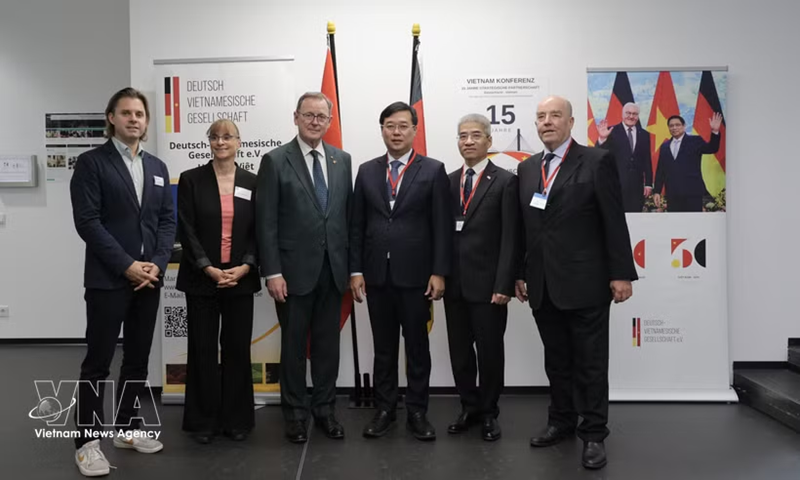
Le Quoc Phong, Member of the Party Central Committee and Standing Deputy Secretary of the Ho Chi Minh City Party Committee (third, from right) and Bodo Ramelow, Vice President of the German Bundestag (third, from left) |
Phong said the center’s practical experience will provide useful references for Ho Chi Minh City as it seeks to improve public administration, strengthen anti-corruption efforts and build a transparent, professional and modern administrative system.
Fels affirmed the center’s readiness to exchange information and share experience with the Vietnamese city in developing preventive mechanisms, controlling conflicts of interest, receiving and handling reports, strengthening coordination among relevant agencies, applying technology and promoting integrity in the public sector.
On October 13, the delegation met with Martina Münch, Leipzig’s deputy mayor responsible for social affairs, health and diversity. Their discussions focused on expanding cooperation in healthcare, healthcare innovation, social welfare, urban governance and people-to-people exchanges.
Phong said the existing partnership between Ho Chi Minh City and Leipzig, together with their longstanding friendship, provides a solid foundation for further cooperation that will bring tangible benefits to residents of both cities and contribute to strengthening the Viet Nam-Germany Strategic Partnership.
The delegation subsequently visited the Helmholtz Center for Environmental Research (UFZ) and Tilia GmbH in Leipzig to exchange experience in integrating green-space management, rainwater management and flood prevention.
The discussions also covered data-driven urban governance, wastewater treatment and the circular economy. The sides explored links between the German institutions and Ho Chi Minh City’s specialized agencies, research institutes, universities and infrastructure businesses, as well as expert exchanges and staff training.
The Ho Chi Minh City delegation attended a conference marking 15 years of the Viet Nam-Germany Strategic Partnership, co-organized by the German-Vietnamese Association, the Asia Bridge Association and FOM University of Applied Sciences in Berlin on the next day.
On the sidelines, Phong met Bodo Ramelow, Vice President of the German Bundestag. Both sides welcomed the positive development of bilateral relations and expressed confidence that cooperation will continue to deepen across various fields.
Phong called on Ramelow to continue supporting ties between Ho Chi Minh City and German agencies, localities and partners, particularly through delegation exchanges and practical cooperation in the economy, science and technology, education, healthcare, culture and people-to-people exchanges.
The delegation also had meetings with Ates Gürpinar, deputy chairman of Germany’s Left Party (Die Linke) and a Bundestag member, discussing party building and public trust. The German side spoke highly of Ho Chi Minh City’s policies on housing and healthcare, particularly efforts to improve access to social housing for low-income people and expand access to healthcare services. Both sides agreed to maintain dialogue and share experience in party building.
During a visit to the Vietnamese Embassy in Berlin, Phong called for continued support in promoting cooperation between Ho Chi Minh City and German localities and partners.
Germany remains an important European partner for Ho Chi Minh City, with the German House and the Vietnamese-German University serving as flagship symbols of bilateral cooperation.
The city maintains friendly and cooperative relations with Leipzig, Frankfurt and Heidelberg. As of September 30, Germany had 316 investment projects in Ho Chi Minh City, with total registered capital of around USD 742 million.
Source: VNA