VCCI Vice Chairman Bui Trung Nghia said that after nearly three decades of development, Vietnam’s wood processing industry has become a key export sector, recording export revenue of over 17 billion USD in 2025.
    |
 |
|
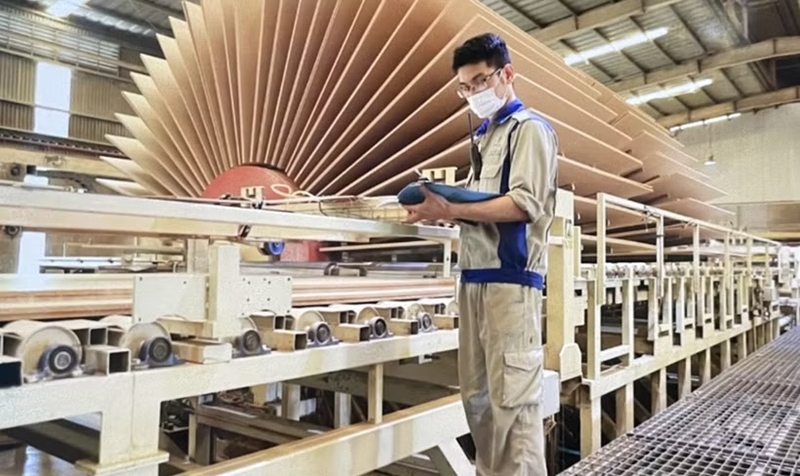
MDF wood production at Quang Tri Wood Compan |
The country ranked fifth globally, second in Asia and first in Southeast Asia in wood and wood product exports, providing an important foundation for the industry to pursue modern, sustainable development and generate higher added value.
However, he noted that future growth will no longer come from expanding production scale, but must instead be driven by higher-quality growth, improved productivity and the ability to adapt to new market requirements. Increasingly stringent regulations on deforestation, carbon emissions and traceability, together with the growing trend towards green consumption, are compelling the wood industry to transform its development model.
To achieve the target of 25 billion USD in export revenue by 2030, the industry needs to move towards sustainable forestry, greater material self-sufficiency, upgraded value chains and more efficient use of forest resources, Nghia said.
He noted that a sustainable and transparent material supply chain is not only essential for meeting export market standards, but also helps businesses secure supplies, reduce dependence on imported materials, improve competitiveness and raise the value of deeply processed products.
Ngo Sy Hoai, Vice Chairman and Secretary General of the Vietnam Timber and Forest Products Association (VIFOREST), said that while the forestry sector has successfully expanded planted forest areas over the past 30 years, the next three decades should focus on improving timber quality and the value of raw materials.
The focus should shift from “planting more to harvest more” to creating greater value from the same forest area by developing large-timber plantations, applying science and technology, and improving deep-processing capacity, he said.
Bui Thi Nha Trang, Sustainability Team Manager at Control Union Vietnam, said global forest-product trade was shifting from a “trust-based” to an “evidence-based” model. Businesses must now demonstrate not only the legality of their materials, but also traceability, sustainable forest management and carbon-emission control throughout the supply chain.
Participants said sustainable development of the wood industry required a stronger focus on material quality, technological innovation and transparent and traceable supply chains, rather than simply expanding planted forest areas. The development of large-timber forests, high-yield varieties and smart forestry was identified as key to raising the value and efficiency of forest resources.
They noted that the 25-billion-USD export target by 2030 will require a comprehensive restructuring of the industry towards greener, more sustainable and lower-carbon growth, rather than simply increasing output.
To remove bottlenecks, Doan Van Tinh, Chairman of the Board of Directors of MDF Mekong, called for policy adjustments to encourage deep processing instead of raw-material exports. He also urged measures to address high material costs, improve forestry-related administrative procedures, and increase investment in research and development of high-yield and high-quality forest varieties suited to local conditions and deep processing.
Source: VNA