Thang, who is also Chairman of the VIFC’s Executive Council, requested this at a meeting with VIFC-HCMC members and potential investors on October 28, on the sidelines of the Autumn Economic Forum (AEF) 2026 in Ho Chi Minh City, to discuss measures to address bottlenecks.
    |
 |
|
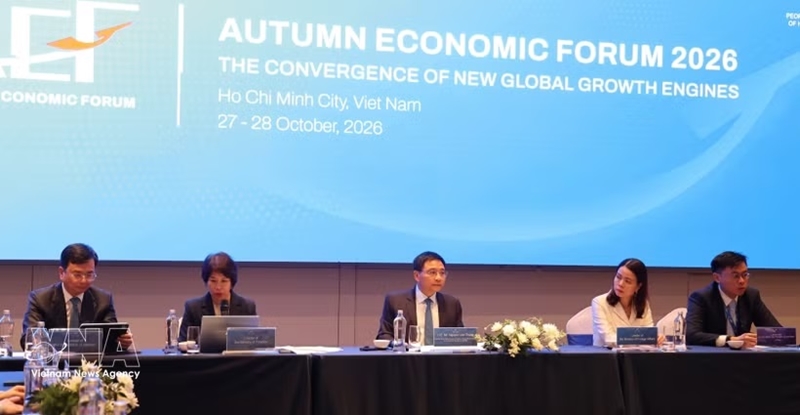
Deputy Prime Minister Nguyen Van Thang (center) has a meeting with VIFC-HCMC members and potential investors on October 28, on the sidelines of the Autumn Economic Forum 2026 in Ho Chi Minh City. |
He urged VIFC-HCMC to move quickly from organizational establishment to substantive operations, from attracting members to developing markets, and from investment commitments to actual transactions.
The Deputy PM asked the center’s executive body to work with members to identify deals ready for implementation, with the aim of signing and executing the first transactions in November 2026.
Each deal must have clearly defined partners, financing plans, structures and legal conditions, with obstacles identified for resolution, he noted, adding that prioritizing initial deals will not preclude other transactions that meet market demand and legal requirements.
He stressed that all transactions must comply with regulations on licensing, financial safety, foreign exchange management, anti-money laundering and investor protection. He also urged ministries and agencies to promptly resolve bottlenecks related to banking, accounts, foreign exchange, payments, taxation, investment funds and asset management.
Thang asked the State Bank of Viet Nam coordinate with the center’s executive body to finalize guidance on applications, procedures and licensing conditions, with the aim of admitting an official member bank in November 2026.
Institutional proposals should be classified according to whether they can be addressed under existing regulations, require additional guidance or necessitate legal amendments. Bottlenecks must be removed within the proper authority without creating regulatory gaps or compromising financial system safety, he said.
Thang said VIFC-HCMC should go beyond attracting capital and financial institutions to organizing markets, developing products and efficiently channeling domestic and international capital.
The center should initially focus on areas where it has an advantage and for which there is a practical need, including capital markets, investment funds, asset management and project finance, while developing infrastructure, green, trade and logistics finance and supply-chain services, he said, adding that digital finance, commodity markets and new financial products should be introduced according to an appropriate road-map.
He stressed the need to diversify funding sources beyond bank credit to meet the economy’s substantial capital needs and ease pressure on commercial banks.
He also called for an integrated ecosystem encompassing banking, investment funds, financial advisory and arrangement, custody, payments, insurance, credit ratings, legal advice and other professional services, supported by strong institutions, technological infrastructure, dispute resolution mechanisms, supervisory capacity and skilled personnel.
The Deputy PM stressed the need for close coordination between the VIFC in Ho Chi Minh City and Da Nang city to capitalize on their respective strengths, avoid fragmented resources and build a unified financial ecosystem linked to regional and global markets.
Government agencies must clearly assign responsibilities, deadlines and deliverables, with the center’s performance assessed based on actual transactions, international capital mobilized and disbursed, service quality, processing times, and market safety and transparency, the official said.
At the meeting, businesses reported difficulties with accounts, payments and international capital transfers due to the absence of a member bank, while also raising concerns over taxation, investment funds and asset management.
Earlier the same day, VIFC-HCMC announced its first 10 members, mainly holding companies.
Source: VNA