    |
 |
|
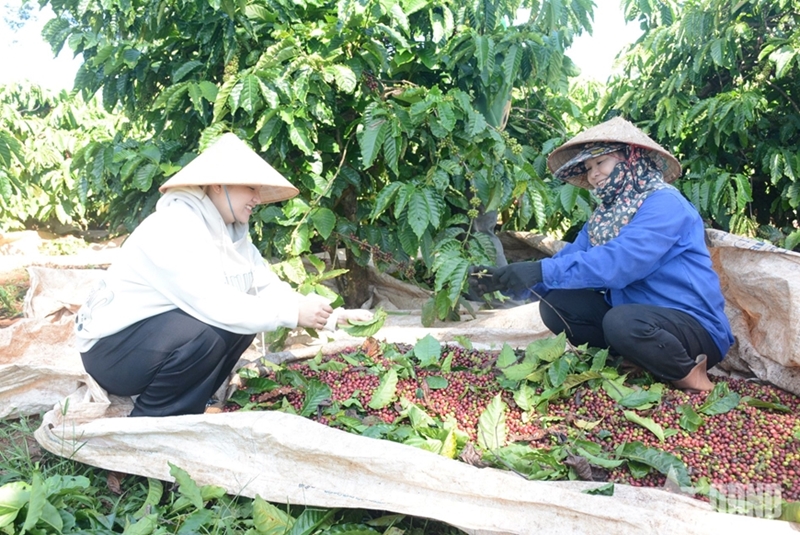
After harvesting, coffee cherries are taken to open areas for workers to remove impurities and pack them into bags. |
|
|
 |
|
Workers and laborers at Coffee Company 15 celebrate a successful harvest. |
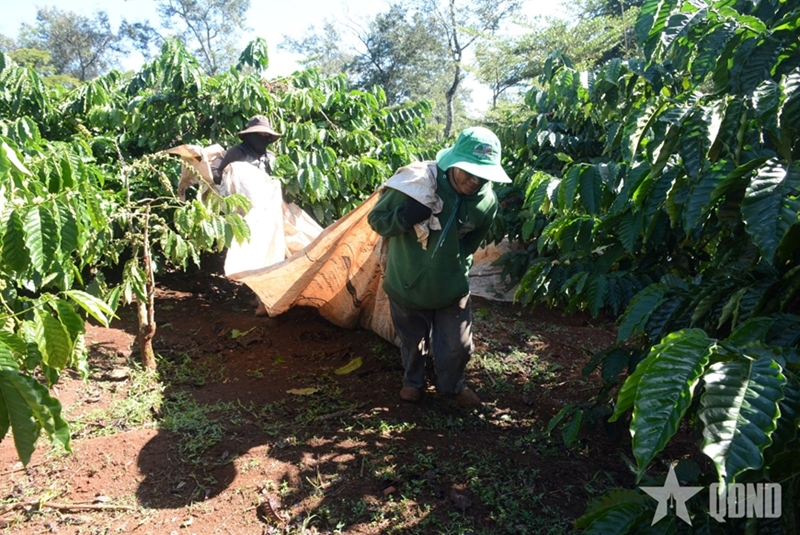
As midday approaches, at Production Team 3, workers remain busy harvesting ripe coffee cherries under the guidance of non-commissioned Lieutenant Colonel Nguyen Thi Thu Ngan, the team's leader. They use ladders and plastic stools to reach higher branches, while groups of male workers pull tarpaulins loaded with freshly picked cherries to open areas, where female workers remove impurities and pack the produce into bags. The work is carried out in a coordinated manner, reflecting the collective effort and enthusiasm of the workers after a year of hard work.
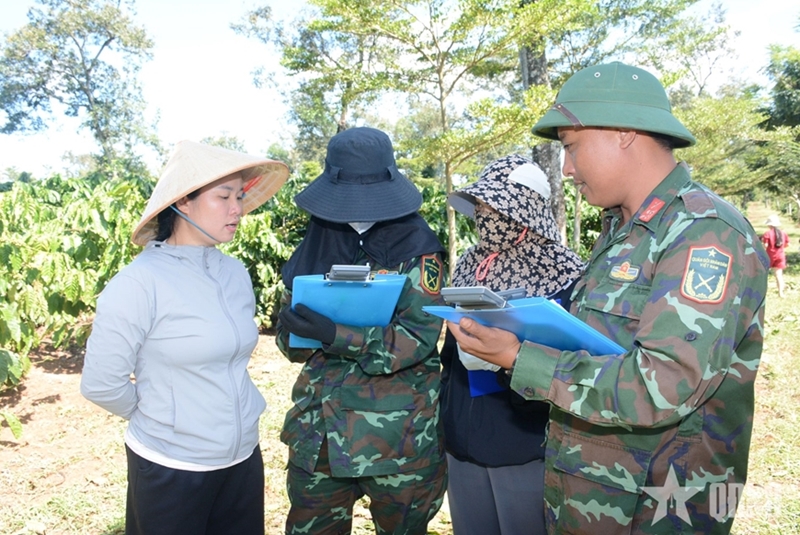
The company maintains strict control over the harvesting process, with representatives from management, production teams, plantation owners, and warehouse staff jointly weighing, recording, and cross-checking the output at each plantation. To ensure product quality, coffee cherries are harvested in several rounds rather than all at once, preventing ripe and unripe fruit from being mixed. Although this method requires more time and effort, it helps produce higher-quality coffee that is more favorably received by the market and commands better prices.
|
|
 |
|
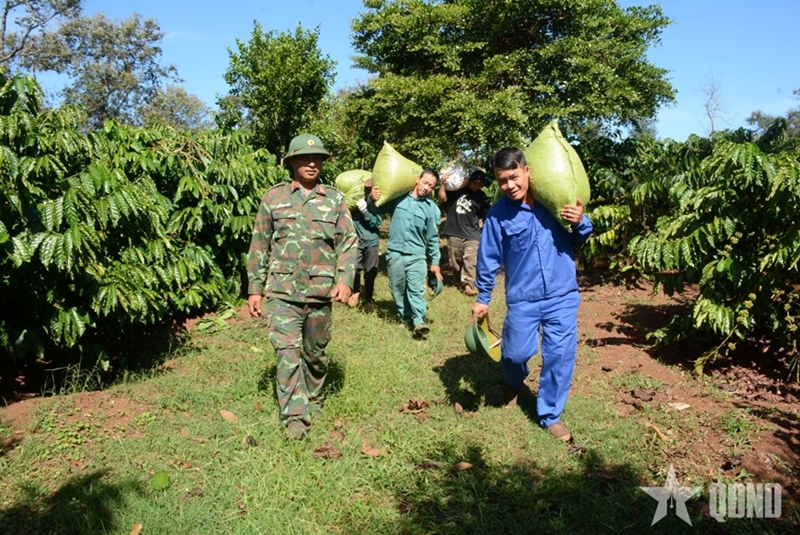
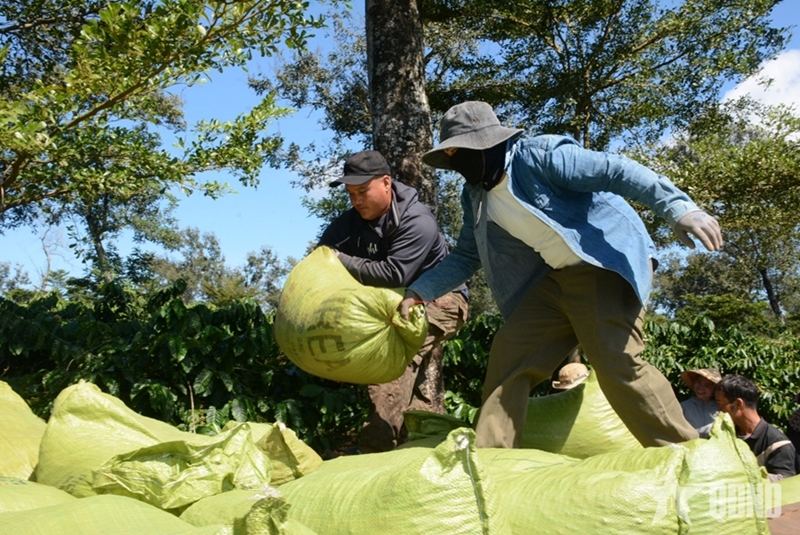
Male workers transport bags of fresh coffee cherries to collection points. |
|
|
 |
|
Weighing, recording, and cross-checking harvest figures are conducted transparently and rigorously at each plantation. |
|
|
 |
|
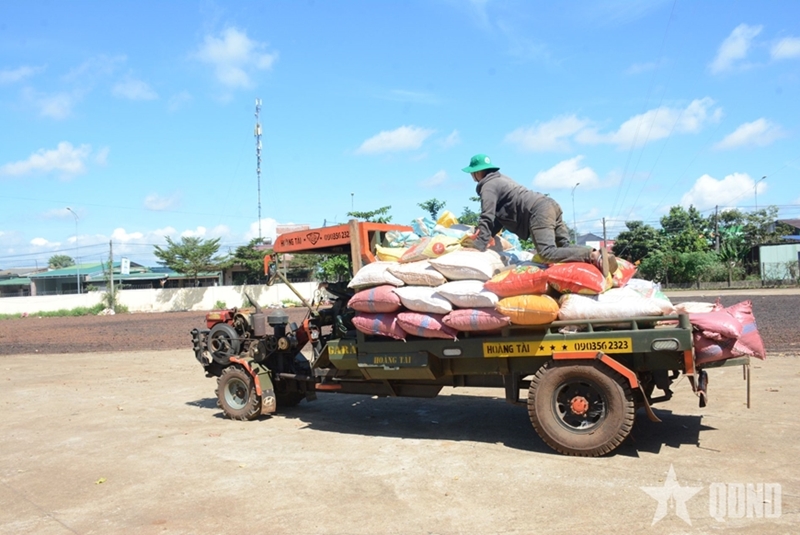
Workers load fresh coffee cherries onto agricultural tractors for transport to the drying yards. |
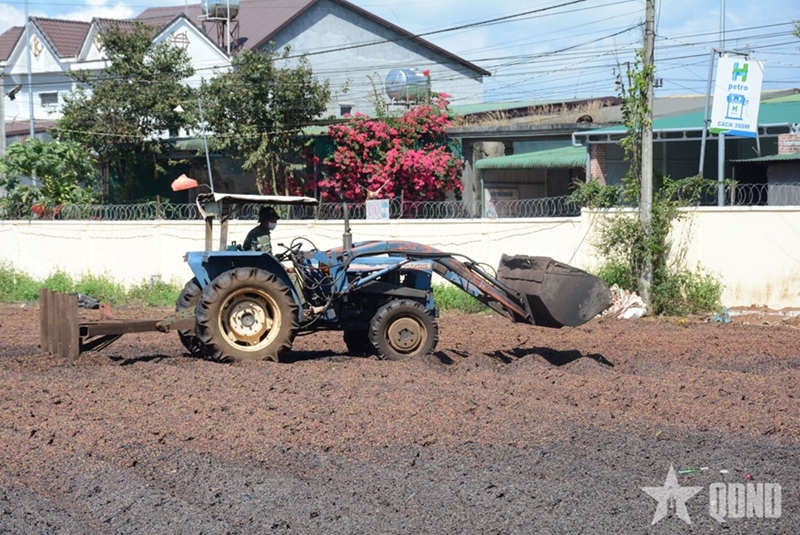
At the drying yards, coffee batches are arranged separately according to the number of days they have been exposed to sunlight, preventing them from mixing. Specialized tractors continuously rake and turn the cherries to ensure even drying. According to non-commissioned Lieutenant Colonel Nguyen Van Bang, head of Production Team 1, freshly harvested ripe coffee cherries require 10 to 15 days of sun-drying to dry completely, depending on weather conditions. When dark clouds signal approaching rain, production teams mobilize additional personnel to help warehouse staff quickly collect the coffee from the drying yards and protect the harvest.
According to Senior Colonel Le Trung Thanh, Director of Coffee Company 15, the company currently manages and operates nearly 830 hectares of coffee plantations in the commercial production stage. In the 2026 crop year, fresh coffee cherry output is expected to reach approximately 12,530 tons, equivalent to 110.14 percent of the 2025 output.
The company is adopting advanced farming methods to promote green, sustainable, and circular agriculture. All its coffee-growing areas have received the Buon Ma Thuot Coffee Geographical Indication. In 2025, it became the first enterprise in Dak Lak province to establish a 23-hectare organic coffee-growing area meeting United States Department of Agriculture and E.U. standards.
In 2025, the company commissioned a modern ground coffee processing plant with a roasting, grinding, and packaging capacity of 200 kilograms per hour to diversify products and improve quality for domestic and international markets.
|
|
 |
|
Agricultural tractors continuously transport fresh coffee cherries to the drying yards. |
|
|
 |
|
Workers at the drying yards use specialized equipment to rake and turn the coffee cherries, ensuring they dry thoroughly. |
It has also completed the replanting of more than 550 hectares of aging coffee plantations using grafted new varieties, reducing investment costs and development time. These plantations yield 22 tons of fresh coffee cherries per hectare, the highest in the Central Highlands. The company also produces biological pesticides to control pests and diseases.
Coffee production provides stable employment for 650 workers, including 101 ethnic minority workers, with an average monthly salary of 16 VND million. It also generates seasonal jobs for thousands of local laborers. More than 80 percent of the over 600 contracted worker households exceed their annual production quotas, reflecting the effectiveness of the company's production model and worker support policies.
Translated by Quynh Oanh