In his speech, Tri outlined Vietnam’s on-the-ground experience in sustainable forest management, enhancing forest ecosystem resilience to climate change and improving ecological well-being for all.
Vietnam views sustainable forest management as the fundamental, long-term solution to building self-regenerating forests that adapt to climate change while continuing to deliver essential ecosystem services to citizens, he said.
    |
 |
|
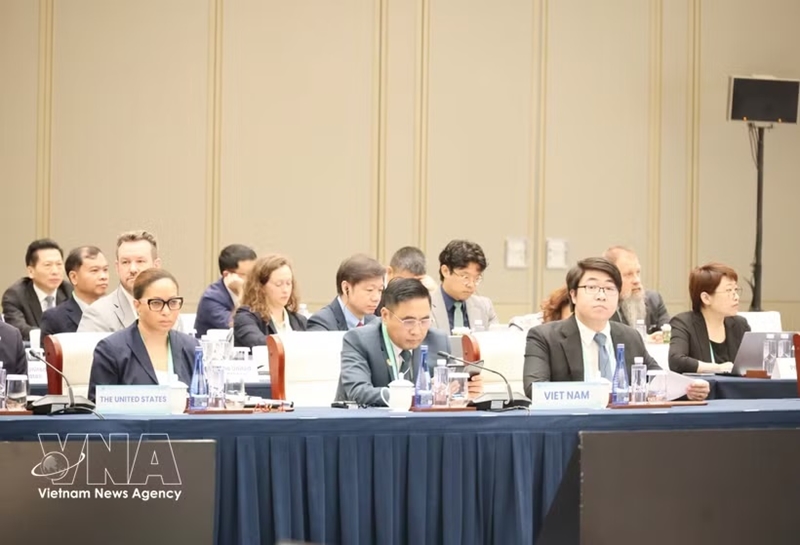
Deputy Minister of Agriculture and Environment Nguyen Quoc Tri (front, center) leads the Vietnamese delegation to the APEC Ministerial Meeting on Forestry. |
For years, Vietnam has deployed a coordinated set of policies, from strictly protecting existing forest areas and restoring natural forest ecosystems to aggressively adopting science, technology, and digital tools for monitoring forest resources, early fire warnings, tracking forest change and modernizing forestry governance.
In particular, Vietnam puts people at the center of sustainable forest management. When local communities benefit from forests, they become the most effective protectors. To that end, Vietnam has rolled out its forest environmental services payment policy that creates stable funding for forest protection and lifts the livelihoods of millions in mountainous areas. At the same time, the country has pushed development of non-timber forest products, medicinal plants, ecotourism, carbon credits and economic models under the forest canopy.
Ecological well-being, Tri said, is not just a clean and healthy living environment. It also means equitable development opportunities, sustainable livelihoods and a better quality of life for all.
That is why Vietnam is shifting step by step from a “forest protection” mindset to “forest ecosystem governance”, and from exploiting individual forest values to capturing the economic, ecological and socio-cultural worth of forests simultaneously, he added.
According to the Deputy Minister, forestry today is tightly bound up with green growth, climate change adaptation, food and water security, biodiversity conservation and the fulfilment of the Sustainable Development Goals.
He said Vietnam believes that international cooperation should place greater emphasis on sharing knowledge to improve forest ecosystem resilience, and green finance, carbon credits and long-term investment mechanisms for forest conservation and restoration. It should also deepen research, biodiversity conservation and sustainable management, and build resilient forest product supply chains to meet international trade requirements.
Vietnam is committed to being a reliable and responsible partner, and stands ready to share experience, drive cooperation and contribute actively alongside APEC economies to building healthier forests for sustainable regional development, he said.
Participants from the 21 APEC member economies and relevant international organizations shared practical experience in conserving forest resources, realizing the value of ecological products, and driving tech-driven development. They also discussed new solutions to strengthen forestry cooperation in the region.
They also adopted a joint statement, which expects that APEC economies would push biodiversity conservation, strengthen law enforcement against illegal trade in forest products, and integrate forest governance and sustainable forest management into economic development plans, policy frameworks and recommendations.
It also calls for more investment and financing opportunities for forestry development and the legal trade of forest products, consistent with each economy’s specific circumstances and development priorities.
The statement encourages support for the upgrading of forest-product processing and the strengthening of value chains. It also calls for closer cooperation in urban forestry and water resource management across the Asia-Pacific, leveraging technological innovation and sustainable forest management to restore ecosystems and reduce habitat fragmentation.
At the same time, it pushes the development of emerging forestry industries, products and services in line with sustainable forest management principles.
Source: VNA