The conference was organized by Viet Nam’s Ministry of Industry and Trade and Poland’s Ministry of Economic Development and Technology, gathering senior officials and corporate executives from both countries.
Addressing the forum, PM Le Minh Hung noted that the meeting immediately followed the elevation of bilateral ties to a Strategic Partnership, reflecting deep political trust and mutual resolve to advance cooperation.
    |
 |
|
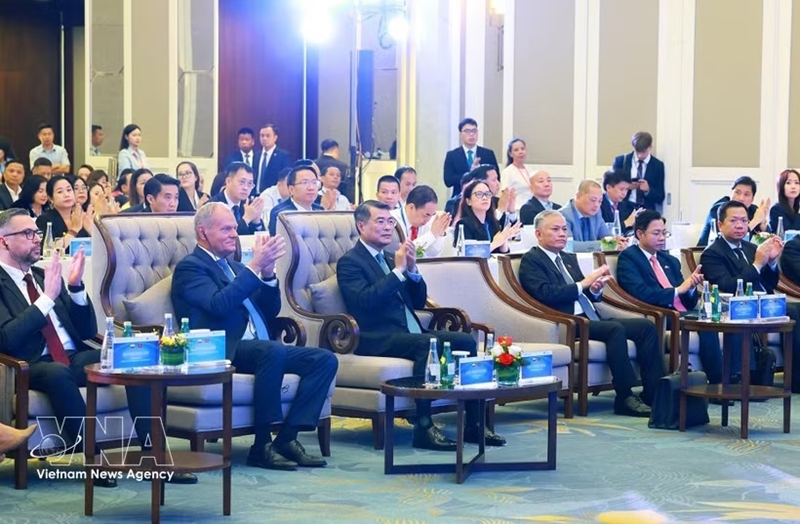
Prime Minister Le Minh Hung and his Polish counterpart Donald Tusk attend the Viet Nam–Poland Business Roundtable in Hanoi on October 26 |
He expected the roundtable to translate the Strategic Partnership into concrete economic, trade, and investment initiatives, urging focused programs in complementary sectors aligned with national roadmaps.
Prime Minister Le Minh Hung and his Polish counterpart Donald Tusk attend the Viet Nam–Poland Business Roundtable in Hanoi on October 26
PM Le Minh Hung highlighted that economic cooperation remains the anchor of bilateral ties, with Poland being Viet Nam’s top trading partner in Central and Eastern Europe. Bilateral trade reached nearly 4 billion USD in 2025, up 14.8% year-on-year, and nearly 3.5 billion USD in the first nine months of 2026, a 19% increase.
With Poland’s central role in Central and Eastern Europe and Viet Nam’s economic standing in Southeast Asia, both nations hold substantial opportunities to connect regional markets, integrate supply chains, and deploy investments, the Vietnamese leader said.
Poland demonstrates competitive advantages in pharmaceuticals, healthcare, defense, renewable energy, digital transition, precision agriculture, and green technologies. Meanwhile, Viet Nam offers advanced manufacturing, extensive maritime ports, a skilled workforce, and 18 free trade pacts with over 60 partners.
By combining these reciprocal assets, both economies can build resilient manufacturing and logistics systems, PM Le Minh Hung noted, affirming that the bilateral trade target of 6 billion USD is fully achievable through effective coordination.
To align with the Strategic Partnership, he urged partners to elevate joint programs, welcoming Polish firms in medicine, pharmaceuticals, security, and aerospace to pursue direct engagement and high-tech ventures.
Viet Nam invites Polish investors to expand operations, particularly in green energy, smart farming, digital transformation, rail transit, and environmental protection, supported by genuine technology transfer.
PM Le Minh Hung called on both administrations to resolve bottlenecks in legal frameworks, licensing, customs, and technical standards, while strengthening dialogue platforms like the Viet Nam Business Forum.
He emphasized modernizing multi-modal transport links, commending LOT Polish Airlines on plans to resume nonstop Warsaw-Hanoi flights and urging authorities to explore integrated air cargo, maritime, and intercontinental rail corridors.
He urged enterprises to forge enduring partnerships, practice corporate responsibility, integrate Vietnamese firms into supply chains, upskill local workers, and commit long-term capital using eco-friendly technologies.
Affirming that "business growth drives national development," PM Le Minh Hung reaffirmed the Government’s commitment to providing stable, transparent conditions for bilateral business cooperation.
He called on entrepreneurs to demonstrate leadership by identifying partners and launching commercially viable ventures that benefit both societies.
Grounded in longstanding solidarity and high-level alignment, he expressed confidence that Viet Nam-Poland ties will advance robustly, fulfilling the Strategic Partnership's potential.
Expanding Strategic Investment in Medicine, Defense, and Advanced Technologies
Polish PM Tusk called the roundtable a valuable platform to assess economic prospects, focusing on actionable capital projects and durable corporate alliances.
He noted that Viet Nam ranks among Asia’s most agile economies, serving as an indispensable manufacturing hub that is actively expanding high-value production and innovation.
He voiced confidence that each nation's industrial strengths can reinforce the other, creating a solid foundation for deeper commercial integration.
While bilateral trade and investment have progressed, he noted that trade structures remain unbalanced and capital flows lag behind the potential of both markets.
Consequently, both governments and private sectors must collaborate to diversify trade, unlock export opportunities, and improve the investment climate, supported by the EU–Viet Nam Free Trade Agreement (EVFTA).
PM Tusk outlined key areas for future cooperation, specifically pharmaceuticals, healthcare infrastructure, defense equipment, dual-use technology, aerospace, and advanced science.
In healthcare and pharmaceuticals, Polish capital and expertise can accelerate the modernization of Viet Nam's domestic production and cross-border distribution across regional markets.
Such ventures offer clear mutual gains by creating skilled jobs, securing supply chains, and broadening clinical access, he emphasized.
On defense and dual-use technology, PM Tusk stated that Poland is expanding production of unmanned aerial systems, specialized communications, electronics, and security solutions with civilian applications.
In aerospace, Poland possesses deep capabilities in satellite platforms, microelectronics, enterprise software, and big data, while Viet Nam is expanding its sovereign space engineering know-how.
PM Tusk suggested partnering on satellite Earth observation, geospatial analytics, smart farming, and environmental tracking by combining satellite networks with artificial intelligence.
He expressed hope that commercial partners will move beyond basic hardware transactions toward co-developing proprietary technologies for global markets.
Underscoring the shift toward integrated manufacturing, PM Tusk observed that Polish firms contribute technology and financing, while Vietnamese partners offer strong manufacturing ecosystems and regional market access.
The Polish leader welcomed corporate delegates to present their investment roadmaps, seek regulatory support, and explore equitable co-development with domestic enterprises.
Reflecting on longstanding friendly relations, he hoped upcoming forums would yield new capital investments, joint ventures, and co-developed technologies.
During the working session, officials and executives from both countries presented roadmaps and evaluated collaboration paths across aviation, pharmaceuticals, defense technology, and aerospace.
Poland remains a dynamic European economy and gateway to Central and Eastern Europe, while Viet Nam serves as an essential hub within ASEAN with extensive global market access.
These complementary assets provide fertile ground for Polish businesses entering ASEAN and Vietnamese firms expanding into Poland and the broader European Union.
The EVFTA remains a dependable institutional driver, empowering enterprises to widen market access, leverage tariff preferences, and build diversified international supply chains.
Translated by Chung Anh