Held annually on the 15th day of the seventh lunar month, which falls on August 27 this year, Vu Lan is a major traditional Buddhist observance in Viet Nam that honors filial piety and ancestors.
According to Buddhist scriptures, Vu Lan originated from the story of Bodhisattva Maudgalyayana rescuing his mother, highlighting filial devotion and gratitude towards one's parents. From its origins as a Buddhist observance, Vu Lan gradually became intertwined with the Vietnamese tradition of remembering one's roots, ancestor worship and filial values, evolving into a cultural tradition preserved across generations.
    |
 |
|
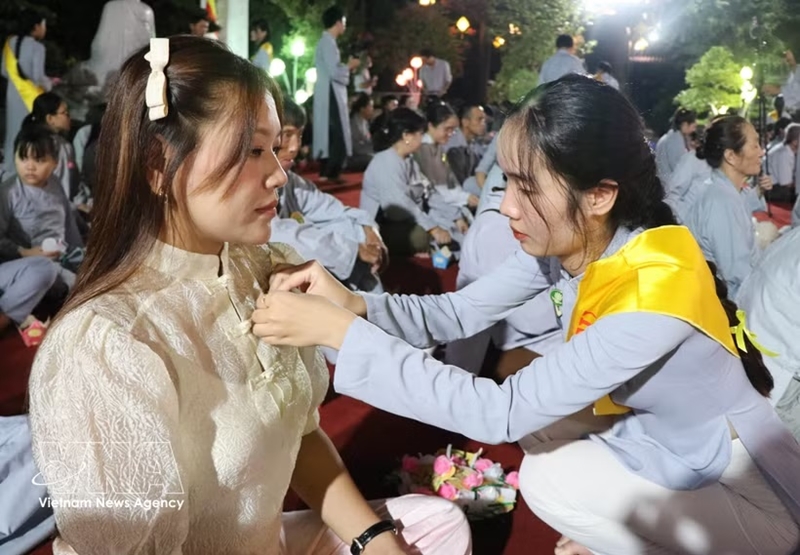
The flower-pinning ceremony at the Vu Lan festival held at Tuong Van Pagoda in Thuy Xuan ward, Hue city. |
Customs such as preparing offerings for ancestors, visiting pagodas to pray for parents' well-being and burning incense in memory of the deceased have been maintained as ways of expressing gratitude and preserving the bond between generations.
In modern life, however, the way young people express filial devotion has also changed, as not everyone has the time or means to prepare elaborate offerings or take part in every traditional ritual. For many young people, what matters more is understanding the meaning behind those rituals.
Tran Phuong Dung, a second-year student at Hanoi Law University, said Vu Lan is an opportunity for young people like her to reflect on how they treated their parents in everyday life.
“Normally, we go to university, work part-time and spend time with friends, so it can be very easy to forget to check in on our parents. Sometimes when they call, we feel busy and think we will call them back later, but then forget. There have even been times when we have found it annoying. So for me, Vu Lan is a reminder to care more about my parents and to improve myself, starting with the way I speak and behave towards them,” Dung said.
Nguyen Minh Huy, a first-year student at Hanoi University of Science and Technology, said the most important message Vu Lan conveys to young people is not to wait until they lose a loved one before realizing how little time they have spent with them.
“I don't think filial devotion should be something we wait until Vu Lan to practice, nor should it be understood in a rigid way. As we continue our studies and enter the workforce, we may become busier, but if we maintain the habit of caring for our families and spending time with them, that is also a way of preserving our traditions and a genuine expression of filial devotion,” Huy said.
According to the Viet Nam Buddhist Sangha, Vu Lan activities not only honor parents but also remind people of the Vietnamese principle of remembering one's roots, gratitude towards ancestors and those who contributed to the nation, and responsibility towards the community.
These values, from youth’s perspective, remain relevant in today's society, even though the ways in which they are expressed may have changed.
In Hanoi, during the seventh lunar month's full moon, alongside preparing offerings at home, many people visit places of worship to pray for peace and for the souls of the deceased, as well as take part in traditional ceremonies.
Many older people say they wish to maintain these practices so that their children and grandchildren can continue to remember the tradition of filial devotion and honor their grandparents and ancestors.
Vu Lan is no longer confined to pagodas and family homes. It has also found a place online, where it continues to spread among younger generations. Messages to parents, family stories, photographs of family meals and reflections on loved ones have become ways for young people to express their feelings.
Above all, regardless of how it is expressed, one value remains unchanged: gratitude.
Source: VNA