Born into a family with a tradition of making To he, Hon grew up accompanying his mother to local markets and watching his father working beside a pot of dough. Fascinated by the craft from an early age, he began making his first To he figures, including buffaloes and dragons, in 1980.
    |
 |
|
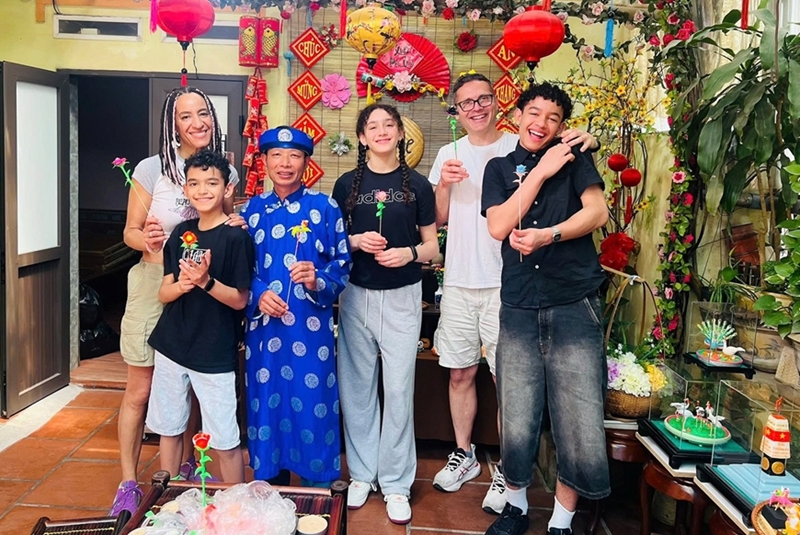
Artisan Dang Dinh Hon (third from left) joins foreign visitors during the “To He Village” experience tour. |
He remembers that making To he was once a demanding process. Rice had to be pounded by hand, winnowed, and sifted into flour before being boiled to create the dough for To he figurines. Each batch of dough was carefully prepared because it was closely tied to the family's livelihood. As modern toys became more popular, however, the traditional craft faced growing difficulties. Many families in the village abandoned To he making for other livelihoods, and the colorful figures gradually disappeared from rural markets.
“To me, To he is more than a livelihood. It is a childhood memory and part of the soul of folk culture. Preserving the craft and passing it on to future generations is not only a wish, but also a responsibility,” Hon said.
Like many other traditional crafts, the art of making To he has had to change to adapt to the pace of modern life. To he figures are now mounted on sticks so children can hold them more easily, while improved materials and a glossy coating help them retain their colors and resist cracking. Hon also keeps pace with children's interests, creating popular superheroes and cartoon characters alongside traditional Vietnamese figures such as Thanh Giong, Tam, Uncle Cuoi and Thach Sanh.
He also creates figures and models depicting Turtle Tower, Chinese characters and Chu Teu (Uncle Teu - a symbol of Vietnamese puppet art), adding variety while preserving the craft's cultural roots. “For a traditional craft to survive, it must know how to change, but changing does not mean losing its roots,” he said.
In 2019, Hon launched the “To He Village” experience tour, allowing domestic and international visitors to learn about the craft and make their own figures. The tour has since welcomed more than 850 groups and nearly 4,000 participants. For many visitors, the experience of handling multicolored dough and shaping a To he themselves offers a direct connection to Vietnamese folk culture.
“The most interesting thing about To he is watching an artisan make it and then trying to mold one yourself. That experience is what connects people with folk culture,” Hon said.
For Hon, the greatest reward is not the number of figures sold but the excitement of people seeing or making a To he for the first time. As his hands continue to bear the marks of time, he remains committed to preserving the traditional craft as long as people continue to love To he.
Translated by Tran Hoai