Recently, the Ho Chi Minh City Cultural Heritage Association launched the Heritage Ho Chi Minh City Communications Project, a series of activities running through the end of 2026 to connect people who love cultural heritage, particularly young people, with the city’s diverse heritage. The project aims to celebrate the Vietnamese Cultural Heritage Day on November 23 and the Vietnamese Culture Day on November 24.
    |
 |
|
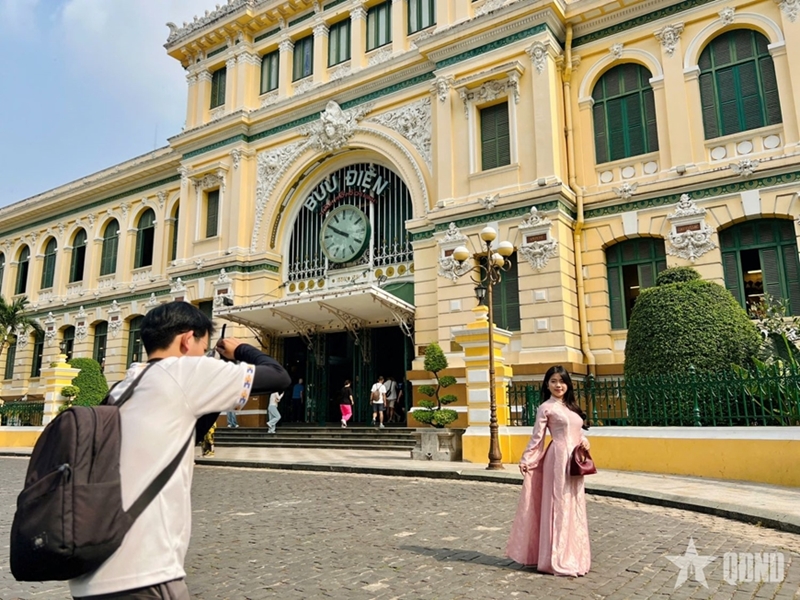
Young people "check in" at the Central Post Office of Ho Chi Minh City. |
The project comes as Ho Chi Minh City expands its administrative boundaries, bringing a larger and more diverse heritage treasure encompassing historical sites, architectural works, folk songs, cuisine, traditional craft villages, folk knowledge, and traditional festivals. Beyond the deterioration of historic structures, the decline of traditional crafts, and the loss of folk knowledge, heritage also faces a growing gap with everyday life, particularly among young people.
The project aims to build an ecosystem connecting cultural practitioners, experts, artists, educational institutions, and the public. Digital platforms and experiential activities are expected to make heritage stories more accessible to young people, giving them opportunities to explore, create, and share traditional values in ways that fit contemporary life. Activities will be organized at nearly 20 universities and colleges across the city to make heritage more familiar, accessible, and relevant to younger generations.
Under the plan, the Heritage Creative Contest in 2026 for young people is scheduled to launch on August 29 at Ho Chi Minh City University of Culture. A series of workshops will be held at universities and colleges from September to November, followed by the Heritage Fest exhibition on November 23 and 24 at the Ho Chi Minh Museum-Ho Chi Minh City Branch. The project brings together experts, artists, and prominent figures in the cultural sector as advisors to provide professional input and guidance on heritage-related content and approaches. It also seeks to renew heritage communications by bringing heritage closer to the public through experiences, creativity, and digital platforms.
Experts say that young people should not be treated as passive recipients of heritage. Instead, they should be given opportunities to explore heritage themselves and choose approaches that suit them. Relevant agencies should also encourage greater youth participation in heritage research, communications, and content creation, helping develop a new generation that can continue to promote cultural values within the community.
Le Tu Cam, Chairwoman of the Ho Chi Minh City Cultural Heritage Association, said the association hopes to serve as a bridge between state management agencies and organizations and individuals working in the field, contributing to a richer spiritual life and greater public awareness of heritage values. She stressed that preserving and promoting heritage cannot stop at protecting what currently exists, but must continue through new and creative approaches, with young people playing an important role.
Translated by Tran Hoai