“Learning Station” model for all ages
Before moving to Columbia University to establish its Vietnamese language program under the Department of East Asian Languages and Cultures, Chung spent many years teaching Vietnamese to foreigners in Viet Nam, including university students, diplomats, employees of international organizations, as well as children of overseas Vietnamese returning to the country.
She recalled that one of the questions students often asked her at that time was “Am I Vietnamese or American? Am I Vietnamese or Australian?’ That question came back to her when she began teaching at Columbia University, where students asked me: ‘Who am I in the flow of these two cultures?’”
    |
 |
|
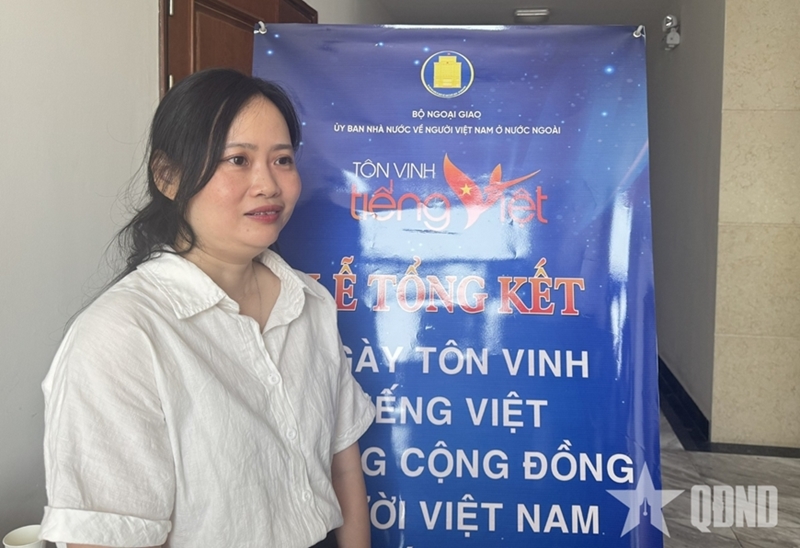
Nguyen Phuong Chung believes that learners not only turn to Vietnamese to learn a language, but also to rediscover their own cultural identity and roots. |
Through her observations and practical experience, Chung realized that learners were not only turning to Vietnamese to learn a language; they were also seeking to rediscover their own cultural identity and roots.
According to Chung, the U.S. is home to a large Vietnamese community of approximately 2 million people. In New York and surrounding areas, there is strong demand for learning Vietnamese and preserving the mother tongue, particularly among students who are third-generation overseas Vietnamese.
Working with students has helped Chung gain a deeper understanding of the needs and aspirations of the Vietnamese community in New York City and nearby areas. Many parents want their children to speak Vietnamese but lack an appropriate learning environment. Meanwhile, community classes often have large numbers of students with diverse ages, proficiency levels and learning objectives.
In response to these realities and the needs of the community where she lives and works, in 2025 Chung collaborated with the Permanent Mission of Viet Nam to the United Nations to develop a Vietnamese language program for children of Vietnamese families in New York and surrounding areas.
The program’s innovative feature is that it does not apply a single model to all learners. Instead, it is flexible and tailored to the needs of different learner groups, and is known as the “Learning Station” model. Rather than building learning materials around vocabulary and grammar, Chung adopts a task-based teaching approach involving real-life experiences, such as retelling family stories, interviewing relatives and exploring the history of one’s own community.
“I divide the learning stations according to age groups: 5 to 7, 9 to 11, and 12 to 16. Each learning station features activities appropriate to the learners’ ages and needs. For younger children, I organize activities through games, storytelling and physical activities. For older learners, I ask them to participate in projects connecting family, culture and communication. I also encourage parents to accompany their children throughout the learning process,” Chung said.
Sweet fruits filled with flavors of home
In teaching Vietnamese overseas, Chung and her colleagues have encountered many challenges. In addition to the diversity of learners, who come from different backgrounds and regions, developing learning materials suitable for different groups is also a significant challenge.
Despite the challenges, each Vietnamese course has produced “sweet fruits” filled with the flavors of home. One student sent Chung a message saying that, for the first time, they had been able to speak Vietnamese with their mother for 45 minutes. Many other learners said they tried to speak Vietnamese with their grandparents at home, ask about their family history, and share their dreams and plans for the future.
After these conversations, many students said they felt more strongly that they were Vietnamese and needed to deepen their connection with Vietnamese culture and their roots.
Firmly committed to the mission of preserving and developing the Vietnamese language in the time ahead, Chung shared three key lessons learned from implementing the “Learning Station” model.
First, she said, family is the most important environment for maintaining Vietnamese. Classes can provide motivation, but daily use of the language should begin with conversations within the family. Therefore, after each lesson, she assigns age-appropriate homework that students must complete together with their families.
|
|
 |
|
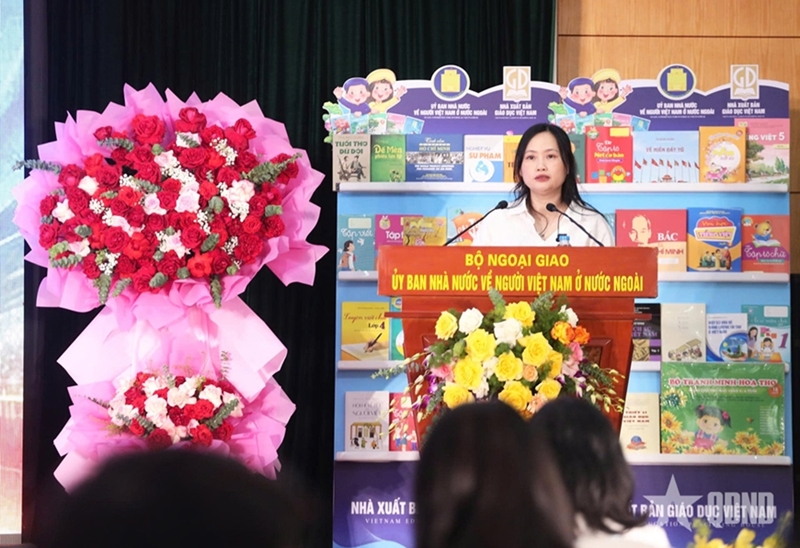
Chung shares three lessons from implementing the “Learning Station” model at the closing ceremony of the 2026 Day for Honoring the Vietnamese Language among Vietnamese communities abroad, held in Hanoi on August 12. |
She also believes that no single teaching model is suitable with all communities. Each program needs to be designed based on the characteristics of the local community, the learners’ ages and their specific needs.
Finally, sustainable development of the Vietnamese language requires the creation of a Vietnamese-language ecosystem. Within this ecosystem, universities serve as centers for research and teacher training; teachers inspire learners; and digital learning materials serve as tools connecting Vietnamese communities around the world.
Chung shared that in the coming years, the path she hopes to continue pursuing is to build an ecosystem in which Vietnamese is spoken in every family, passed down from generation to generation, connects Vietnamese communities overseas, and reaches international friends.
Translated by Quynh Oanh