Also known as Nui Pagoda or Phnom Ta Pa, the pagoda is a Khmer Theravada Buddhist temple closely associated with the religious and cultural life of the local Khmer community. Viewed from Tri Ton Commune Square across vast rice fields, it stands prominently against the green backdrop of the surrounding forest.
    |
 |
|
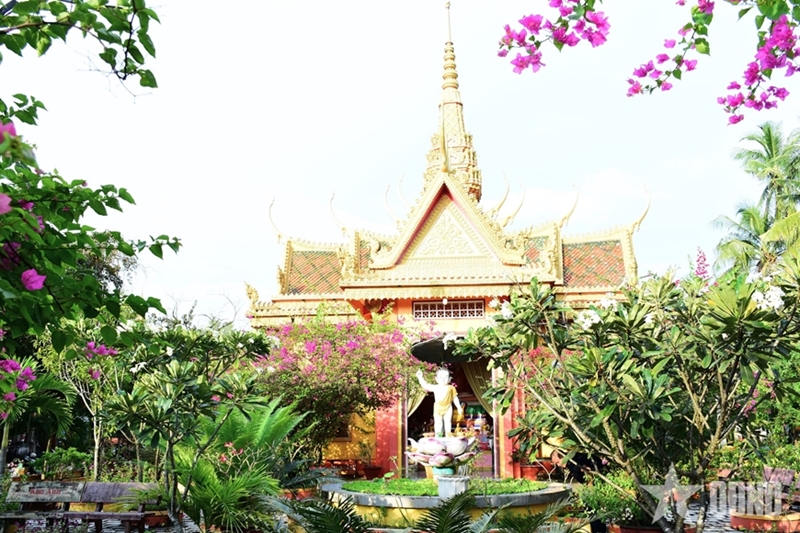
The pagoda stands beneath the cool shade of green trees. |
The pagoda's architectural beauty is evident throughout its grounds. Its multi-tiered roofs feature elegantly curved edges, while intricate decorative motifs reflect Buddhist beliefs. The dominant golden color, complemented by red and green accents and elaborate ornamental details, gives the complex a striking appearance.
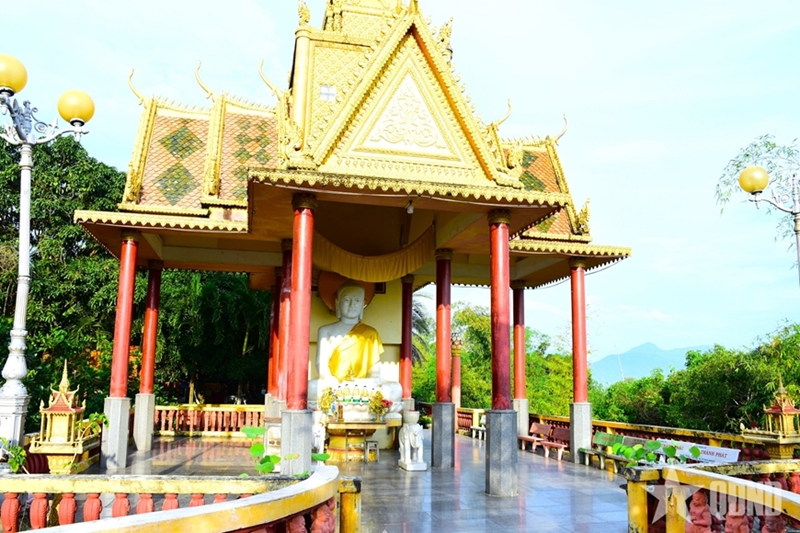
The main hall is particularly impressive. Built along the mountainside and supported by sturdy concrete pillars, it appears to float halfway up the mountain when viewed from a distance, partially concealed beneath the green canopy of trees.
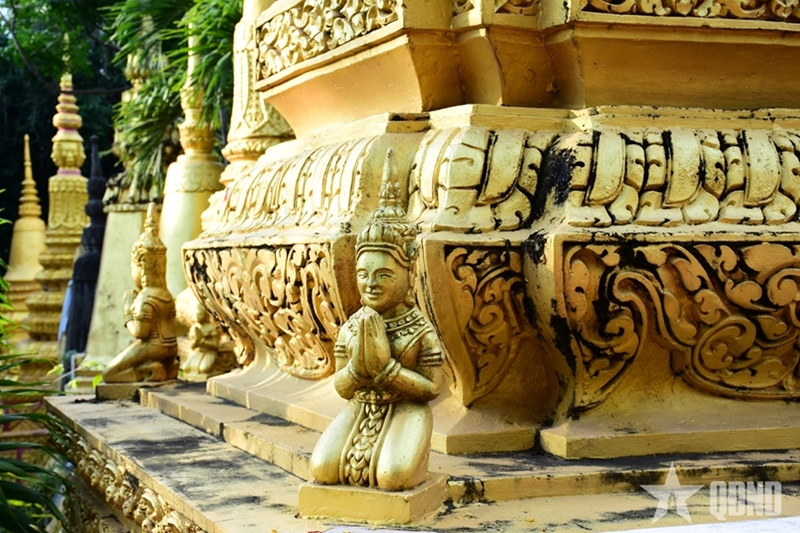
The pagoda also attracts visitors with its elaborate decorative art. Pillars, roofs, walls, and auxiliary structures are adorned with intricately crafted bas-reliefs and ornamental patterns depicting scenes from the life of the Buddha, Buddhist stories, and motifs associated with Khmer culture.
Beyond the main hall, the grounds feature stupas, Buddha statues, a cremation area, and other auxiliary structures. Together, these buildings form a harmonious religious complex that blends with the natural landscape. A visit offers tourists an opportunity to admire distinctive Khmer architecture while learning more about the spiritual life, customs, and cultural traditions of the Khmer community in southern Viet Nam.
|
|
 |
|
A Buddha statue worshiped at Ta Pa Pagoda |
Nguyen Hoa Binh, a resident of Long Xuyen ward, An Giang province, said, “What impressed me most about Ta Pa Pagoda was the combination of Khmer architecture and natural scenery. Located on a mountain, the pagoda looks beautiful from a distance and has a distinctive character. Visiting it has helped me learn more about Buddhism and Khmer culture, while giving me many interesting experiences in Tri Ton.”
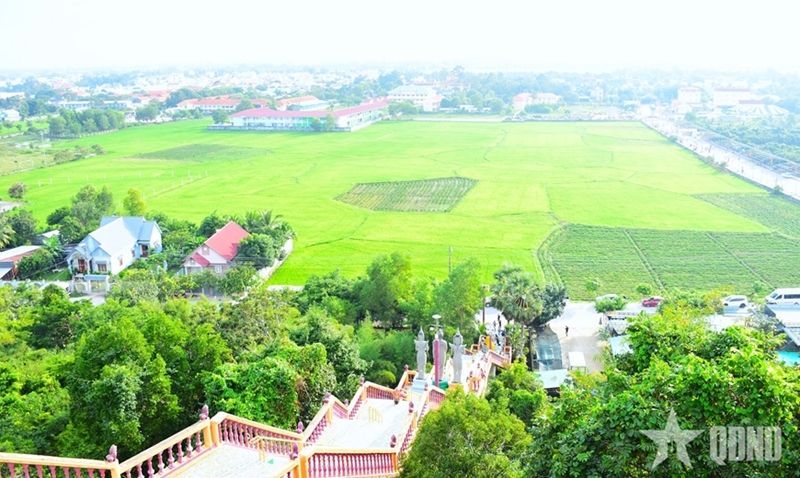
From the pagoda grounds, visitors can take in the expansive scenery of the “Seven Mountains” region. Below, rice fields stretch toward the horizon, interspersed with towering palmyra palms. Nearby, Ta Pa Lake features clear blue water surrounded by rocky cliffs, adding to the area's diverse natural beauty.
|
|
 |
|
The pagoda features an elaborate system of bas-reliefs and ornamental patterns. |
In recent years, Ta Pa Pagoda has become increasingly popular among tourists exploring the “Seven Mountains” region. Many include it in their itineraries through Tri Ton, combining their visit with trips to Ta Pa Lake, Ta Pa Rice Fields, and other well-known destinations in An Giang.
However, the pagoda's lasting appeal extends beyond its scenic setting and picturesque photo opportunities. It is an important religious site that preserves distinctive aspects of Khmer architecture, art, and cultural life. Its roofs, bas-reliefs, Buddha statues, and religious ceremonies all reflect the rich cultural heritage of a community that has long been part of southern Viet Nam.
Neang Mon, a resident of Tri Ton commune, An Giang province, said, “For the Khmer people, going to the pagoda to worship the Buddha, pray for peace, learn good values and moral principles, preserve our customs, and pass on these traditions to our children and grandchildren is very important. Ta Pa Pagoda is situated on a mountain with beautiful scenery, so many visitors come here. We hope tourists will help preserve the surroundings and respect the sacred atmosphere of the pagoda.”
|
|
 |
|
Visitors can enjoy views of Tri Ton landscape from the pagoda. |
Amidst the mountains and forests, Ta Pa Pagoda remains a spiritual center for the local Khmer community. Bringing together natural beauty, traditional architectural artistry, and enduring cultural values, it offers visitors not only an opportunity to admire the landscape, but also a sense of peace and a deeper appreciation of An Giang's distinctive cultural heritage.
Translated by Tran Hoai