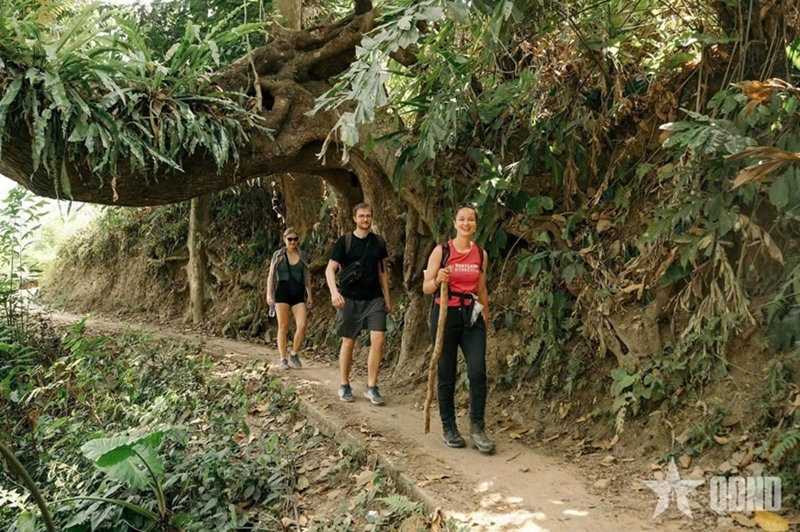
The trails wind beneath old forest canopies, through fallen leaves and vines. Children in a group of German tourists eagerly explored Ba Be National Park. One stopped to touch the rough bark of a tree, while another listened to birdsong or played on low-hanging vines.
Phung Van Hoang from Bo Lu village, Ba Be commune, guided the group, keeping a close eye on the children and occasionally stopping to take photographs. Having grown up beside the lake, Hoang knows many of the local trails and began leading trekking tours about two years ago. He said visitors trek for different reasons, including challenging themselves on longer routes, learning about local culture, exercising, and exploring nature.
    |
 |
|
Foreign tourists trek through Ba Be National Park. |
For children, the forest becomes a fascinating outdoor classroom, keeping them absorbed in observing trees, birds, squirrels, and vines. Adults patiently allow them to explore at their own pace.
Ba Be’s appeal extends far beyond the lake. Since early 2026, the destination has attracted 6,000-6,500 domestic visitors and 700-750 international visitors each month. Trekking offers another way for tourists seeking a deeper experience of nature and local life.
Covering more than 10,000 hectares, Ba Be National Park is known for its natural forest ecosystems, limestone mountains, and freshwater lakes. The richness of the landscape can be experienced along the trails through the scent of fallen leaves, colorful flowers, and wild forest fruits.
Before each tour, Hoang carefully prepares supplies and selects routes suited to the physical condition of each group. Trekking routes such as Keo Siu - An Ma, Keo Siu - Tham Kit Cave, Coc Toc - Dau Dang, and Pac Ngoi - Hua Ma Cave take visitors to lakes, caves, and villages. Along the route from Tham Kit Cave to An Ma Temple, tourists often stop to admire old trees, listen to stories about the forest, and rest beneath the canopy.
For visitors in good physical condition, Hoang leads a 17-kilometer trek through the forest to Mong and Dao ethnic villages. Tourists can accompany local people to the fields, visit their homes, observe their daily activities, and listen to local hosts play the two-stringed fiddle. A forest meal featuring local specialties, including rice wrapped in dong leaves, sesame sticky rice, and grilled meat, is also served. Hua Thi Tham from Pac Ngoi village said foreign tourists particularly enjoy and praise the rustic rice dish.
After the trip, two British tourists, Guy and Alex, said they were impressed by the pleasant atmosphere, majestic natural scenery, and friendliness of local people. They noted that walking allowed them to discover more of Ba Be’s beauty.
For Hoang, each group brings a new experience. On one occasion, a tourist suggested that he carry a bag to collect rubbish along the trail, an idea he subsequently adopted.
Initially relying on translation software, Hoang has gradually become more confident in communicating in English. He also uses cameras and drones to capture memorable moments and help promote Ba Be to a wider audience.
Recognizing that personal experience alone is not enough to deal with every situation, Hoang hopes to attend professional training courses so that local people can organize trekking tours more safely and professionally.
In villages such as Pac Ngoi, Bo Lu, Coc Toc, and Ban Cam, many homestay families also guide tourists or connect them with experienced trekking guides. Such coordination enables local people to introduce their homeland’s landscapes and culture to visitors more effectively.
As evening falls, tourists return to the peaceful Ba Be Lake, with kitchen smoke rising nearby. For many visitors, walking slowly through the forests and villages is a way to get closer to the nature and people of Ba Be.
Translated by Minh Anh