Ho Chi Minh City's data center market remained at an early stage of development in H1, with 33 MW of operational IT capacity across 14 facilities operated by nine providers. Future expansion is supported by a development pipeline of 68 MW, comprising 14 MW under construction and 54 MW in the planning stage, representing more than twice the city's existing operational capacity. Colocation vacancy stood at 34.8%, indicating that existing supply still provides room to accommodate future demand as cloud adoption and hyperscale investment continue to develop.
    |
 |
|
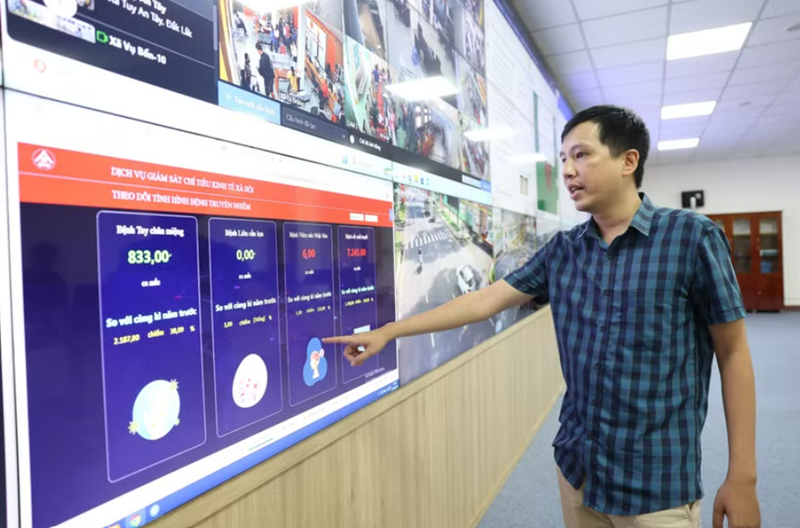
Dak Lak Province's Smart City Monitoring and Operations Center manages and operates the provincial data center, as well as shared digital platforms and software systems used across the province. (Photo: VNA) |
The report said UAE-based AI company G42 signed a 1 billion USD framework agreement with FPT Corporation and Viet Thai Group to develop three data centers across the country, while also participating in the launch of a 2 billion USD AI hyperscale data center project in Ho Chi Minh City.
"These developments highlight growing confidence in Viet Nam as a destination for hyperscale, cloud, and AI infrastructure. The broader digital infrastructure ecosystem also strengthened during the period," the report noted.
The International Finance Corporation (IFC) announced plans to invest up to 3 billion USD across Viet Nam, supporting strategic sectors including digital infrastructure, while the MViSTA (Malaysia-Viet Nam-Singapore-Thailand) submarine cable advanced into implementation and commercialization. The system will provide a new regional connectivity corridor linking Viet Nam with Singapore, Johor, and Thailand's key data center markets, reinforcing the country's attractiveness for hyperscale and AI infrastructure investment.
Meanwhile, the Asia Pacific continued its rapid expansion in H1, with approximately 1,372MW of new operational capacity brought online and an additional 7,103MW added to the development pipeline. Although supply increased substantially, vacancy remained relatively stable, declining marginally from 10.9% in H2 2025 to 10.3% in H1 2026, highlighting the market's ability to absorb new capacity amid robust demand.
In H1 2026, AI and cloud investment across Asia Pacific has entered a phase of rapid, power-constrained execution, with hyperscale capex accelerating even as electricity availability becomes the industry's binding bottleneck. Neoclouds have emerged as a distinct demand driver alongside hyperscalers, while capacity growth is shifting from saturated hubs to peripheral areas of cities or to completely new locations.
Source: VNA