Just four years ago, few imagined that a single fruit could become one of Vietnam's billion-dollar export earners. Since fresh durian exports to China officially began in 2022, the industry has set a new export record almost every year and is now emerging as one of the country's fastest-growing agricultural sectors.
    |
 |
|
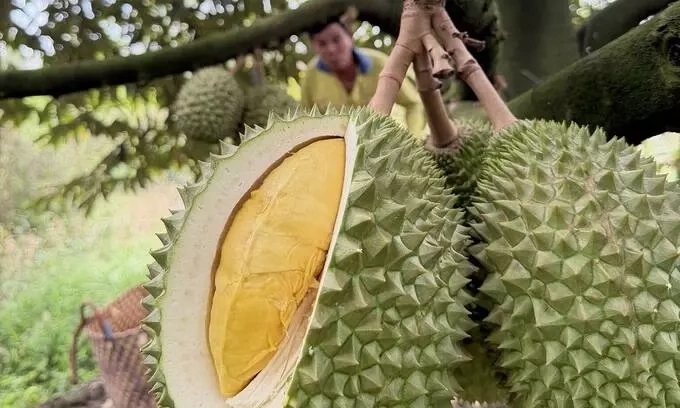
Durians at an orchard in the Mekong Delta city of Can Tho (Photo: vnexpress.net) |
Durian exports reached nearly 1.1 billion USD in the first six months of 2026, up 32% year-on-year. The industry's strongest export season, however, is still ahead. The Central Highlands harvest, which accounts for a large share of annual production, begins in August and lasts through October. During the same period last year, the country's monthly export turnover approached 1 billion USD.
With exports maintaining strong momentum, industry insiders believed annual revenue could exceed 4 billion USD and potentially reach 4.5 billion USD, bringing Vietnam closer to Thailand in supplying China's lucrative durian market.
Recent policy developments have strengthened those prospects. The General Administration of Customs of China (GACC) officially recognized 18 additional Vietnamese testing laboratories on July 31, raising the total number of approved laboratories to 50.
The move comes after exporters faced disruptions earlier this year when several laboratories temporarily suspended operations, slowing customs clearance for shipments.
At the same time, authorities have accelerated the issuance of planting area codes, with processing time reduced from ten days to three days through a fully digital system.
The Government has also intensified efforts to clean up the industry. Authorities have prosecuted and detained several officials for allegedly receving bribery and abuse of power in the management of planting area codes and export procedures, aiming to eliminate unnecessary administrative barriers and restore fair competition.
Industry experts said fraudulent trading of planting area codes had undermined the sector for years. The ongoing crackdown is expected to improve transparency and strengthen confidence among overseas buyers.
Vietnam is also expanding beyond its heavy reliance on China by opening new markets.
India has recently opened its market to Vietnamese durian, offering another promising destination as production continues to increase.
Dang Phuc Nguyen, General Secretary of the Vietnam Fruit and Vegetables Association (VINAFRUIT), estimated that exports to India could generate 50-100 million USD annually in the initial years as consumers gradually become familiar with the fruit.
Vietnam's durian exports officially began four years ago after Vietnam and China signed a protocol on fresh durian exports in July 2022. Export turnover reached 400 million USD in the final months of that year before surging to 2.2 billion USD in 2023.
Last year, exports climbed to 3.8 billion USD, placing durian alongside Vietnam's traditional export staples such as rice, shrimp, rubber and cashew nuts.
Unlike several major agricultural exports that rely partly on imported raw materials, durian's value is created almost entirely within Vietnam, generating higher returns for domestic growers.
Despite its rapid rise, the industry remains heavily dependent on China, which accounts for around 90% of exports. Experts, therefore, stressed the need to diversify markets while investing more in processed durian products, which are easier to transport, have a longer shelf life and appeal to a broader range of international consumers.
Source: VNA