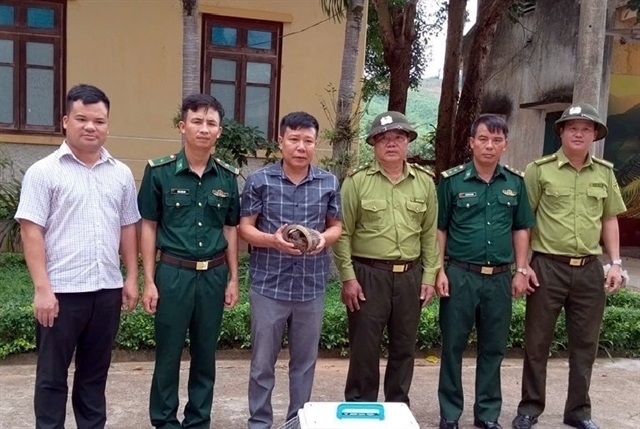
Accordingly, one pangolin was discovered by a man residing in Xa Vi hamlet, Huong Hiep commune of Quang Tri province, while travelling on the road. It was subsequently handed over to the authorities. The second individual was found in a farm garden in Troi hamlet, Thuong Trach commune, Quang Tri.
    |
 |
|
The Center for Creature Rescue, Conservation and Development under Phong Nha - Ke Bang National Park received a juvenile Sunda pangolin found in Thuong Trach commune. |
At the time of reception, both animals were in weak condition. The pangolin found in Thuong Trach is a juvenile weighing around 0.9 kg, while the other is a female weighing 1.2 kg. Immediately, veterinary staff at the center conducted health checks, isolation, monitoring, and care in accordance with professional procedures, with a view to eventual reintroduction into the wild once they are fit.
Previously, on June 29, the People’s Committee of Khe Sanh commune, Quang Tri received a report from a resident in the commune's Tan Xuyen hamlet, on the discovery of a wild animal. In coordination with the local forest protection unit, authorities identified it as a Sunda pangolin weighing more than 4 kg. The commune authorities subsequently requested Phong Nha - Ke Bang National Park to take over the animal for rescue, care, and release in accordance with regulations.
The Sunda pangolin is a critically endangered and rare species prioritized for protection, listed under Group IB in Circular No.85/2025/TT-BNNMT issued on December 31, 2025 by the Ministry of Agriculture and Environment, which regulates endangered and rare species management and the implementation of the Convention on International Trade in Endangered Species of Wild Fauna and Flora (CITES).
The species is also classified as Critically Endangered on the International Union for Conservation of Nature (IUCN) Red List, with all wild capture and commercial international trade strictly prohibited.
According to the center, the voluntary reporting and handover of wild animals by residents is a positive signal that contributes to biodiversity conservation efforts. After recovery and health check, the animals will be released back into their natural habitat in accordance with regulations.
Source: VNA