In an interview with the Viet Nam News Agency in Singapore, Associate Professor, Dr. Duong Minh Hai of the National University of Singapore said Viet Nam has several advantages, including its industrial manufacturing base, network of industrial parks, foreign investment inflows and technical workforce.
    |
 |
|
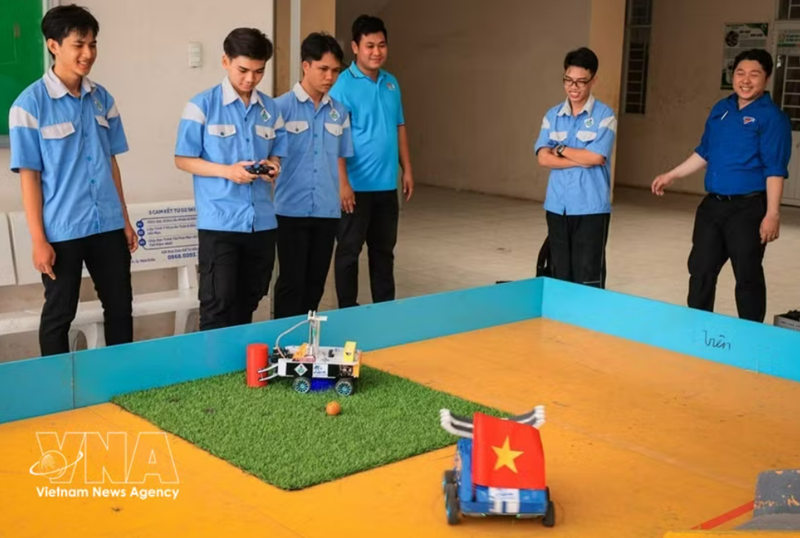
Students from Can Tho Vocational College are actively practicing and fine-tuning their robots on a mock-up of the Robocon competition arena, with professional guidance from lecturers in the Electronics Department. |
Decision No.1131/QD-TTg, issued on June 12, 2025, which includes robotics and automation on the list of strategic technologies, also provides a foundation for promoting research and applications in manufacturing, logistics, agriculture and processing.
However, Viet Nam should not aim to manufacture all robot components and systems from scratch at this stage, given the substantial capital requirements and intense competition, he said.
Instead, the country should focus on three areas where it can build competitive advantages: developing software and AI for robots, integrating robotic systems, and designing specialized robots for specific industries.
Key capabilities to be developed include robot control, computer vision, autonomous robot management, production line design and equipment connectivity.
To achieve these goals, Hai stressed the need to strengthen links among research institutes, universities and businesses, helping bring research results from prototypes to real-world testing and commercialization.
Pilot projects could focus on robots for electronics manufacturing, warehousing, agricultural product sorting, hospital logistics and environmental monitoring in hazardous industrial settings.
Investment costs, limited technology assessment capacity and shortages of skilled personnel remain major obstacles, particularly for small and medium-sized enterprises (SMEs).
The expert proposed helping businesses assess their readiness for automation, select suitable solutions, access financing and test robotic systems. Robot-as-a-service models, which allow businesses to use robots without purchasing them outright, could also be promoted. The effectiveness of investment should be measured through improvements in productivity, defect rates, machine downtime, energy savings and payback periods, rather than simply the number of robots purchased.
Viet Nam also needs to invest in workforce training in control programming, system integration, computer vision, robot safety and maintenance. Shared facilities for testing, evaluation and certification should be developed, with standards aligned with international practices to ensure safety and facilitate exports.
Regarding foreign investment, Hai said its long-term value should not be measured solely by the number of factories using robots.
More importantly, foreign-invested enterprises should help transfer skills in system design, operation, programming and improvement to Vietnamese engineers and businesses.
Policies should encourage foreign-invested companies to train domestic suppliers, conduct joint research with universities and develop technical services in Viet Nam. Such cooperation should ensure fair competition and transparency and comply with international commitments, rather than rely on rigid localization requirements.
Viet Nam's goal, the expert said, should not necessarily be to own the largest number of robots, but to become a competitive hub for robot integration, applications and commercialization in Southeast Asia.
Progress should be measured by productivity gains, domestic technological value, commercialization capacity, export revenue and job quality.
Achieving this vision will require coordinated policies on science and technology, industry, education, investment and trade, alongside stronger ASEAN cooperation in standards, testing, training and robotics supply chains.
Source: VNA