Issues raised by legislators included digital transformation in remote and mountainous areas, the development of the digital economy, digital signatures, backlogs of industrial property applications, sandbox mechanisms, and the management of AI risks.
Deputy Trang A Duong from Lao Cai province pointed out that ethnic minority communities in remote and mountainous areas still have to make repeated trips to complete administrative procedures. In response, minister Quan noted that to date, around 102 million of approximately 115 million mobile subscriptions have had their information synchronized and identities verified. Scam calls have fallen by more than 60%, while spam messages have also declined.
    |
 |
|
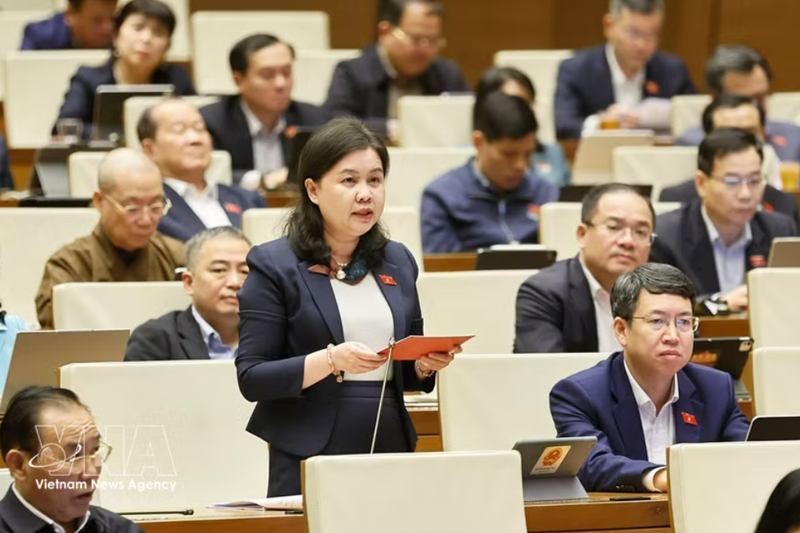
Deputy Nguyen Phuong Thuy of Ha Noi raises her question at the session. |
The minister affirmed that the ultimate goal of digital transformation is to serve the people, with public satisfaction being its most important measure.
Regarding areas with poor or no mobile coverage and the use of Starlink satellite Internet equipment following its trial period, the minister said the Public-Utility Telecommunications Service Fund, managed by the ministry, supports three areas: installing transmission equipment in areas without coverage; helping residents register for basic telecommunications services, which are largely free of charge; and providing end-user equipment.
To date, efforts to address coverage gaps in villages and hamlets are nearly 100% complete, with the Government assigning Viettel to carry out the work.
As for Starlink, if the six-month trial proves effective, the ministry will propose that the Government continue allocating funds so that particularly disadvantaged areas without coverage can access the service.
Questioning the development of the digital economy, Deputy Nguyen Ngoc Son from Hai Phong asked the Ministry of Science and Technology, which advises the Government on the sector’s development, to clarify its proposed solutions.
Quan expressed concern that many foreign corporations, including Amazon, Shopee and Grab, were keen to join efforts to develop Viet Nam’s digital economy, as they already had e-commerce and online business platforms. He said Vietnamese scientists and technology experts are fully capable of developing similar platforms, but attracting large numbers of users will require substantial investment.
The Ministry of Science and Technology is focusing on helping small and medium-sized enterprises apply digital transformation and AI to improve productivity and quality through financial support and training. Specifically, the National Technology Innovation Fund (NATIF) provides interest-rate support for loans taken out by enterprises to innovate their technologies, including digital technologies. The program has been piloted in four localities: Thai Nguyen, Bac Ninh, Da Nang and Dong Nai, bringing substantial benefits to household businesses as well as small, medium-sized and micro-enterprises.
The ministry is also developing training programs to strengthen the capacity of household businesses and enterprises. The minister emphasized that businesses must be at the center of technological innovation, with all activities driven by their practical needs, he said.
Deputy Phan Thi My Dung from Tay Ninh noted that Viet Nam has issued tens of millions of digital signatures, but registration is one thing and effective use another. She asked the minister about programs to promote their wider adoption.
Quan said that more than 30 million digital signatures represented only an initial achievement in terms of numbers.
|
|
 |
|
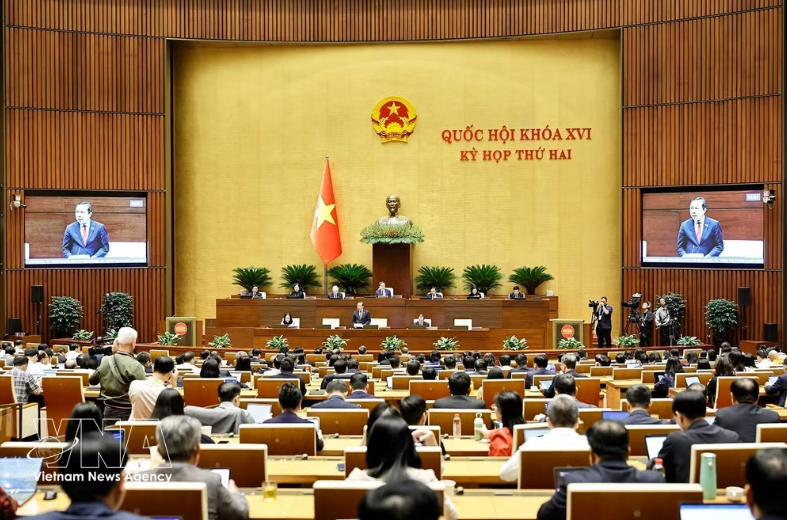
Minister of Science and Technology Vu Hai Quan answers questions at the session. |
As for future measures, the minister said the ministry will lead by example, requiring scientists, for instance, to submit research project applications using digital signatures. It will also work with other ministries, sectors and businesses to promote acceptance of digital signatures, while stepping up public communication and inter-agency coordination. He added that the National Electronic Authentication Center has been actively and effectively promoting the use of digital signatures in actual transactions.
Responding to concerns raised by deputy Nguyen Danh Tu from An Giang province about the risk of a renewed backlog of industrial property applications, the minister said the key solution is to digitalize intellectual property registration and strengthen international connectivity, highlighting international cooperation efforts in the work.
The minister said he will direct the Intellectual Property Office to resolve the backlog completely, stressing that patents and copyright protection are prerequisites for commercializing research results and applications.
Regarding measures to turn innovation and digital transformation into higher labor productivity, Quan said the ministry has advised the Prime Minister to issue a decision on measuring the contribution of science and technology and innovation to the economy. The framework comprises 46 indicators covering four stages: inputs, outputs, efficiency and impact.
To date, ministries, sectors and localities have submitted data for 28 indicators. A pilot assessment is expected to be conducted in early 2027, with input from foreign experts. The minister noted that this was a highly complex task. According to the total factor productivity (TFP) measure, the latest figure was around 46%, making the target of more than 50% by 2030 achievable.
Questioning the sandbox mechanism, Deputy Nguyen Phuong Thuy from Ha Noi asked the ministry to clarify its coordinating and advisory role to prevent the emergence of multiple parallel mechanisms lacking connectivity.
In response, Quan described the sandbox mechanism as a breakthrough policy framework established in the Law on Science, Technology and Innovation. He said the ministry has established a legal framework in the law and issued a guiding decree. Where further clarification is needed, it will continue working with local authorities, businesses and relevant organizations to develop testing frameworks.
Deputy Si Thi Mai Anh from Lao Cai asked the ministry what measures it will take to protect young users and limit the risk of dependence on AI.
Quan said the ministry has classified AI risks into high, medium and low levels and introduced corresponding safety mechanisms.
Responding to questions about preventing AI risks, Quan said the ministry has established a framework for assessing and classifying AI risks and will provide a detailed written response. Regarding deepfake impersonation, the Law on Artificial Intelligence and its guiding decree clearly define the responsibilities of three groups: AI platform developers, organizations deploying and introducing platforms in Viet Nam, and users.
He called on parents to strengthen family bonds and communication to help their children protect themselves against the harmful aspects of AI.
Source: VNA