The PII is designed to provide data and evidence to help localities formulate and implement measures to improve innovation performance.
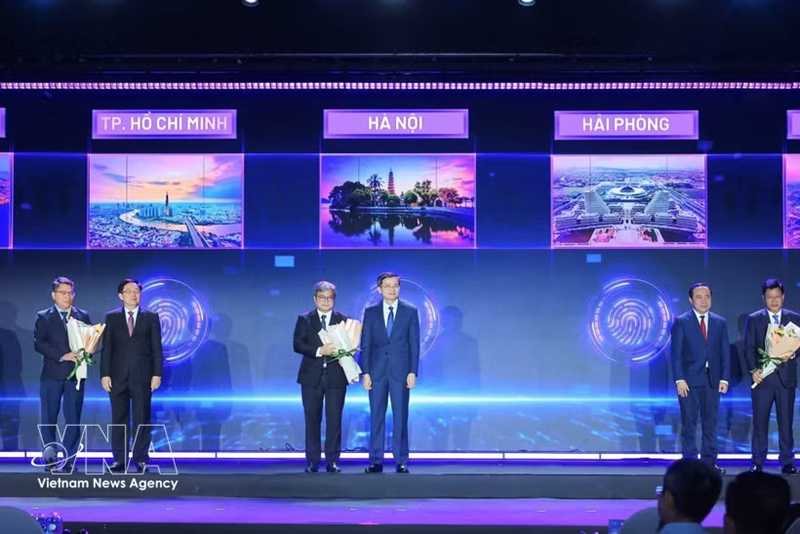
The top 10 localities in the 2026 rankings are Hanoi, Ho Chi Minh City, Hai Phong, Quang Ninh, Bac Ninh, Hue, Da Nang, Thai Nguyen, Tay Ninh and Hung Yen. The list comprises seven centrally governed cities, six Northern localities, two in the Central region and two in the South.
Hanoi scored 63.80 points, while Cao Bang province ranked 34th with 21.22 points.
    |
 |
|
Hanoi tops the 2026 Provincial Innovation Index (PII) announced by the Ministry of Science and Technology at the 2026 National Innovation Day in Hanoi on October 4. |
The 2026 results highlight differences among localities in both innovation inputs and outputs. Hanoi led in 18 of the 52 component indicators – the highest number among the 34 localities assessed. Its strengths included research and development (R&D) capacity, R&D spending, the number of science and technology organizations, and the proportion of businesses engaged in R&D and innovation activities.
Hanoi also led in a number of innovation output indicators related to intellectual property such as patents, utility solutions, plant varieties, trademarks and industrial designs, as well as indicators related to poverty reduction and human development. The results reflect the capital’s strong capacity to create conditions for innovation and turn those resources into tangible outcomes.
Ho Chi Minh City ranked second, leading in 12 of the 52 indicators, with strengths in science and technology organizations, infrastructure, private-sector credit, microfinance, business density and corporate R&D and innovation activities. The city also shared the lead with Hanoi in several intellectual property indicators.
Quang Ninh ranked third, leading in five indicators, including digital infrastructure, private-sector credit, investment projects in industrial clusters, OCOP products and poverty reduction.
By pillar, Hanoi led in Human Capital and Research & Development and Market Development; Quang Ninh topped Infrastructure; Ho Chi Minh City ranked second in Infrastructure and Market Development; Bac Ninh led Business Development; and Hanoi topped Knowledge, Creative and Technology Outputs. Notably, the Impact pillar showed a different pattern, with Phu Tho, Bac Ninh and Ninh Binh ranking first, second and third, respectively.
The 2026 PII comprises 52 indicators grouped into seven pillars. Five input pillars cover Institutions; Human Capital and Research & Development; Infrastructure; Market Development; and Business Development. Two output pillars cover Knowledge, Creative and Technology Outputs and Impact.
Data for the index came from two main sources. Official statistics and government data accounted for 40 indicators, while the remaining 12 were collected and submitted by localities with supporting documentation.
According to the Ministry of Science and Technology, the index is intended to measure the role and contribution of science, technology and innovation to local socio-economic development. It also provides a basis for local authorities to identify strengths and weaknesses, assess innovation performance and formulate policies to promote development driven by science, technology and innovation.
Source: VNA